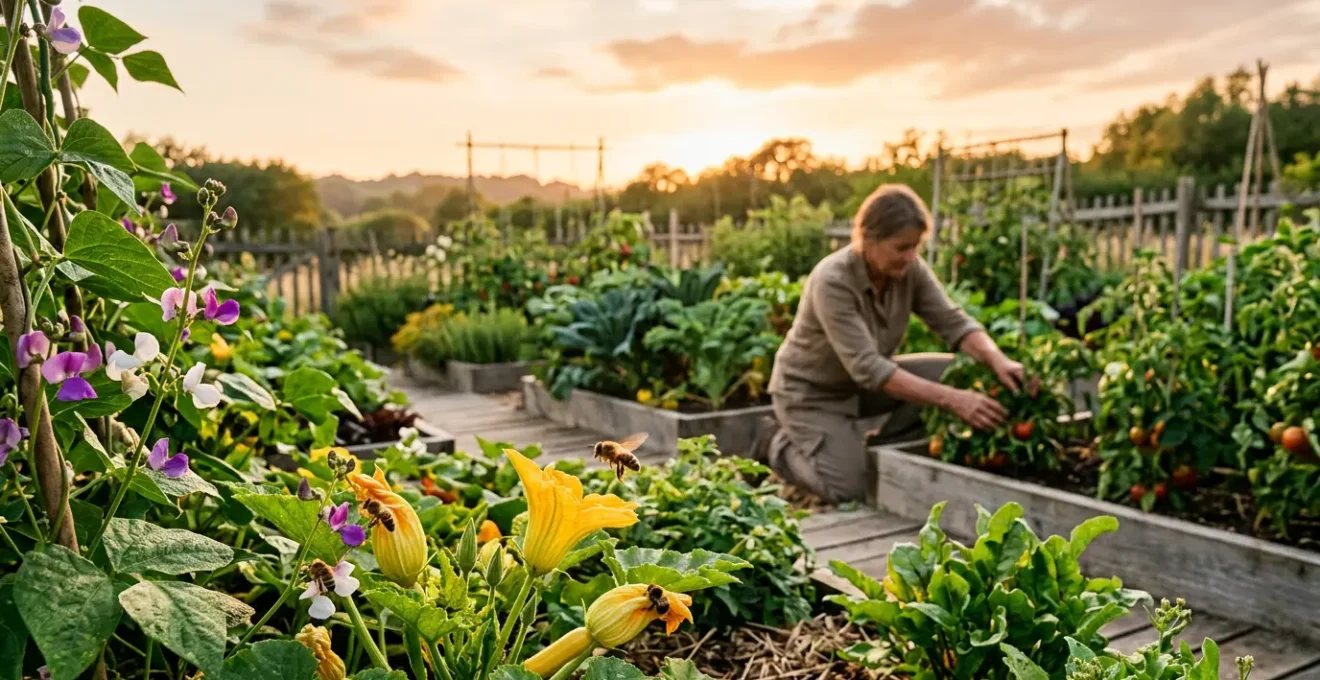
The secret to a vibrant, bee-friendly garden that’s safe for children isn’t just planting flowers—it’s designing a smart ecosystem that works with nature, not against it.
- Most DIY bee hotels can actually attract more wasps and invasive species than native bees.
- Planting flowers in dense color clumps and ensuring continuous blooms from spring to fall makes pollinators more efficient and predictable.
Recommendation: Start by focusing on providing a consistent food source (flowers all season) and safe, natural nesting sites instead of buying or building a commercial bee hotel.
As a parent, you want a thriving vegetable patch, and you know that means attracting bees. But the vision of your children playing in a yard buzzing with insects can be nerve-wracking. The fear of a painful sting is real, and it often leads to a garden that’s less vibrant than it could be. Many guides offer simple advice: plant some lavender, put out a dish of water, and hope for the best. This approach, however, is not only incomplete but can sometimes make the problem worse by attracting the very insects you want to avoid, like territorial wasps.
What if the solution wasn’t just about luring bees in, but about creating a thoughtful, harmonious ecosystem? A garden designed for pollinator efficiency is a garden that’s also safer and more predictable for your family. When bees can find what they need easily—abundant food, safe shelter, and clean water—they are more focused on their work and less likely to have random, stressful encounters with people. This turns your garden from a source of anxiety into a fascinating, living classroom.
This guide moves beyond the basics. We’ll explore why some common advice fails, how to choose plants that are genuinely safe for pollinators, and how to create a garden that hums with the gentle buzz of happy bees, not the aggressive drone of wasps. We will cover the strategic thinking required to build a productive garden that is a true sanctuary for both wildlife and your family.
To help you navigate this journey, we’ve structured this article to cover every key aspect of creating a safe and thriving pollinator habitat. You’ll find actionable advice organized into clear sections, from building proper shelters to deterring unwanted guests.
Summary: How to Attract Bees to Your Vegetable Patch Without Getting Stung?
- Bee Hotels: Why Most DIY Versions Fail and How to Build a Good One?
- The Hunger Gap: How to Ensure Flowers From Early Spring to Late Fall?
- Neonicotinoids in Nursery Plants: How to Buy Safe Flowers?
- Why You Should Plant White Flowers for Moths and Bats?
- Why Bees Prefer Clumps of Color Over Scattered Flowers?
- Ladybugs vs. Aphids: How to Encourage Predatory Insects?
- How to Keep Wasps Away From Your Outdoor Dinner Without Chemicals?
- How to Create a Thriving Ecosystem in a 500 Sq Ft Urban Garden?
Bee Hotels: Why Most DIY Versions Fail and How to Build a Good One?
Building a bee hotel seems like a perfect weekend project to help pollinators, but the reality is often disappointing and sometimes harmful. Many popular designs, especially those with large-diameter holes or made from bamboo, become death traps. They can harbor parasites, mold, and predators. In fact, research shows these structures often attract more unwanted guests than native bees. A Canadian study of 200 bee hotels found that an astonishing 50% were dominated by wasps, with only a quarter housing the intended native bee species.
Further research highlights the issue. The University of Illinois Extension initiated a project analyzing donated bee hotels and discovered they were primarily attracting introduced, non-native bee species, not the local pollinators that need the most support. This led them to temporarily recommend against installing new ones until better designs are established. The core problem is that many designs don’t replicate the specific conditions native bees require.
So, what’s a safer and more effective alternative? Focus on natural nesting opportunities. About 70% of native bees are ground-nesters. Simply leaving a small, undisturbed patch of bare, sunny soil in a quiet corner of your garden can be far more beneficial than any man-made structure. For the other 30% that are cavity-nesters, you can create simple “stem bundles.” Collect hollow-stemmed plants like raspberry canes, reeds, or ornamental grasses, cut them to varying lengths, and tie them together. Hang these bundles horizontally under an eave to protect them from rain. This method is cheaper, easier to clean or replace annually to prevent disease, and more closely mimics their natural habitat.
The Hunger Gap: How to Ensure Flowers From Early Spring to Late Fall?
One of the biggest challenges pollinators face is the “hunger gap”—periods during the year when few or no flowers are in bloom. A garden full of beautiful peonies in June is wonderful, but it does little for the queen bumblebees emerging in early spring or the colonies preparing for winter in the fall. To create a reliable food source, you must think like an ecosystem designer and plan for a continuous sequence of blooms. This ensures bees have a consistent food supply, keeping them healthy and reducing their need to forage far and wide into areas like your patio or children’s play space.
This means planting in layers, not just for aesthetics, but for seasonal function. Start with early spring bulbs like crocuses, squill, and grape hyacinths. For late spring and early summer, move to perennials like salvia, catmint, and alliums. Your vegetable patch itself will help during mid-summer, with squash, tomato, and bean flowers. The most critical and often overlooked period is late summer into fall. As one study notes, gardens providing flowers in late summer are of the greatest benefit, as this is when there is a significant nectar deficit in the wider landscape. Plants like asters, goldenrod, sedum, and Japanese anemones are essential for this final stretch.
As the image above illustrates, a thoughtfully layered garden provides a visual feast throughout the year while serving a critical ecological function. By intentionally selecting plants with staggered bloom times, you create a dependable “refueling station” for pollinators. This reliability makes your garden a preferred foraging spot, increasing pollination for your vegetables and supporting a healthy, stable bee population that you and your children can safely observe from a distance.
Neonicotinoids in Nursery Plants: How to Buy Safe Flowers?
You’ve meticulously planned your pollinator garden, only to unknowingly introduce a hidden danger. Many ornamental plants sold at large nurseries are pre-treated with systemic pesticides, most notably neonicotinoids (“neonics”). These pesticides are absorbed into every part of the plant, from the roots to the leaves, nectar, and pollen. When a bee forages on a treated flower, it ingests a neurotoxin that can cause disorientation, a weakened immune system, or death. It’s a tragic irony: the very plants we buy to help bees could be poisoning them.
This isn’t a rare occurrence. Comprehensive research confirms that ornamental plants sold to the public are a significant and widespread source of pesticide residues. For a parent, this is concerning not just for the bees, but for the overall health of the garden ecosystem your children interact with. The only way to be sure is to ask the right questions and vote with your wallet.
Navigating this requires you to become a proactive consumer. Don’t assume a plant labeled “bee-friendly” is free from systemic pesticides. Before you buy, it’s essential to investigate the nursery’s growing practices. Many smaller, local, or organic nurseries have already committed to neonic-free cultivation. To make this process easier, use the following checklist when you go shopping.
Your Checklist for Buying Bee-Safe Plants
- Do Your Homework: Check the nursery’s website before visiting to see if they advertise “neonic-free” or “pollinator-safe” plants.
- Ask Directly: Approach a sales agent and ask, “Can you direct me toward your neonic-free plants?” Their response will tell you a lot about their awareness.
- Inquire About a Plant’s Origin: Ask, “Are these plants grown from untreated, organic seeds?” This addresses the entire lifecycle of the plant.
- Understand Their Pest Control: Ask about the nursery’s general pest management practices. Do they use Integrated Pest Management (IPM) or rely heavily on chemical treatments?
- Be Prepared to Walk Away: If no neonic-free options are available or the staff is uninformed, consider shopping at a different nursery that prioritizes pollinator safety.
Why You Should Plant White Flowers for Moths and Bats?
When we think of pollinators, we usually picture daytime visitors like bees and butterflies. But a truly resilient garden ecosystem also caters to the “night shift.” Moths and even some species of bats are crucial nocturnal pollinators, responsible for fertilizing many plants that bees might miss. Designing for these creatures adds another layer of biodiversity to your garden and creates a unique opportunity for your family to witness the magic of nature after sunset.
Unlike bees, who rely on color and UV patterns, nocturnal pollinators navigate by different cues. They are primarily attracted to two things: strong, sweet scents and flowers that are highly visible in low light. This is why many night-blooming flowers are white, pale yellow, or light pink. These pale colors act like beacons in the moonlight, reflecting what little light is available and guiding moths to their nectar source. Flowers like evening primrose, moonflower, nicotiana, and some varieties of phlox are perfect examples. They often unfurl their petals at dusk and release their intoxicating fragrance into the night air.
Incorporating a “moon garden” patch can be a wonderful family activity. It doesn’t have to be large; a few strategically placed night-bloomers near a window or patio are enough. It provides a fascinating sensory experience—the sweet smells and the sight of pale blossoms glowing in the twilight. More importantly, it teaches a valuable lesson about the interconnectedness of nature. By supporting these often-overlooked pollinators, you are strengthening the overall health of your garden and creating a more complete, 24-hour ecosystem.
Why Bees Prefer Clumps of Color Over Scattered Flowers?
Have you ever noticed how bees seem to methodically work their way through a patch of lavender, ignoring other flowers nearby? This isn’t random; it’s a highly efficient foraging strategy. Bees, especially specialist native bees, often practice “flower constancy,” meaning they focus on one type of flower per foraging trip. Scattering individual flowers of different types throughout your garden forces them to waste precious energy flying from place to place and re-learning how to access the nectar in each different flower shape.
By planting in dense clumps of a single species or color (at least three feet in diameter), you create a highly visible, high-reward target. This acts like a bright, flashing sign that says, “Easy, abundant food here!” It allows bees to forage more efficiently, gathering more pollen and nectar in less time. This efficiency is not just good for the bee; it’s good for your family’s peace of mind. A bee focused on a rich patch of coneflowers is a predictable bee, less likely to be aimlessly buzzing around your yard where it might encounter a curious child or pet.
This principle of creating efficient foraging zones is a cornerstone of safe pollinator gardening. As garden experts explain, it’s all about reducing the bee’s cognitive load.
Big batches of the same plants make it easier for pollinators to forage. When they visit the same type of plant again and again, they don’t have to ‘relearn’ how to enter the plants to feed.
– SKH Garden Experts, SKH Garden Guide
Think of your garden beds as landing zones. Instead of a polka-dot pattern of scattered individual plants, design bold drifts and clusters of color. This simple shift in planting strategy will make your garden more attractive to pollinators and, by extension, a more organized and predictable environment for everyone.
Ladybugs vs. Aphids: How to Encourage Predatory Insects?
A thriving garden ecosystem isn’t just about pollinators; it’s also about maintaining a natural balance of predator and prey. Before you reach for even an organic insecticidal soap to deal with an aphid outbreak on your kale, consider inviting in your own private security force: predatory insects. Ladybugs, lacewings, and hoverflies are voracious predators of common garden pests like aphids, mites, and thrips. Encouraging them to take up residence is a key part of creating a self-sustaining, chemical-free garden.
The most famous of these garden guardians is the ladybug. A single ladybug can consume up to 5,000 aphids in its lifetime. Rather than buying and releasing ladybugs (which often just fly away), you can attract and retain a local population by providing what they need. Their needs are simple: a steady food source and a place to shelter. While they feast on aphids, adult ladybugs also feed on pollen and nectar from specific types of flowers.
To attract them, plant flowers with small, flat-topped blossoms, which are easy for them to land on. Good choices include plants from the carrot family like dill, fennel, and cilantro, as well as yarrow and cosmos. You can also employ a “trap cropping” strategy. Plant something that aphids love, like nasturtiums, a short distance away from your prized vegetables. This sacrificial plant will lure the aphids, which in turn will attract the ladybugs, creating a living buffet that keeps the predators in your garden and off your main crops. By cultivating these “garden bodyguards,” you reduce the need for intervention and foster a healthier, more resilient ecosystem.
How to Keep Wasps Away From Your Outdoor Dinner Without Chemicals?
For many parents, the primary source of “bee anxiety” is actually wasp anxiety. It’s crucial to distinguish between the two. Honeybees and bumblebees are typically fuzzy, focused on flowers, and will only sting if they feel their life or hive is threatened. Wasps, particularly yellow jackets, are sleek, aggressive, and are attracted to the same things we are: proteins and sugars. They are the uninvited guests who show up to your barbecue. Keeping them away doesn’t require toxic sprays; it requires a little bit of strategic thinking and sensory warfare.
Wasps are highly territorial and visual. One of the most effective non-chemical deterrents is a decoy wasp nest. You can buy these papery, lantern-like decoys or even make one from a crumpled brown paper bag. Hang it in a visible spot near your patio or picnic area before wasp season starts in earnest. Foraging wasps will see the “existing nest” and, assuming the territory is already claimed by a rival colony, will typically move on to avoid a conflict.
Wasps also have a very sensitive sense of smell. You can use this to your advantage by creating a scent barrier with smells they despise. They have a strong aversion to the essential oils of clove, lemongrass, and peppermint. You can place a few cotton balls dabbed with these oils around your seating area, or use an outdoor essential oil diffuser. A simple, attractive method is to stud a lemon or lime half with whole cloves and place it on your table. It acts as a natural repellent and a pleasant centerpiece. Finally, the simplest rule is to keep food and sugary drinks covered. By making your dining area less attractive and actively unpleasant for wasps, you can enjoy your meal in peace.
Key Takeaways
- Design Over Decoration: A safe and effective pollinator garden is a thoughtfully designed ecosystem, not just a random assortment of pretty flowers.
- Safety Through Knowledge: Understanding how to buy pesticide-free plants and how to distinguish and deter wasps are the most powerful tools for a worry-free garden.
- Efficiency for Bees, Predictability for You: Making it easy for bees to forage (with flower clumps and continuous blooms) keeps them focused and makes their behavior more predictable.
How to Create a Thriving Ecosystem in a 500 Sq Ft Urban Garden?
It’s easy to think that making a real ecological impact requires acres of land, but that’s a misconception. Even a small urban garden—a 500-square-foot backyard, a balcony, or a collection of containers—can become a vital and thriving ecosystem. By applying the principles we’ve discussed, you can transform your small space into a powerful sanctuary for wildlife and a safe, productive oasis for your family. The key is to think vertically, prioritize diversity, and understand that your garden is part of a larger network.
In a small space, every plant counts. Choose plants that do double or triple duty. For example, a pot of dill will feed you, provide pollen for predatory insects like ladybugs, and serve as a host plant for swallowtail butterfly caterpillars. Use vertical spaces by planting climbing beans or flowering vines. Layer your plantings with a mix of flowers, herbs, and vegetables to create a dense, diverse habitat. A small patch of bare soil, a dish of water with pebbles, and a bundle of hollow stems can provide all the shelter and resources most native bees need.
Most importantly, remember that your garden is not an island. Recent research has shown that a collection of small, scattered urban and suburban gardens can collectively provide a more stable and continuous supply of floral resources for pollinators than even large tracts of farmland. This “portfolio effect,” where different gardens offer different resources at different times, helps create resilient corridors for wildlife through our cities. Your small garden is a critical node in this network. By managing it thoughtfully, you are contributing to a healthier environment for everyone and creating a priceless living laboratory where your children can learn to love and respect nature, not fear it.
Start today by choosing one small, manageable change. Whether it’s planting a clump of asters for the fall hunger gap or setting up a simple wasp decoy, every action you take builds a safer, more vibrant garden for pollinators and for your family.