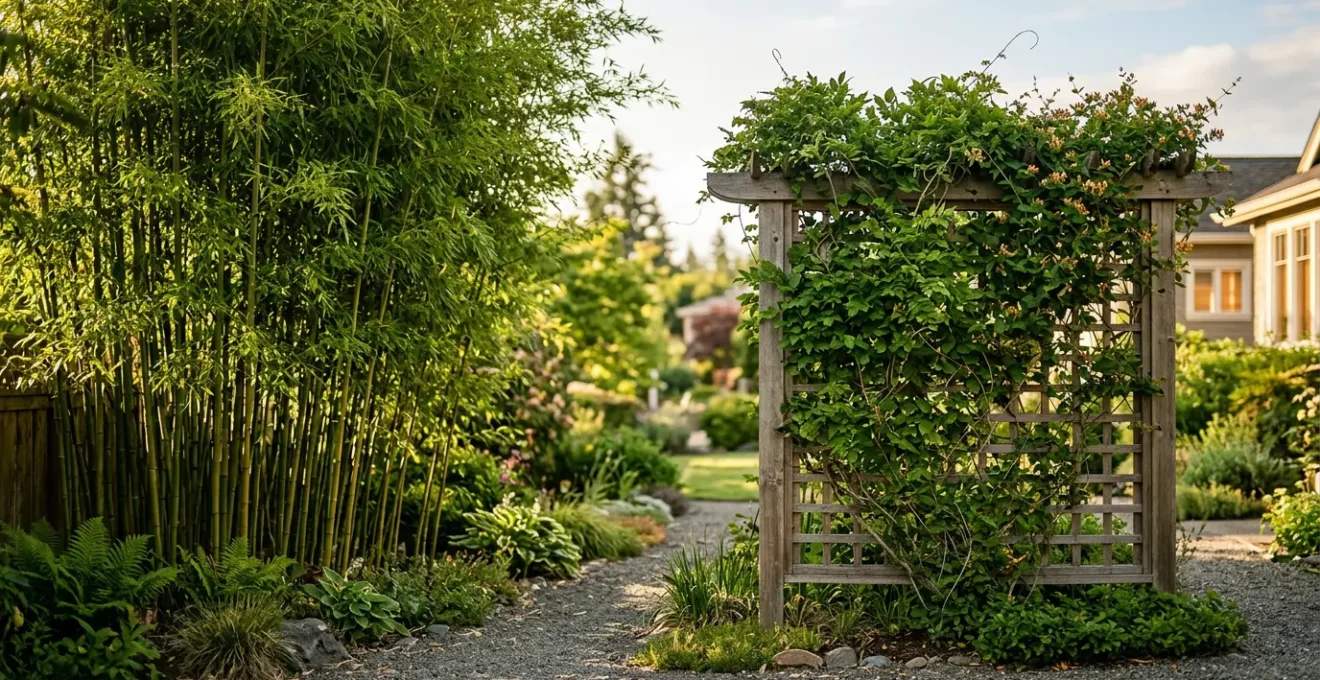
The fastest privacy screen isn’t a single plant, but a structural system chosen for its specific ‘time-to-opacity’.
- Bamboo offers unrivaled vertical speed but demands serious engineering (containment) to prevent disaster.
- Vines on trellises provide predictable, year-over-year coverage, but only if you select the right species for your “vertical zone”.
Recommendation: Before buying any plants, step into your yard and accurately assess your specific vertical and horizontal privacy gaps. The problem dictates the solution.
There’s a universal moment of discomfort for many homeowners: you’re enjoying a quiet moment in your backyard, and you suddenly notice a neighbor’s window staring directly back at you. The immediate reaction is a craving for privacy, and not just any privacy—fast privacy. The knee-jerk solution is often a trip to the nursery to ask, “What grows fast?” This question, however, is where many well-intentioned plans go wrong.
The common advice usually revolves around planting a row of Arborvitae or putting up a simple trellis. But for the truly impatient, these generic answers often lead to disappointing results: hedges that remain see-through at eye-level for years, or worse, a bamboo experiment that ends in a neighborhood dispute. The fundamental mistake is focusing on the plant’s growth rate in isolation.
The real key to achieving rapid privacy isn’t about finding the single ‘fastest’ plant; it’s about understanding and implementing the right structural solution for your specific visibility problem. It’s about shifting your mindset from “plant growth” to “time-to-opacity”—how quickly a chosen system creates a solid, visual block. This requires a consultant’s approach: diagnosing the privacy gap, understanding the growth mechanics of different options, and engineering a solution that delivers speed without sacrificing control.
This guide will move beyond simplistic advice. We will dissect the most popular natural screening options, comparing their true time-to-opacity and revealing the structural considerations required to make them work. We will compare the raw speed of bamboo, the architectural elegance of pleached trees, and the targeted coverage of vines to help you engineer the fastest, most effective privacy screen for your yard.
Summary: Bamboo vs. Trellis: A Speed-Focused Comparison for Natural Privacy
- Clumping vs. Running Bamboo: How to Avoid a Lawsuit From Your Neighbor?
- Pleached Trees: How to Block a Neighbor’s Second-Story Window?
- Star Jasmine or Clematis: Best Evergreen Vines for Skinny Side Yards?
- Why Your Privacy Hedge Is See-Through at Eye Level?
- How Far Apart Should You Plant Arborvitae for a Solid Screen?
- Shutters or Sheers: Which Window Treatment Defines Hamptons Style?
- Planters on Wheels: Creating Flexible Privacy on a Condo Balcony?
- Manual vs. Motorized Canopies: Which Is Better for windy Locations?
Clumping vs. Running Bamboo: How to Avoid a Lawsuit From Your Neighbor?
Bamboo is the undisputed champion of vertical growth speed, but it’s a game of high risk and high reward. The critical distinction that determines whether you get a beautiful screen or a legal nightmare is the type of rhizome (root system) it has: clumping or running. Running bamboo is what you’re thinking of when you hear horror stories. Its rhizomes are aggressive explorers, and according to bamboo containment specialists, they can travel up to 40 feet in a single season, emerging in your neighbor’s yard, under their foundation, or through their asphalt driveway.
This makes running bamboo a high-speed, high-liability option. To use it for privacy requires treating it not as a plant, but as an engineering project. The ‘structural solution’ here is a formidable root barrier, typically a 40-60 mil thick High-Density Polyethylene (HDPE) barrier buried 28-30 inches deep, with a few inches left exposed above ground to spot any escaping rhizomes. Failure to install this correctly is not an ‘if’ but a ‘when’.
Clumping bamboo, on the other hand, is a far more civilized choice for most homeowners. Its rhizomes expand outwards from the center very slowly, much like an ornamental grass, forming a dense, predictable clump. While it doesn’t have the explosive territorial gain of running types, a healthy clumping variety can still grow to its full height in just a few seasons, making it a powerful tool for fast privacy without the associated risk. For the impatient homeowner, the choice is clear: clumping bamboo provides speed you can manage, while running bamboo provides speed that will eventually manage you.
Pleached Trees: How to Block a Neighbor’s Second-Story Window?
What if your privacy issue isn’t at ground level, but ten feet up, right where your neighbor’s new bedroom window looks onto your patio? A standard fence or hedge won’t do the trick. This is a specific “vertical zone” problem that requires a specialized structural solution: pleached trees. Think of them as a hedge on stilts. These are trees that have been trained from a young age to have a clear trunk up to a certain height (typically 6 feet), with their branches then woven and pruned into a flat, screen-like plane above.
This elevated foliage is precisely what makes them so effective for second-story screening. While a 6-foot fence provides a solid base, the pleached canopy starts where the fence leaves off. In fact, garden design experts confirm that pleached trees can provide an additional 1.2m to 1.5m of targeted screening height exactly where it’s needed most. This creates an immediate “wall” in the sky, blocking sightlines without having to wait for a traditional tree to mature and fill out at that height.
Of course, this architectural elegance requires a commitment to maintenance. You are not just planting a tree; you are managing a living sculpture. This involves regular pruning to keep the shape defined and a robust support structure to handle wind load. Here is what the yearly commitment looks like:
- Late Winter/Early Spring: Perform the main structural pruning while the branches are bare. This is your chance to reinforce the framework and encourage dense summer growth.
- Growing Season: Light trims are necessary to snip away unruly shoots and maintain the crisp, geometric shape of the screen.
- Year-Round Support: Ensure the trees are securely fastened to their support frames. Wind rock can damage the structure and the tree’s roots, slowing down its progress.
- Establishment Period: Consistent watering, especially during dry spells in the first couple of years, is critical for the tree to establish a strong root system capable of supporting rapid growth.
Star Jasmine or Clematis: Best Evergreen Vines for Skinny Side Yards?
For narrow spaces like a side yard or a small patio, a bulky hedge is out of the question. Here, the best structural solution is a vertical one: a trellis covered in vines. This approach has a minimal footprint on the ground while maximizing vertical coverage. But again, for the impatient homeowner, not all vines are created equal. The key is choosing a vine whose growth mechanics match your timeline. You need something that climbs fast and, ideally, stays green year-round for constant privacy.
Two popular contenders are Star Jasmine (Trachelospermum jasminoides) and certain varieties of Clematis. Star Jasmine is an evergreen powerhouse, beloved for its fragrant flowers and dense foliage. However, it’s known for its “Year-One Deficit”: it sleeps the first year, creeps the second, and leaps the third. Impatient homeowners may be frustrated by its slow start. Vigorous Clematis varieties, on the other hand, can explode with growth in their first or second year, but most are deciduous, meaning your screen will disappear in winter.
The decision comes down to a direct comparison of their time-to-opacity. The table below, drawing from data on climbing plant growth potential, breaks down the real-world speed you can expect.
| Vine Type | Annual Growth Rate | Mature Length | Coverage on 6ft Trellis | Key Characteristics |
|---|---|---|---|---|
| Star Jasmine (Trachelospermum jasminoides) | Up to 6 feet per year (after establishment) | 15 to 30 feet | Year 1: Slow establishment; Year 2-3: Full coverage | Evergreen; Fragrant white flowers; Patient first year |
| Common Jasmine (Jasminum officinale) | 12 to 24 inches per year | 15 to 30 feet | Year 1-2: Partial; Year 3-4: Full coverage | Deciduous; Highly fragrant; Moderate growth |
| Clematis (various species) | 8 to 12 feet per year (vigorous varieties) | 6 to 30 feet depending on variety | Year 1-2: Full coverage possible with vigorous types | Deciduous; Showy flowers; Variable by species |
As the data shows, if year-round screening is paramount, the initial patience required for Star Jasmine pays off with a permanent, dense screen. If you need maximum speed for summer privacy and don’t mind winter transparency, a vigorous Clematis is the faster choice to achieve initial coverage.
Why Your Privacy Hedge Is See-Through at Eye Level?
It’s one of the most common and frustrating failures in backyard privacy: you’ve spent years growing a hedge, it’s tall, but you can still see right through it at eye level. The bottom is a collection of leggy, bare stems. This isn’t bad luck; it’s a predictable result of ignoring a plant’s basic growth mechanics. Plants grow towards the light, and in a hedge, the top gets the most sun. Without intervention, the plant directs all its energy upwards, creating a dense top canopy that shades out the lower branches, causing them to thin out and die back.
Shearing the hedge into a perfect rectangle exacerbates the problem. A hedge should always be pruned so it’s slightly wider at the bottom than at the top. This “A” shape allows sunlight to reach the lower branches, encouraging them to stay full and dense. The biggest mistake impatient homeowners make is letting the hedge shoot up for height, fearing that hard pruning will set them back. In reality, the opposite is true: hard pruning in the early years is what builds the dense lower structure for lasting, floor-to-ceiling opacity.
If you’re already facing a leggy hedge, all is not lost. A renewal pruning strategy can often restore density, though it requires patience. It’s an audit and correction process.
Your action plan to fix a see-through hedge
- Assess the Foundation: In late winter, critically examine the bottom two feet of the hedge. Identify all bare, non-productive stems versus those with potential for new growth.
- Perform the Drastic Cut: For deciduous hedges like privet, you may need to cut a third of the oldest, thickest stems right down to 6-12 inches from the ground to force new, low branching. This feels brutal but is essential. For evergreens, this is riskier and a less severe thinning is advised.
- Shape for Light: As new growth emerges, begin shaping the entire hedge so the base is always wider than the top. Use string lines to guide your cuts and ensure sunlight can penetrate to the lowest leaves.
- Evaluate Light Conditions: If the base is in deep shade from an overhanging tree or building, pruning alone may not be enough. Be honest about the light environment; you might be fighting a losing battle.
- Plan for Layering: If renewal pruning is not an option or fails, your best bet is to accept the hedge as a “tall and airy” backdrop and plant a second, lower tier of shade-tolerant shrubs in front to fill the eye-level gap. This creates a multi-layered solution.
How Far Apart Should You Plant Arborvitae for a Solid Screen?
Arborvitae, particularly the ‘Emerald Green’ variety, is the default choice for privacy screens across the country. The most critical question that determines its success or failure is spacing. Plant them too far apart, and you’ll be waiting a decade for the gaps to fill. Plant them too close, and the desire for an “instant screen” will backfire spectacularly. When Arborvitae are packed too tightly, they compete for water, nutrients, and sunlight. More importantly, the lack of air circulation creates a perfect environment for fungal diseases.
As they grow, the crowded inner branches that don’t get light will die off. In a few years, your “solid” screen becomes a row of sickly, browning trees that are bare on three sides. The consultant’s approach is to balance speed with long-term plant health. For a standard 4-5 foot wide ‘Emerald Green’ Arborvitae, a spacing of 3 feet on center is the sweet spot. This feels too spacious at first, but it gives each plant just enough room to thrive without creating huge, long-lasting gaps.
However, for the truly impatient homeowner, there is a superior strategy that accelerates the time-to-opacity: the staggered, double-row planting. Instead of one single row, you plant two rows, with the trees in the back row positioned to be in the gaps of the front row. This creates a much deeper, denser visual barrier much faster. While it requires more plants and a wider garden bed, this structural approach achieves a solid, non-see-through screen in nearly half the time of a single row, while still providing adequate air circulation for each tree.
Shutters or Sheers: Which Window Treatment Defines Hamptons Style?
The quest for privacy isn’t limited to the outdoors. The same principles of light control and visual obstruction apply to window treatments, and the classic Hamptons style offers a perfect indoor analogy for our outdoor privacy dilemma. The two defining choices are plantation shutters and flowy, sheer curtains. This isn’t just a style choice; it’s a decision between two very different privacy mechanics.
Plantation shutters are the indoor equivalent of a dense bamboo screen or a solid wall. When closed, they offer total, absolute privacy. They block light and views completely. Their louvers allow for precise control, tilting to let in angled light while still obstructing a direct line of sight. This offers a feeling of security and solidity, a hard barrier between your home and the outside world. It is a full-block solution.
Sheer curtains, on the other hand, are the equivalent of an airy, deciduous hedge or a lightly-covered trellis. They don’t block the view; they filter it. During the day, they allow light to flood the room while making it very difficult for anyone outside to see in, creating a sense of privacy through obscurity. At night, with the lights on inside, this effect is reversed. Sheers provide filtered privacy, softening the light and the architecture, and creating an ethereal, relaxed atmosphere. It’s a solution that prioritizes light and ambiance over absolute security.
Planters on Wheels: Creating Flexible Privacy on a Condo Balcony?
For those in condos, apartments, or rental homes, planting a permanent screen in the ground is not an option. Privacy needs can also be dynamic: perhaps you only need to block the view from a neighboring balcony during dinner, or you need to move a screen to follow the sun. In these scenarios, the fastest solution is one that is also mobile. This is where planters on wheels become an ingenious structural solution.
The speed here is not about growth rate, but about deployment. A large planter on heavy-duty casters, filled with a tall ornamental grass or a slender clumping bamboo, can be moved into position in seconds. This creates “on-demand” privacy exactly where and when you need it. You can create a green wall to shield your dining area in the evening and then roll it away in the morning to open up the view. This flexibility is its primary advantage.
Case Study: The Mobile Balcony Screen
Lightweight planters on wheels offer an inspired solution for balconies and patios, allowing homeowners to move privacy screens around easily according to where they most need them. This strategy was highlighted by experts at Gardening Know How, who note that these movable containers let you mask or block specific views to create privacy, in addition to holding the eye and attention within your garden. Some of these movable containers even come with integral trellises, providing immediate vertical screening capability for climbing vines, while maintaining the flexibility for repositioning based on sun exposure, wind direction, or social gathering needs. This turns a static privacy problem into a dynamic, controllable solution.
This approach combines the greenery of a natural screen with the adaptability of a piece of furniture. It’s the ultimate solution for small-space dwellers who need to react quickly to changing privacy needs. The key is to choose planters that are large enough to support a plant of significant height but not so heavy that they become immobile. Lightweight fiberglass or composite planters paired with robust, locking casters are an ideal combination.
Key takeaways
- The fastest privacy solution is always the one that precisely matches the height and nature of your specific visibility problem (e.g., ground-level vs. second story).
- True speed is measured in ‘time-to-opacity’, which depends on the entire system—plant, structure, and maintenance—not just the plant’s advertised growth rate.
- For high-speed options like running bamboo or dense hedges, non-negotiable engineering (containment barriers, structural pruning) is required to prevent future problems.
Manual vs. Motorized Canopies: Which Is Better for windy Locations?
While living screens are a beautiful solution, sometimes the need for privacy is instantaneous. This is where mechanical solutions like retractable canopies and awnings enter the picture, representing the ultimate in on-demand privacy and shade. In windy locations, however, the choice between a manual and a motorized system becomes a critical decision centered on reaction speed. A sudden gust of wind can turn a beautiful canopy into a giant, destructive kite. The ability to retract it quickly is not a luxury, but a necessity for protecting your investment.
A manual canopy, operated by a hand crank, is reliable and doesn’t depend on electricity. However, its retraction speed is limited by how fast you can turn the crank. In a sudden downpour or a rapidly approaching windstorm, this can feel agonizingly slow. You must be physically present and able to operate it. If you’re away from home when the wind picks up, the canopy is left vulnerable.
A motorized canopy offers superior speed and convenience. With the press of a button, the canopy retracts smoothly and quickly, often in under a minute. This rapid reaction time is invaluable in volatile weather. Furthermore, the most advanced systems can be equipped with wind sensors. These sensors automatically retract the canopy when wind speeds exceed a preset threshold, providing a failsafe level of protection even when you’re not home. For a windy location, this automated, high-speed reaction capability makes a motorized system the clear winner from a risk-management perspective.
Now that you are armed with a consultant’s framework, the next step is to walk into your own backyard and perform a privacy audit. Identify the sightlines, measure the vertical gaps, and choose the structural solution that will deliver the opacity you need in a timeframe you can live with.