Human-centric lighting’s true power isn’t just dimming lights, but delivering a precise “light diet” to reprogram your body’s internal clock for better sleep and daytime energy.
- Blue-rich light after 8 PM actively suppresses the sleep hormone melatonin, delaying sleep onset and disrupting your rhythm.
- Automating your light’s color temperature to mimic the sun provides the correct biological signals to your brain throughout the day.
Recommendation: Treat your lighting as a proactive health tool, not just a utility, by strategically managing its spectrum, intensity, and timing.
For millions of people, especially insomniacs and shift workers, the feeling of being biologically out of sync is a daily struggle. You try to wind down, but your mind races. You wake up feeling groggy, as if you’ve been fighting your own body clock. Conventional wisdom offers familiar advice: use dimmers, switch to “warm” bulbs in the evening, and avoid screens before bed. While these tips have merit, they only scratch the surface of a profound biological reality. They treat light as a simple matter of brightness and mood.
But what if we re-framed the entire question? As a circadian biologist, I encourage you to stop thinking about light as mere illumination and start seeing it as a form of biological nutrition. The light you consume—its color, intensity, and timing—is a powerful signal that actively programs your sleep-wake cycle. The problem isn’t just “too much light” at night; it’s the wrong spectral ingredients at the wrong time. This is where human-centric lighting, also known as circadian lighting, moves from a design trend to a critical tool for health.
This article provides a scientific framework for creating a “light diet” that supports, rather than sabotages, your internal clock. We will dissect the specific properties of light that influence your biology, explore how to automate your environment to mimic natural solar cycles, and provide practical guidance on choosing the right technology. It’s time to move beyond simply turning lights on and off and start actively managing your daily dose of light for restorative sleep and optimal daytime function.
To navigate this deep dive into the science of light and sleep, the following guide breaks down the core concepts into actionable insights. From understanding the impact of blue light to the practicalities of installation, each section builds upon the last to provide a complete picture.
Summary: A Biologist’s Guide to Reprogramming Your Sleep with Light
- How to Automate Color Temperature to mimic the Sun From Dawn to Dusk?
- Why You Need to Eliminate Blue Spectrum Light After 8 PM
- Cool White vs. Daylight: Which Setting Is Best for Home Office Focus?
- Do You Need Special Wiring for Tunable White LED Strips?
- Why Your Salad Looks Grey Under Cheap LEDs: The Importance of CRI
- Cool White vs. Warm White: Which Suits North-Facing Rooms?
- Warm vs. Cool Bulbs: Which Looks Best With Matte Black Fixtures?
- How to Create a Scandinavian Bedroom That Helps You Sleep Better?
How to Automate Color Temperature to mimic the Sun From Dawn to Dusk?
Your body’s internal clock, or circadian rhythm, evolved over millennia to synchronize with one primary signal: the 24-hour cycle of the sun. It expects bright, blue-rich light in the morning to promote alertness and a gradual shift to warm, dim light in the evening to prepare for sleep. In our modern world, we spend most of our time indoors under static, unchanging artificial light, which sends confusing signals to our brain. Automating your home’s lighting to mimic the sun’s natural progression is the cornerstone of a healthy light diet.
This is achieved with tunable white LED technology, which allows you to adjust the color temperature (measured in Kelvin) and intensity of your lights throughout the day. A typical automated schedule would look like this:
- Morning (7 AM – 10 AM): The lights slowly brighten and shift to a cool, energizing color temperature (4000K – 5000K), simulating the morning sun to suppress melatonin and boost cortisol for a sharp start to the day.
- Midday (10 AM – 4 PM): Lighting remains bright and cool to maintain focus and productivity, mimicking the peak sun.
- Evening (4 PM – 8 PM): The lights begin a slow transition, becoming warmer and dimmer (shifting from 3000K down to 2200K), mirroring the sunset.
- Night (After 8 PM): All overhead lights are very dim and very warm (below 2700K), with minimal blue spectrum content to allow for natural melatonin production.
This isn’t a niche concept; it’s a rapidly expanding field of wellness technology. According to market research, the circadian rhythm lighting sector is projected to grow at a 20% CAGR between 2025 and 2032. This growth is driven by the increasing scientific understanding that dynamic lighting is not a luxury, but a fundamental component of a healthy indoor environment. By using smart controllers, apps, or pre-programmed systems, you can automate this entire cycle, effectively bringing the sun’s rhythm indoors and providing your body with the clear, consistent signals it needs.
Why You Need to Eliminate Blue Spectrum Light After 8 PM
The single most disruptive element in a modern light diet is the overconsumption of blue-spectrum light in the evening. While blue light is beneficial during the day for alertness, its presence after sunset is a powerful suppressor of melatonin, the hormone that signals your body it’s time to sleep. This biological response is mediated by a special class of photoreceptors in your eyes called intrinsically photosensitive retinal ganglion cells (ipRGCs), which contain the photopigment melanopsin and are highly sensitive to blue wavelengths (around 460-480 nm).
When these cells detect blue light at night, they send a strong “daytime” signal to your brain’s master clock, the suprachiasmatic nucleus (SCN). This directly tells your pineal gland to halt melatonin production. The consequences are significant. Compelling Harvard research demonstrates that blue light exposure at night can shift circadian rhythms by three hours, compared to just 1.5 hours for green light. This means your entire biological clock is pushed back, making it harder to fall asleep and harder to wake up in the morning. For a shift worker or someone with insomnia, this is a recipe for chronic sleep disruption.
Eliminating this disruptive signal after 8 PM is crucial. This involves more than just dimming your lights. You must change the spectral ingredients. Switch to light sources with a color temperature of 2700K or lower, often labeled as “warm white,” “soft white,” or “amber.” These bulbs have a greatly reduced blue light component, minimizing their impact on melatonin. Setting your phone and computer screens to “night mode,” which warms the color output, is also a critical step in practicing good chronohygiene and protecting your body’s natural preparation for sleep.
Cool White vs. Daylight: Which Setting Is Best for Home Office Focus?
Just as warm light signals the body to rest, bright, cool-toned light acts as a powerful stimulant for alertness and concentration. This is a key part of the “light diet” concept: providing the right spectral nutrition for the task at hand. For a home office environment where focus and productivity are paramount, using the right color temperature during the day can have a measurable impact. The two most common settings for this purpose are “Cool White” (around 4000K) and “Daylight” (5000K to 6500K).
From a biological standpoint, both settings are effective because they are enriched with the blue wavelengths that suppress sleepiness and enhance cognitive performance. The choice between them often comes down to personal preference and the specific nature of the work.
- Cool White (4000K): This light provides a clean, neutral, and focused environment without feeling as stark or clinical as higher Kelvin options. It’s an excellent all-purpose choice for general office tasks, reading, and video calls, rendering colors clearly without being harsh.
- Daylight (5000K-6500K): This setting closely mimics the bright, intense light of noon. It is exceptionally good for tasks requiring high visual acuity, such as graphic design, detailed technical work, or crafting. The high blue content provides a significant alerting effect. In fact, some research from the University of Greenwich found that workers under 17,000K blue-enriched bulbs reported increased performance, though such an extreme setting is not common or necessary for most home offices.
For most individuals, starting with a Cool White (4000K) setting is a balanced approach. If you find your energy dipping in the early afternoon, or if your work is highly detail-oriented, switching to a Daylight (5000K) setting can provide an effective, non-caffeinated boost. The key is to have the flexibility to use cooler light as a tool for focus during work hours, while remembering to transition away from it as the workday ends to begin preparing your body for rest.
Do You Need Special Wiring for Tunable White LED Strips?
Implementing a truly dynamic, tunable white lighting system does require more than simply swapping a bulb. While you may not need to completely rewire your house, understanding the specific components and connections is essential for a successful installation. Standard LED strips have two wires (positive and negative), but tunable white strips require a different setup to control the two different sets of LEDs—one warm white and one cool white.
Tunable white LED strips typically have three or more wires. This allows for independent control over the intensity of the warm white LED chips and the cool white LED chips, which are mounted alternately along the strip. Blending their output creates the full range of color temperatures. This means you cannot connect them directly to a standard two-wire power source or a simple dimmer. You need a dedicated tunable white controller and a compatible power supply.
The controller is the “brain” of the system, interpreting signals from a remote, wall panel, or smart app to adjust the power sent to each set of LEDs. The power supply (or driver) must be sized correctly to handle the maximum wattage of your LED strip. Following the 80% rule is a critical safety and longevity measure: the strip’s total power draw should never exceed 80% of the power supply’s rated capacity. This prevents overheating and ensures a long service life.
Your Action Plan for Tunable White LED Setup
- Identify Wires: Before starting, identify the distinct wires on your tunable strip. Typically, there is one for warm white, one for cool white, and a common positive wire (colors can vary, so check the manufacturer’s guide).
- Connect to Receiver: Connect the specific wires to the correct terminals on the tunable white receiver or controller. For example, the warm wire might go to a ‘WW’ or red terminal, and the cool wire to a ‘CW’ or green terminal.
- Connect the Positive Wire: Attach the remaining common positive wire from the LED strip to the main positive terminal on the receiver.
- Install the Controller: Place a compatible controller (like a DMX, wireless, or wired panel) between the LED strip’s receiver and the main power supply. This is the device you will use to change the color temperature.
- Verify Power Supply: Ensure your power supply follows the 80% rule. Calculate the total wattage of your LED strip and confirm it uses no more than 80% of your power supply’s maximum capacity to prevent overheating and failure.
Why Your Salad Looks Grey Under Cheap LEDs: The Importance of CRI
Have you ever noticed that the vibrant colors of your food, clothing, or artwork look dull and lifeless under certain artificial lights? This is not an illusion; it’s a direct result of a poor “spectral diet.” The metric that measures a light source’s ability to faithfully render colors compared to natural sunlight is the Color Rendering Index (CRI). It operates on a scale from 0 to 100, with 100 representing the perfect color rendering of the sun.
Cheap, low-CRI LED bulbs save costs by using phosphors that emit a very narrow band of light wavelengths. They might appear “white” to our eyes, but they are missing many of the spectral ingredients needed to reflect true colors back to us. When light that lacks deep reds hits a tomato, the tomato has no red light to reflect, so it appears brownish or grey. This poor color fidelity creates a subconscious sense of unease and artificiality in a space. It’s the visual equivalent of a highly processed food—it provides calories (lumens) but lacks essential nutrients (spectral richness).
For a healthy and visually pleasing light diet, it is critical to select bulbs with a CRI of 90 or above. At this level, the light source produces a full, rich spectrum that allows objects to appear in their true, natural colors. Skin tones look healthy, wood grains appear warm and rich, and the fresh green of your salad looks appetizing. This isn’t just an aesthetic concern; it’s about creating an environment that feels authentic and comfortable. When designing a lighting scheme for health, paying attention to CRI is just as important as managing color temperature and intensity.
Cool White vs. Warm White: Which Suits North-Facing Rooms?
North-facing rooms present a unique lighting challenge. They receive no direct sunlight, only cool, indirect ambient light throughout the day. This light is consistent but has a strong blue-grey cast, which can make a space feel cold, gloomy, and unwelcoming. Choosing the right artificial light is not just about illumination; it’s about actively compensating for this natural color deficit.
The common instinct might be to fight the cool tones with very warm light (2700K or lower). While this works well in the evening to create a cozy “hygge” atmosphere, it can make the room feel dim and slightly orange during the daytime, clashing with the cool daylight coming through the windows. A more effective strategy is to use a layered, dynamic approach:
- For Daytime Ambiance and Tasks: Use a neutral to slightly warm light, around 3000K to 3500K. This temperature is warm enough to counteract the cold, blueish daylight without creating an artificial-looking orange glow. It provides a clean, comfortable, and inviting light that feels natural in the space.
- For Evening Coziness: In the evening, dim the lights and transition to a much warmer color temperature of 2200K to 2700K. This creates the intimate, relaxing sanctuary effect that is perfect for winding down.
This highlights the importance of user control. As Emily Dunn, a consultant at HOK, noted, giving people the ability to adjust their lighting to their needs improves their sense of well-being and productivity. This is especially true in a space with challenging natural light. Access to natural light is fundamentally linked to well-being; indeed, a study published in the Journal of Clinical Sleep Medicine found that workers with natural light access reported better sleep patterns. In a north-facing room, tunable artificial light allows you to supplement and balance the natural light you do have, making the space functional and comfortable all day long.
Warm vs. Cool Bulbs: Which Looks Best With Matte Black Fixtures?
Matte black fixtures have become a staple of modern interior design, prized for their ability to add dramatic contrast and a touch of sophisticated edge. However, their light-absorbing properties make the choice of bulb critically important. Unlike a reflective brass or chrome fixture that scatters light, a matte black finish consumes it, placing all the emphasis on the quality and color of the light source itself. The bulb is not just a component; it becomes the main event.
The decision between a warm or cool bulb depends entirely on the intended mood and function of the space. There is no single right answer, only different design intents.
- Warm Bulbs (2200K – 3000K): This is the most common and often most successful pairing. The soft, golden glow of a warm bulb creates a powerful and inviting contrast with the stark black fixture. This combination is perfect for creating a cozy, intimate, and dramatic atmosphere. Think of a moody restaurant, a relaxing living room, or a sophisticated bedroom. The warmth of the light balances the coolness of the black finish, creating a harmonious and high-end feel.
- Cool Bulbs (3500K – 5000K): Pairing a cool bulb with a matte black fixture produces a very different effect: one that is graphic, modern, and high-contrast. This look is less about coziness and more about sharp, functional clarity. It works well in utilitarian spaces like kitchens or bathrooms with minimalist design, or in a commercial/gallery setting where you want a stark, architectural statement. The crisp white light against the black creates a bold, defined look.
Ultimately, the fixture is a vessel, and the bulb is what gives it a soul. This choice goes beyond simple illumination and touches on the emotional impact of light. As José dos Santos, Head of Design at Signify, eloquently puts it:
Done right, lighting becomes an active participant in how people see, feel and perform, not just for illumination or as static background.
– José dos Santos, Head of Design and User Experience, Americas, at Signify
With matte black fixtures, this is especially true. The bulb you choose will actively define whether the space feels like a warm embrace or a cool, clean statement.
Key Takeaways
- Light is a powerful biological signal that programs your sleep-wake cycle; treat it as “light nutrition.”
- For better sleep, strictly eliminate blue-rich light (above 2700K) after 8 PM and actively seek it during the day to boost alertness.
- A high CRI (Color Rendering Index) of 90+ is non-negotiable for creating a natural, comfortable, and visually accurate environment.
How to Create a Scandinavian Bedroom That Helps You Sleep Better?
The Scandinavian design ethos, with its emphasis on minimalism, natural materials, and comfort (hygge), is inherently aligned with the principles of creating a sleep-promoting environment. It’s about stripping away the unnecessary to create a calm, uncluttered sanctuary. Applying the principles of a healthy light diet within this framework elevates a Scandinavian bedroom from a style choice to a functional tool for better sleep.
The goal is to create a layered lighting scheme that supports your circadian rhythm. This means moving away from a single, harsh overhead fixture and instead using multiple, smaller light sources that can be controlled independently. This allows you to craft the perfect light environment for any time of day. Here is a practical strategy for a sleep-focused Scandinavian bedroom:
- Embrace Natural Light: The foundation of the design is maximizing daylight. Keep window treatments minimal to allow for at least an hour of morning sun exposure, which is critical for setting your internal clock.
- Prioritize High-CRI Lighting: Scandinavian design celebrates natural textures like light wood, wool, and linen. Use high-CRI (90+) LED lighting to render these colors and textures accurately, enhancing the room’s natural and calming feel.
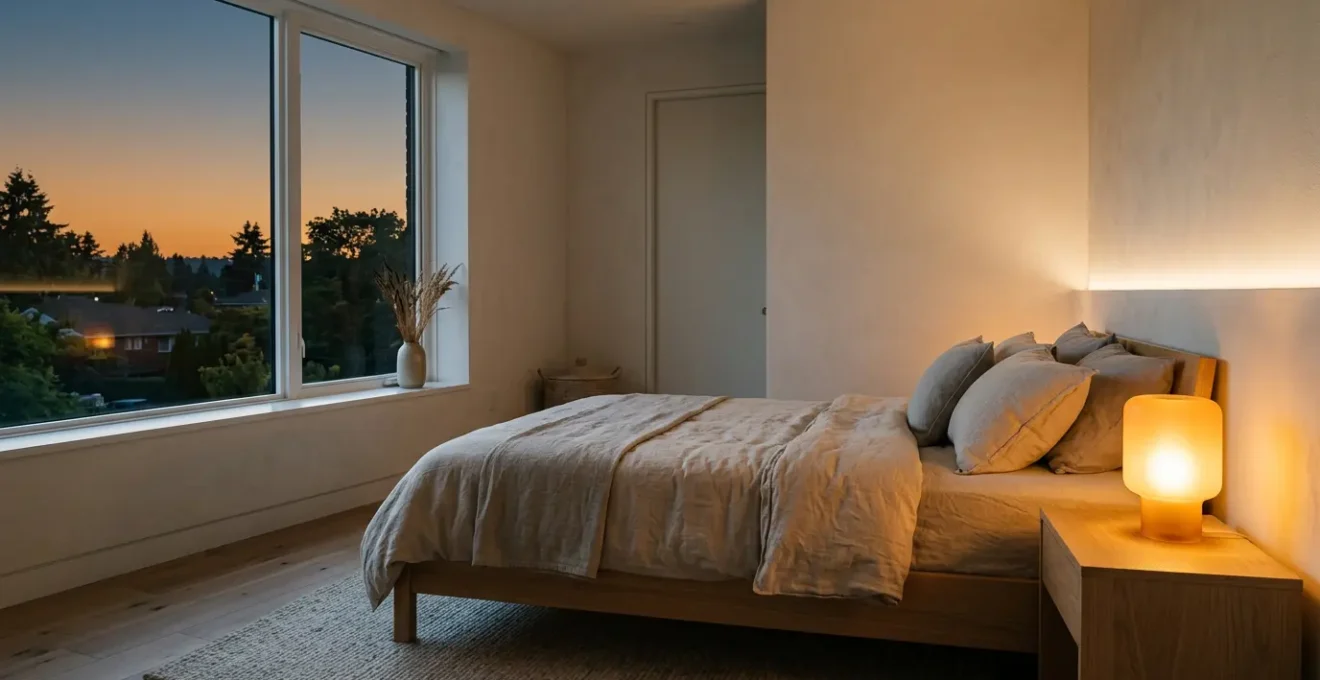
- Layer Your Evening Light: Use a combination of floor lamps and bedside table lamps with very warm bulbs (2200K-2700K). This creates pools of soft, dim light that are perfect for reading and winding down, signaling to your brain that it’s time to produce melatonin.
- Implement a Strict Screen Curfew: The warm ambient light will be negated if you are staring into a blue-light-emitting phone or tablet. Power down all screens at least an hour before bed to protect your natural melatonin production.
By combining the aesthetic principles of Scandinavian design with the biological principles of human-centric lighting, you create more than just a beautiful room. You build a chronohygiene sanctuary—an environment actively designed to reduce stress, calm the nervous system, and provide the clear, gentle light signals your body needs to transition into deep, restorative sleep.
Begin today by auditing the light in your most-used spaces. Treat it not as an afterthought, but as a fundamental pillar of your health and well-being, just as important as the food you eat or the exercise you get. By consciously managing your daily light diet, you can take a powerful, proactive step toward reclaiming control over your sleep.