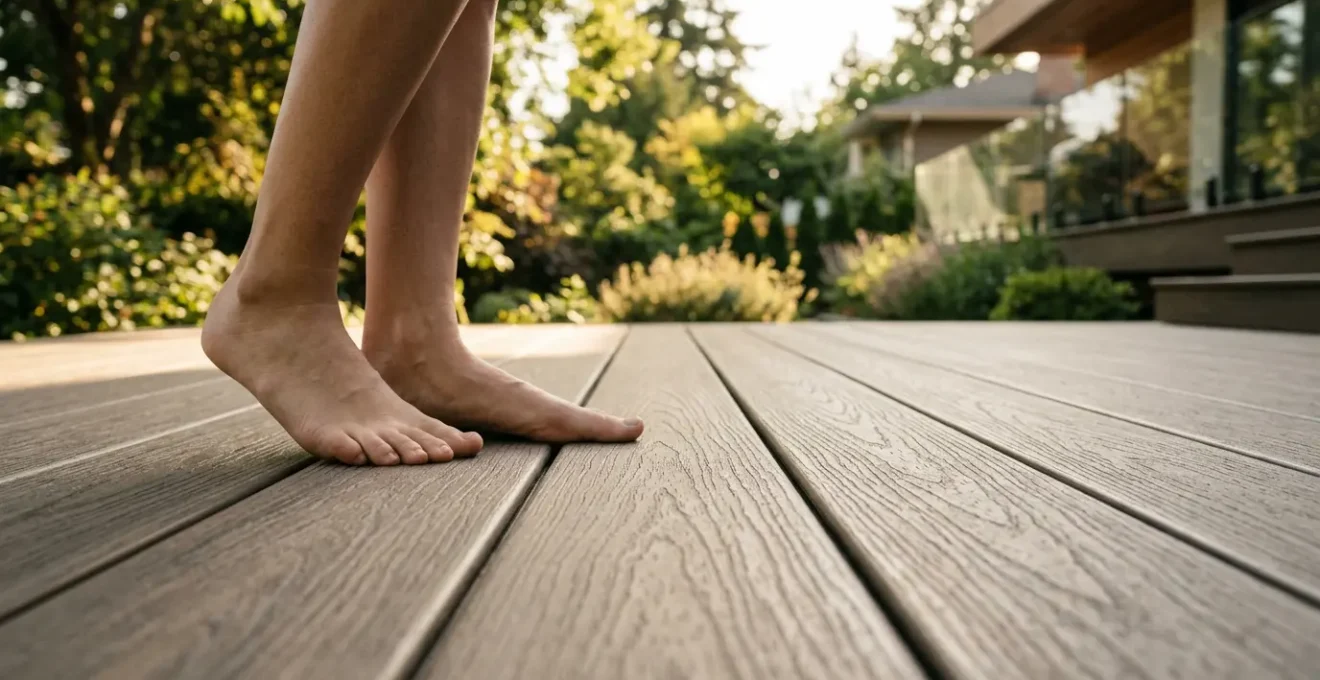
PVC decking is consistently cooler to the touch than composite, not just because of color, but due to its lower thermal capacity.
- PVC stores about half the heat of wood-composite materials, allowing it to cool down faster after being in direct sun.
- Capped composites offer superior scratch resistance and repairability, a key trade-off for homeowners with pets.
Recommendation: For maximum barefoot comfort in direct sun, choose a light-colored, 100% PVC board. For high-traffic areas with pets, a capped composite may be a more durable choice despite being warmer.
Every parent knows the hesitation. On a blazing summer day, you watch your child run towards the deck and instinctively call out, “Careful, it might be hot!” That fleeting moment of concern before a bare foot touches the sun-baked surface is at the heart of a critical decision for any family building an outdoor living space. The choice between composite and PVC decking isn’t just about color or wood grain; it’s about comfort, usability, and safety.
The common wisdom is simple: just pick a lighter color. While true that lighter hues absorb less solar radiation, this advice barely scratches the surface. It overlooks the fundamental material science that dictates how a deck board not only heats up but, more importantly, how it retains and releases that heat. Relying on color alone is like choosing a car based only on its paint job while ignoring the engine.
The real key to a foot-friendly deck lies in understanding the thermal physics of polymer boards. The debate between composite (a blend of wood/plastic) and PVC (100% plastic) is a tale of two different thermal behaviors. It’s a story of thermal capacity—the material’s ability to store heat—and emissivity, its efficiency at releasing it. This guide moves beyond the platitudes to give you the technical understanding needed to make a scientific decision, not just an aesthetic one.
In this analysis, we will deconstruct the properties of each material, from their reaction to summer heat and potential for warping to their resilience against pet claws and the best methods for maintenance. By understanding these technical details, you can engineer a deck that is truly an extension of your home, safe and comfortable for even the smallest bare feet.
Contents: Composite vs. PVC Decking Deep Dive
- The Installation Mistake That Causes Polymer Boards to Warp in Summer
- How to Remove Algae From Grooved Composite Decking?
- Will Dog Claws Scratch Capped Polymer Decking?
- Hidden Fasteners vs. Face Screws: Is the Extra Cost Worth It?
- Can You Replace Just One Composite Board if It Melts From a BBQ?
- How Many BTUs Do You Need to Actually Feel Warm on a Windy Night?
- Leather or Performance Fabric: Which Is Better for Homes With Pets?
- How to Clean Low-Maintenance Decking Without a Pressure Washer?
The Installation Mistake That Causes Polymer Boards to Warp in Summer
The number one cause of warped, buckled, or distorted polymer decking isn’t a faulty product; it’s a failure to respect the laws of thermal physics during installation. Both PVC and composite boards expand and contract with temperature changes, but they do so at vastly different rates. Understanding this is crucial. PVC, being 100% plastic, is far more sensitive to temperature swings. In fact, independent testing reveals PVC’s thermal expansion coefficient is nearly double that of a typical wood-plastic composite. This means a PVC board will grow and shrink much more dramatically from a cold morning to a hot afternoon.
The critical mistake is applying a one-size-fits-all gapping strategy. Installers who don’t account for the higher expansion rate of PVC will fail to leave adequate space at the ends of boards and against the house. As the deck heats up, the boards expand with immense force. With nowhere to go, they are forced to bow upwards or sideways, creating unsightly and unsafe warping. This isn’t just an aesthetic issue; it creates uneven surfaces that are tripping hazards and can compromise the entire deck structure over time. Proper installation requires a material-specific approach based on the temperature at the time of installation.
To prevent this, a meticulous gapping strategy is non-negotiable. Here are the key steps professionals follow:
- Mind the Abutment: Leave a ½-inch (12mm) expansion gap when boards meet a wall or other fixed structure if installing in temperatures below 40°F (4.5°C). This gives the board room to grow in the summer heat.
- Control the Joints: For standard composite, use a 3/16-inch gap for mitre joints and end-to-end connections. For PVC, always consult the manufacturer’s specific guidelines, as it often requires more precise fastener spacing and larger gaps.
- Ventilate from Below: Ensure there is adequate under-deck ventilation. Trapped heat from below can cook the boards from both sides, exacerbating expansion and leading to cupping.
- Break Up Long Runs: On decks longer than 16-20 feet, use “breaker boards” (a board running perpendicular to the main deck) to reset the expansion length and prevent the cumulative force of many boards from causing a massive buckle.
How to Remove Algae From Grooved Composite Decking?
The beautiful, deep wood-grain texture on modern composite decking is a double-edged sword. While it provides excellent slip resistance and a realistic look, those same grooves can become perfect breeding grounds for algae and mold, especially in shaded, damp areas. The organic wood flour within the core of many composite boards provides a food source, and the textured polymer cap creates a micro-environment that traps moisture and spores. Simply hosing the deck down is often not enough to dislodge the stubborn green film that can make a deck look tired and feel slippery.
The key to effective cleaning is to use a method that both chemically neutralizes the algae and physically removes it without damaging the deck’s surface. Avoid chlorine bleach at all costs, as it can be harsh on the polymer cap and cause discoloration. Instead, an oxygen-based cleaner (like OxiClean or similar products) is the professional’s choice. It fizzes on contact, lifting the algae from the grooves and killing the spores without harming the decking material or surrounding plants.
To prevent simply spreading spores around, adopt the “two-bucket method” used by professional detailers. This ensures you’re always working with a clean tool and a fresh solution, preventing cross-contamination.
- Fill one bucket with your oxygen-based bleach cleaning solution.
- Fill a second “rinse” bucket with clean water.
- Dip a soft-bristle brush in the cleaning solution and gently scrub the grooved areas, always moving with the grain of the board.
- After each small section, rinse your brush thoroughly in the clean water bucket before dipping it back into the cleaning solution. This stops you from reapplying contaminated water.
- Let the cleaning solution dwell on the surface for 10-15 minutes, but don’t let it dry. Rinse the entire deck thoroughly with fresh water to remove all traces of the solution and algae.
Will Dog Claws Scratch Capped Polymer Decking?
For families with pets, a deck is an outdoor playroom, and the question of scratch resistance is paramount. The claws of an excited dog can do significant damage to softer materials. Here, the distinction between older, uncapped composites and modern “capped” polymer decking is critical. Capped decking features a tough, protective outer layer made of a harder polymer (often PVC-based) that fully encases the softer composite core. This polymer cap is the board’s first line of defense against scratches, stains, and UV degradation.
While no material is completely scratch-proof, high-quality capped composites and full PVC boards offer excellent resistance to pet claws. As one experienced contractor noted in a Landscaping Network interview on pet-friendly materials, some product lines are exceptionally tough. Decking expert Mr. Edwards states:
PVC-capped composites such as TimberTech’s XLM line tend to be the most scratch-resistant. On one deck, my clients had two standard poodles—these were big, excitable dogs, and the deck looked just fine.
– Edwards, Landscaping Network interview on pet-friendly decking
However, minor scratches can still happen. The good news is that on many capped composite boards (but not PVC), light scuffs and scratches can often be “healed” using a heat gun. This technique carefully melts the surface of the polymer just enough to blend the scratch away. It’s an expert-level fix that can save you from having to replace a board.
Action Plan: Repairing Light Scratches on Composite Decking
- Clean and Prep: Thoroughly clean the scratched area with mild soap and a soft-bristle brush. Rinse with water and let the area dry completely.
- Test First: Always test the heat gun on a scrap piece of decking first. Start on a low heat setting and only increase if necessary to find the minimum effective temperature.
- Apply Heat Evenly: Hold the heat gun about 6 inches away from the scratch. Move it back and forth in a steady, continuous motion. Do not hold it still.
- Watch for Healing: As the polymer cap warms, you will see the marks begin to fade and blend into the surrounding texture. Stop immediately once the mark disappears.
- Know the Limits: This method works on capped composite. Scratches on 100% PVC decking are typically permanent and cannot be heat-repaired. Overheating composite can cause permanent damage.
Hidden Fasteners vs. Face Screws: Is the Extra Cost Worth It?
When installing a polymer deck, the choice of fastening system has profound implications for the deck’s longevity, appearance, and ability to handle thermal expansion. Face screws, which are driven directly through the top of the board into the joist, are the traditional and less expensive option. Hidden fasteners, which are clips that fit into grooves on the side of the boards, offer a clean, screw-free surface but come at a higher initial cost. For a material specialist, the answer is clear: the extra cost of hidden fasteners is an investment in the deck’s structural integrity.
The primary advantage of hidden fasteners is that they create a “slip-plane.” They hold the board down securely but allow it to slide horizontally as it expands and contracts. This works *with* the material’s natural movement. Face screws, by contrast, pin the board in place, creating a point of high stress. As the board tries to expand, the screw restricts its movement, which can lead to buckling, warping, and “screw-popping,” where the screw is pushed up out of the board. Furthermore, every face screw is a penetration point, creating a tiny opening in the protective polymer cap for water to potentially seep into the composite core over time.
The following table, based on engineering comparisons of fastening systems, breaks down the critical differences:
| Factor | Hidden Fasteners (Clip System) | Face Screws |
|---|---|---|
| Thermal Expansion Management | Designed as ‘slip-plane’ allowing natural board movement without binding | Restrictive fastening increases warping and buckling risk |
| Board Replacement Time | 15-minute mid-deck board replacement with proper tool | Multi-hour destructive process requiring adjacent board removal |
| Water Intrusion Risk | Zero penetration points – preserves cap integrity completely | Dozens of penetration points allowing moisture to reach composite core over time |
| Aesthetic Impact | Clean, uninterrupted surface mimicking natural wood | Visible screw pattern every 16-24 inches along each board |
| Installation Cost | Higher upfront material and labor cost | Lower initial installation cost |
Can You Replace Just One Composite Board if It Melts From a BBQ?
Accidents happen. A stray ember from a grill or a hot pan placed on the deck can cause a permanent melt or char mark on a polymer board. While replacing a single board is technically possible, especially with hidden fastener systems, the real challenge is a sensory one: color matching. Due to batch-to-batch manufacturing variations and the effects of UV exposure over time, a brand-new board can stick out like a sore thumb against the slightly faded, weathered originals. This is why professionals strongly recommend purchasing “attic stock”—a few extra boards from the same batch as your initial installation—and storing them away. This guarantees a perfect color and texture match for any future repairs.
The material itself also plays a role in the risk profile. PVC decking generally has a lower melting point (around 160-180°F) compared to wood-plastic composite. This means PVC is more susceptible to deforming or melting under a hot object, while composite is more likely to char and bubble at a higher temperature. Post-2009 capped composite boards offer significantly better resistance to UV fading and staining compared to their older, uncapped counterparts. This makes finding a replacement board for a modern capped composite deck less of a matching-nightmare than for a 10-year-old uncapped deck that has faded considerably.
How Many BTUs Do You Need to Actually Feel Warm on a Windy Night?
While a powerful outdoor heater can certainly extend your deck’s usability into the cooler months, the thermal comfort of your outdoor space begins with the material right under your feet. Before you even consider adding heat with BTUs, it’s crucial to understand how your deck material itself manages thermal energy. The choice between PVC and composite directly impacts not only how hot the deck gets in the sun, but also how it feels on a cool evening and how it interacts with external heat sources.
The core of the issue is a property called thermal capacity. This is the amount of heat energy a material can store. Wood-plastic composite, with its organic wood flour filler, has a significantly higher thermal capacity than 100% synthetic PVC. Think of it like this: composite acts like a brick, slowly absorbing a lot of heat and then slowly releasing it over a long time. PVC acts more like a thin sheet of metal, heating up quickly but also releasing that heat just as fast. According to thermal physics research, PVC decking holds approximately half the heat capacity of composite materials on a per-mass basis.
This has two huge implications for barefoot comfort. On a hot day, the composite “brick” will continue to absorb and store heat, becoming a hot plate that stays hot long after a cloud passes over. The PVC “metal sheet” will feel hot in direct sun but will start to cool down almost immediately once the sun is blocked, making it feel much cooler to the touch overall. Conversely, on a cool evening, the composite deck may retain some of the day’s warmth for a little longer, while the PVC deck will quickly match the cool ambient air temperature. For a parent concerned about burned feet in the summer, PVC’s low heat capacity and quick cooling time make it the clear scientific winner.
Leather or Performance Fabric: Which Is Better for Homes With Pets?
Creating a truly pet-friendly and comfortable outdoor living space requires a systems approach. The decking is the foundation, but the furniture and textiles you place on it are just as important for durability and comfort. Just as you analyze the scratch resistance and heat retention of your deck boards, the same logic applies to your outdoor cushions and seating. Choosing materials that work in harmony with your decking and lifestyle is key. Leather, for example, while luxurious, is a poor choice for an outdoor space with pets; it scratches easily and can become dangerously hot in the sun.
Performance fabrics, like those from Sunbrella or similar brands, are designed for the rigors of outdoor life. They are typically made from solution-dyed acrylic or olefin fibers, which makes them inherently resistant to staining, moisture, and UV fading. For pet owners, this means muddy paws, shedding, and the occasional accident are far less of a concern. These fabrics are also much better at managing heat compared to leather or dark vinyl. When building a complete outdoor system, it’s useful to compare all the surfaces your family and pets will interact with.
The table below compares the key pet-friendly criteria across decking and common outdoor furniture materials, helping you make a holistic decision.
| Criteria | PVC Decking | Composite Decking | Performance Fabric (Outdoor) | Leather (Outdoor-treated) |
|---|---|---|---|---|
| Scratch Resistance | Moderate (gouges easier but harder surface) | High with capped surface (heat-repairable) | High (woven synthetics resist tearing) | Low to Moderate (shows scratches prominently) |
| Stain Resistance (urine/mud) | Excellent (100% synthetic, non-porous) | Very Good (capped boards resist penetration) | Excellent (solution-dyed fibers resist staining) | Poor (requires immediate treatment) |
| Heat Retention (dark colors, direct sun) | Moderate (heats faster but cools quicker) | High (retains heat longer than PVC) | High (dark fabrics can reach 130°F+) | Very High (becomes uncomfortably hot) |
| Slip Factor When Wet | Moderate to High (smooth PVC can be slippery) | Low (textured grain provides traction) | Low (rug creates safe traction zone) | Moderate (slick when wet) |
| Maintenance for Pet Owners | Low (hose clean, no organic material to harbor odor) | Low to Moderate (occasional deep cleaning of grooves) | Moderate (machine washable or hose clean) | High (conditioning, stain treatment, odor management) |
Key Takeaways
- PVC’s lower thermal capacity makes it feel cooler to the touch and cool down significantly faster than composite after direct sun exposure.
- Modern capped composite decking offers superior scratch resistance and can often be repaired with a heat gun, a major advantage for homes with pets.
- Proper installation that accounts for the material’s specific thermal expansion rate, especially when using hidden fasteners, is critical to prevent warping and ensure long-term durability.
How to Clean Low-Maintenance Decking Without a Pressure Washer?
The term “low-maintenance” can be misleading; it really means “lower-maintenance.” While polymer decking frees you from the annual cycle of sanding and staining required for wood, it still needs periodic cleaning to look its best. Many homeowners are tempted to reach for a pressure washer to speed up the job, but this is a significant mistake. As one composite decking maintenance expert warns, a pressure washer can do more harm than good. In professional cleaning guidelines, they explain:
High pressure, even on a low setting, can cause micro-abrasions on the polymer cap, making the surface rougher over time and ironically causing it to hold more dirt and grow algae faster.
– Composite Decking Maintenance Expert, Professional deck cleaning guidelines
These micro-abrasions compromise the integrity of the protective cap, creating a texture that dirt and spores can cling to more easily. The professional approach is gentler but more effective, using the right tools and chemistry instead of brute force. The goal is to lift dirt and organic matter from the surface and its grooves without scouring the material itself.
A pro’s cleaning kit is simple and relies on technique. Here is the recommended process for a deep clean without a pressure washer:
- Assemble Your Kit: You’ll need a soft-bristle car wash brush on an extension pole, a foam cannon attachment for your garden hose, and a large floor squeegee.
- Pre-rinse: Always pre-rinse the deck with a standard garden hose nozzle to wash away loose dirt and debris. This prevents you from grinding grit into the surface during the scrubbing phase.
- Tackle Tough Stains: For tough stains like berries or grease, mix an oxygen-based bleach powder with a small amount of dish soap to create a paste. Apply this directly to the stain and let it dwell for 10-15 minutes.
- Scrub Correctly: Apply your cleaning solution (a mix of deck cleaner and water) using the foam cannon for even coverage. Scrub with the soft-bristle brush using long, smooth strokes that follow the direction of the board’s grain. Never scrub in circles, as this can create visible wear patterns.
- Rinse and Squeegee: Rinse the deck thoroughly with your hose. Immediately use the floor squeegee to pull all the standing water off the surface. This is a crucial final step that prevents water spots and mineral deposits from forming as the deck dries.
Now that you understand the science behind a cooler, more durable deck, you can make an informed choice that balances barefoot comfort with long-term performance for your family’s specific needs.