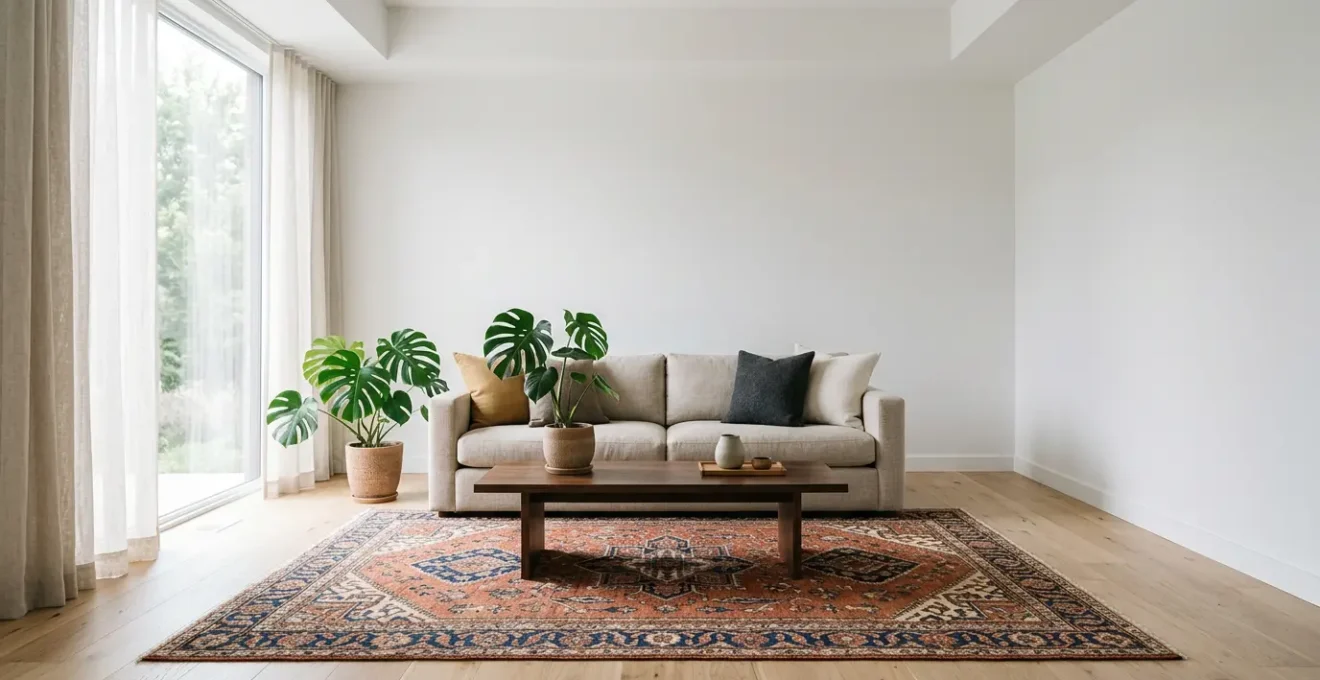
Stop trying to match your bold tribal rug to your modern decor. The secret to a stunning, cohesive space isn’t matching colors, but creating a dialogue. Treat the rug as a historical artifact and your room as its gallery. This shift in perspective transforms the fear of clashing patterns into the art of curating a space with soul, story, and a captivating tension between ancient and contemporary design.
You found it: a one-of-a-kind tribal rug with stunning colors and a pattern that feels alive. You love it, but a wave of doubt washes over you. How could this bold, intricate piece possibly work in your clean, modern living room? The fear is that it will clash, overwhelm the space, and look completely out of place next to your neutral sofa and minimalist furniture. The common advice is to pull accent colors from the rug for your pillows and throws, a safe but often uninspired approach that treats the rug as mere decoration.
But what if the goal wasn’t to simply match, but to create a compelling story? The true key to styling a statement rug is to stop seeing it as a pattern to be tamed and start seeing it as a piece of history—an artifact with its own narrative. Your modern room, in turn, becomes the perfect, quiet gallery to showcase it. This approach isn’t about avoiding a clash; it’s about mastering a deliberate and beautiful curated tension between old and new, handcrafted and manufactured, complex and simple.
This guide will walk you through the practical and philosophical steps to achieve that balance. We’ll cover the essentials of identifying an authentic piece, choosing the right size to honor its presence, and caring for it properly. More importantly, we’ll explore advanced strategies for layering, pattern mixing, and applying color theory not to colors, but to eras, allowing your tribal rug to become the soul and narrative anchor of your home.
Dive into the sections below to learn how to confidently build a room that feels collected, personal, and rich with history, all centered around your magnificent rug.
Summary: A Guide to Integrating a Tribal Rug with Modern Decor
- Hand-Knotted vs. Machine-Made: How to Spot a Fake Persian Rug?
- The Rug Sizing Mistake That Makes Your Living Room Look Smaller
- How to Clean a Vintage Wool Rug Without Bleeding the Dyes?
- Why Layering a Small Vintage Rug Over Sisal Solves Budget Issues
- Geometric or Floral: Which Upholstery Patterns Work With Kilim Rugs?
- Encaustic Tiles vs. Hardwood: Which Is Better for Wet Mudrooms?
- The 60-30-10 Color Rule: Does It Work for Eclectic Interiors?
- How to Clean a Jute Rug When You Can’t Use Water?
Hand-Knotted vs. Machine-Made: How to Spot a Fake Persian Rug?
The first step in treating your rug as a historical artifact is to understand its origin. Is it a unique story woven by hand, or a mass-produced copy? A genuine hand-knotted rug is an investment in artistry and longevity. Unlike their machine-made counterparts, which are often uniform and have a shorter lifespan, hand-knotted pieces are imbued with character. As the Carpet-Wiki Authentication Guide notes, “Every handknotted oriental carpet is a unique piece according to tradition. The knotter always brings his own interpretation or taste into a carpet.” This individuality is the soul you want to bring into your modern space.
To spot an authentic piece, look at the back. The pattern on a hand-knotted rug will be nearly as clear on the reverse as it is on the front, and you’ll see tiny, imperfect knots. A machine-made rug will have a less-defined pattern on the back, often obscured by a rigid grid or over-stitching. The fringe is another clue: on a handmade rug, the fringe is an integral part of the rug’s foundation warp threads. On a machine-made one, it’s typically sewn or glued on afterward.
Choosing a hand-knotted rug is choosing a piece with a future as rich as its past. According to textile preservation experts, a hand-knotted rug can last for centuries with proper care, while a machine-made rug typically lasts only 20 years. This durability solidifies its status as a true heirloom, a narrative anchor that will evolve with your home for generations.
This understanding transforms your purchase from a simple decorative choice into the acquisition of a unique piece of functional art.
The Rug Sizing Mistake That Makes Your Living Room Look Smaller
A rug that is too small for a space is like a picture frame that’s too small for the art—it diminishes the piece and makes the entire composition feel awkward. This is especially true for a bold tribal rug, which needs adequate “breathing room” to command attention without overwhelming the eye. A small, “postage stamp” rug floating in the middle of your living room will shrink the perceived size of the space and break the connection between your furniture pieces, creating visual clutter rather than a cohesive foundation.
The goal is to create a unified zone that anchors your seating area. The golden rule, which interior designers consistently recommend, is that for most living rooms, an 8×10 or 9×12 rug provides the right scale. This size allows you to place at least the front legs of your sofa and any armchairs onto the rug. This simple act connects all the elements, making the arrangement feel intentional and expansive. The rug becomes the stage upon which your modern furniture is set, creating a clear and harmonious dialogue between them.
Think of the space around the rug as negative space that frames your artifact. A generous border of exposed flooring between the rug’s edge and the walls of the room prevents the space from feeling cramped. This balance between the bold pattern and the quiet floor gives the rug the presence it deserves, allowing its story and artistry to be fully appreciated.
By investing in the correct size, you’re not just buying a floor covering; you’re defining the very architecture of your living space.
How to Clean a Vintage Wool Rug Without Bleeding the Dyes?
Owning a vintage wool rug means being the custodian of its history, and that includes preserving the very materials it was made from. Many of these rugs were colored using natural methods, a process that gives them their incredible depth and unique color variations. As Rug Insider Magazine explains, “The color dyeing process involved the titration of different amounts of organic plant or animal materials in boiling water, without the addition of any harmful chemicals.” These natural dyes are beautiful but can be sensitive to modern, harsh cleaning chemicals and aggressive techniques, which can cause them to bleed and fade.
The key to safe cleaning is a gentle, minimalist approach. Forget steam cleaners or powerful carpet cleaning machines. Your first line of defense is regular vacuuming (without the beater bar engaged) to remove abrasive dirt. For spills, immediate action is crucial. Blot the spill from the outside-in with a clean, dry white cloth to absorb as much as possible. Never, ever scrub, as this can permanently damage the wool fibers and push the stain deeper.
For a more targeted spot treatment, you need a cleaning kit that respects the rug’s delicate nature. The following checklist outlines a professional, safe method for handling minor issues and maintaining your rug’s integrity over the long term.
Action Plan: Safely Spot-Cleaning Your Vintage Wool Rug
- Test for Colorfastness: Before applying any liquid, dampen a clean white cloth with cold water and gently blot a small, hidden area of the rug (like a corner that sits under a sofa). If any color transfers to the cloth, avoid all water-based cleaning and consult a professional.
- Choose a Gentle Cleanser: For a colorfast rug, use a pH-neutral soap or even a small amount of clear, unscented hair shampoo. Wool is a protein fiber, much like human hair, making this a compatible choice.
- Blot, Don’t Scrub: Dilute your gentle cleanser in a bit of cold water. Dip a clean cloth in the solution, wring it out well, and gently blot the stain from the edges toward the center. This prevents the stain from spreading.
- Promote Quick Drying: Once the spot is treated, it’s vital to dry the area quickly to prevent moisture from damaging the cotton foundation. Elevate the damp section of the rug, perhaps over a stool or a box, to allow air to circulate underneath.
- Schedule Professional Care: For a deep clean, you should have your rug professionally hand-washed every 5 to 6 years. Insist on a hand-washing service and explicitly state to avoid industrial dry cleaning or steam methods, which can be catastrophic for vintage pieces.
By treating your rug with this level of care, you ensure that its character and value will not diminish but will continue to enrich your home for years to come.
Why Layering a Small Vintage Rug Over Sisal Solves Budget Issues
What if you’ve fallen in love with a smaller, exquisite vintage rug but your room demands a larger footprint? Or perhaps a room-sized hand-knotted rug is simply outside your budget. The designer’s secret weapon in this scenario is layering. By placing your smaller, more precious tribal rug on top of a larger, neutral rug—like one made of sisal, jute, or a low-pile wool—you get the best of both worlds: ample floor coverage and a powerful decorative statement.
This technique works brilliantly for both aesthetic and practical reasons. As designer Lauren Simmons of Studio L Interior Design points out, “This style of rug layering works so well because, let’s be honest – many times natural fiber rugs are not super comfy underfoot. If you need to cover a large floor area, start with a natural fiber rug first – to achieve a lot of floor coverage for not a lot of coin.” The neutral base rug defines the space and provides texture, while the smaller top rug injects personality, color, and a sense of history exactly where it matters most.
The sisal or jute base acts as a “frame” or a “pedestal,” elevating your vintage piece from a simple floor covering to a true work of art. This strategy is widely endorsed by professionals; in fact, a 2023 interior design survey revealed that 68% of designers prefer natural fibers for foundational pieces in layered compositions. The natural, earthy texture of a sisal rug creates a perfect material dialogue with the rich wool of a tribal rug, making the combination feel organic and intentional.
By layering, you’re not compromising; you’re curating a richer, more complex and texturally interesting foundation for your room.
Geometric or Floral: Which Upholstery Patterns Work With Kilim Rugs?
Pairing another pattern with a bold Kilim or tribal rug is the step that instills the most fear, but it’s also where the most dynamic and personal rooms are born. The secret isn’t in finding a pattern that matches, but one that creates a fascinating conversation. Instead of a “rule,” think of a guiding principle: pair different scales and similar spirits. If your rug has a large, bold geometric design, avoid another large geometric on your chairs. Instead, consider a small-scale floral, a subtle pinstripe, or even a solid-colored fabric with a heavy, interesting texture.
Texture can be your greatest ally. A nubby bouclé, a rich velvet, or a classic linen creates a tactile contrast that is just as powerful as a pattern. This “material dialogue” allows each piece to shine without competing. The visual rest provided by a textured solid makes the complexity of the rug’s pattern even more appreciated. The goal is to create layers of interest. A case study on integrating these pieces into contemporary homes reinforces this idea, noting that they infuse much-needed personality into otherwise sterile spaces.
Case Study: Adding Warmth to Modern Spaces
A design analysis on how tribal rugs enhance modern interiors revealed that their unique colors and patterns help bring all seven elements of design into a contemporary space. The study found that strictly modern designs often feel cold and flat. Incorporating a tribal rug infuses the room with depth and interest through its inherent texture, color, and pattern. It transforms an uninspired room into a layered, visually warm environment, providing a perfect counterpoint to the clean lines of modern furniture.
Ultimately, choosing a companion pattern is an intuitive process. If it feels right and tells the same “story” of a collected, personal home, you are on the right track.
Encaustic Tiles vs. Hardwood: Which Is Better for Wet Mudrooms?
While our focus is the living room, the philosophy of creating a historical narrative can extend to every surface in your home. When considering the backdrop for a tribal rug, especially in a transitional space like a mudroom or entryway, the flooring choice itself can either support or undermine your story. The choice between traditional hardwood and patterned encaustic tiles is a perfect example. Hardwood offers a warm, classic, and neutral backdrop—a safe and beautiful choice. It acts as a quiet canvas.
However, encaustic cement tiles offer something more: a shared soul. These tiles, known for their handcrafted nature and intricate, baked-in patterns, echo the very essence of a hand-knotted rug. They are not mass-produced; they carry a sense of place and artistry. As one Design Narrative Analysis on the topic beautifully puts it, “The handcrafted, patterned nature of encaustic tiles shares a ‘soul’ with a tribal rug, creating a richer historical narrative than the more uniform backdrop of hardwood.”
In a practical sense for a wet mudroom, encaustic tiles are superior. They are incredibly durable, water-resistant, and easy to clean, making them ideal for an area that sees moisture and dirt. But their greatest strength is in storytelling. Pairing a geometric tribal runner with a complementary encaustic tile floor creates a powerful layered effect from the ground up. You’re not just placing an artifact on a floor; you’re placing it within a context that speaks the same language of craft, pattern, and history. This creates a much deeper, more cohesive design narrative from the moment you step into the home.
Choosing your foundation with this narrative in mind elevates your design from decorating to true world-building within your home.
The 60-30-10 Color Rule: Does It Work for Eclectic Interiors?
The traditional 60-30-10 rule is a designer’s staple: 60% of a room should be a dominant color, 30% a secondary color, and 10% an accent. But what happens when your “accent” is a complex, multi-hued tribal rug? Forcing its myriad colors into a rigid formula is a recipe for frustration. For eclectic, history-rich interiors, it’s time to evolve the rule. Instead of applying it to colors, apply it to eras or styles. This is the master-level trick for creating a room that feels curated, not chaotic.
This advanced approach allows you to build a coherent narrative that honors both your modern furniture and your historical rug. It provides a framework that celebrates contrast instead of trying to eliminate it. It’s the ultimate permission to mix and match with intention and confidence, ensuring your home feels like a personal collection, not a showroom floor.
Case Study: The 60-30-10 Rule for Eras
In a revolutionary reframing for collected interiors, designers have adapted the 60-30-10 rule to apply to historical periods rather than just colors. The formula works like this: 60% of your room is your dominant modern, neutral backdrop (walls, large sofa, contemporary architecture). 30% comes from a secondary era, such as Mid-Century Modern furniture (a walnut credenza, a shapely armchair). Finally, 10% is your powerful historical accent—the ancient or tribal piece, like your bold rug. This method provides a clear structure for creating a layered, eclectic space that still feels balanced and intentional, allowing the rug to be the powerful, soulful statement it’s meant to be.
By thinking in terms of eras, you move beyond simple color matching and into the realm of true interior storytelling.
Key Takeaways
- Think Artifact, Not Accessory: Shift your mindset. Your rug is a piece of history, and your modern room is the gallery that showcases it. This reframes every decision from fear to curation.
- Size Defines the Stage: A generously sized rug that allows at least the front legs of furniture to rest on it is non-negotiable. It unifies the space and gives your statement piece the presence it deserves.
- Layer for Impact and Budget: Use a large, neutral rug (like sisal) as a base to define the space, then layer your smaller, more precious tribal rug on top. This creates texture, depth, and solves sizing issues.
- Apply the 60-30-10 Rule to Eras: For a truly sophisticated eclectic look, think 60% Modern Neutral, 30% Secondary Era (e.g., Mid-Century), and 10% Ancient/Tribal accent—your rug.
How to Clean a Jute Rug When You Can’t Use Water?
The primary rule for cleaning a jute rug is to avoid moisture at all costs. Jute is a natural plant fiber that is highly absorbent. When it gets wet, it can brown, stain, and even begin to break down or develop mildew. Therefore, the answer to cleaning a jute rug when you can’t use water is simple: you use a vacuum. As experts at Cyrus Artisan Rugs advise, you must “stick with low-pressure vacuum methods and avoid moisture altogether.” Regular, thorough vacuuming (at least once or twice a week) is the single most important maintenance step, as it removes the dirt and dust that can act like sandpaper on the fibers.
But what about an unavoidable spill? Time is of the essence. You must act immediately to blot the spill with a clean, dry cloth, pressing firmly to absorb as much liquid as possible. For a dried stain, a dry-cleaning powder for carpets can sometimes be effective. Sprinkle it on, let it sit, and then vacuum it up thoroughly. For anything more serious, a professional cleaner who specializes in natural fiber rugs is your only safe option.
This careful, preservationist approach is a perfect metaphor for styling. Just as a delicate jute rug requires a specific, thoughtful method of care, so too does the integration of a powerful historical artifact into a contemporary home. It is not about applying a one-size-fits-all solution, but about understanding the unique properties of the piece and responding with a tailored, respectful approach. It’s about preserving the story.
Now, armed with the right mindset and practical tools, you can confidently stop worrying about your rug clashing and start celebrating the incredible story it tells in your home. Go forth and style fearlessly.