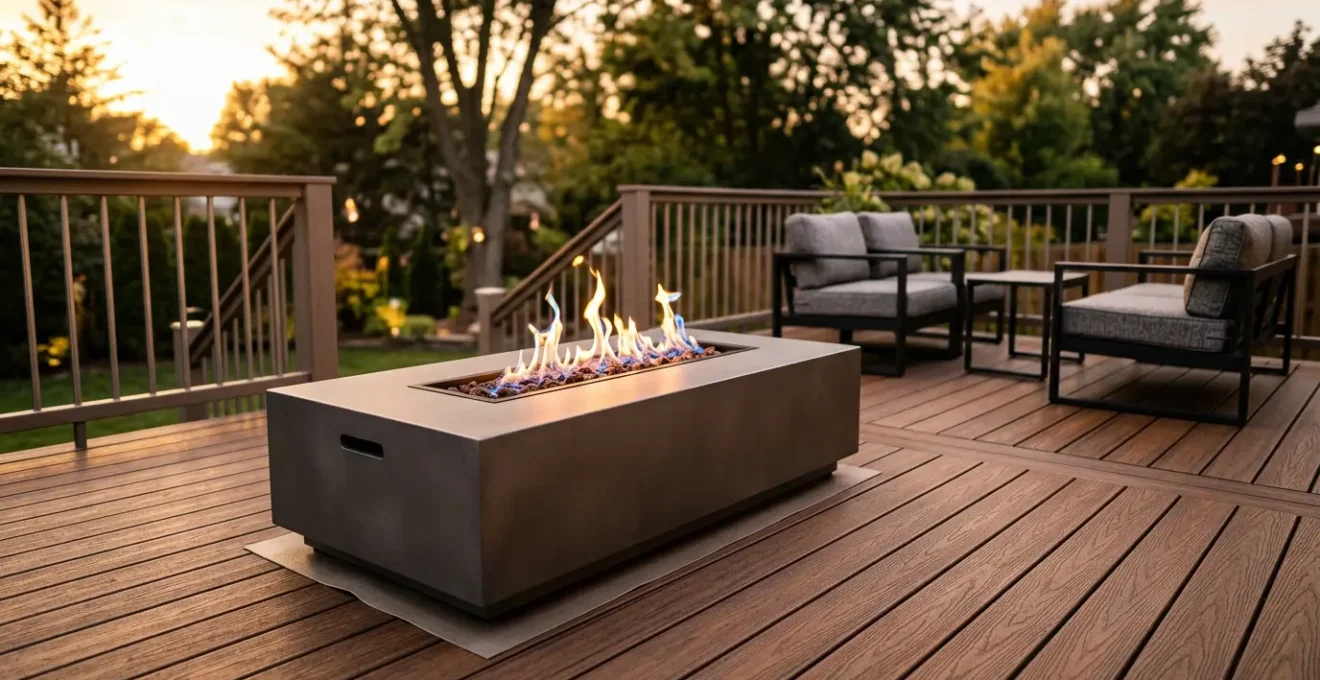
Operating a gas fire table on composite decking is not a casual act; it is a matter of strict regulatory compliance and understanding material science to prevent catastrophic failure.
- The primary risk is not open flame but prolonged, concentrated heat causing irreversible thermal deformation of the deck boards.
- A non-combustible heat barrier is mandatory, and clearance distances are dictated by the unit’s BTU output, not aesthetic preference.
Recommendation: Before installation, homeowners must verify the fire table’s BTU rating and acquire a correctly sized thermal barrier to ensure full compliance and mitigate property damage liability.
The allure of a gas fire table is undeniable, offering a central gathering point that extends the outdoor living season. However, for homeowners with composite decking, this popular amenity introduces a significant and often underestimated risk. The common assumption is that since there are no flying embers, the danger is minimal. This is a critical misunderstanding of the physics involved. The primary threat is not ignition from a stray spark but the slow, cumulative effect of radiant and conductive heat on the deck’s material integrity.
Standard guidance often stops at “use a heat shield,” but fails to explain the non-negotiable principles behind this directive. Composite materials, a blend of wood fibers and plastics like PVC or HDPE, are not designed to withstand sustained high temperatures. Without a proper thermal barrier, the consistent heat from the fire table’s base can cause the decking to soften, warp, and discolor, leading to permanent and costly damage. This guide moves beyond simple tips to provide a regulatory framework for safe operation, treating your outdoor space with the same rigor as any indoor installation. It is imperative to understand that safe use is a matter of compliance, not convenience.
This document outlines the mandatory considerations for placing a gas fire table on a composite deck. We will examine the relationship between BTU output and required clearances, proper fuel source management, essential maintenance protocols, and the specific thermal properties of different fire media. By adhering to these guidelines, homeowners can safely enjoy the ambiance of an outdoor fire feature without compromising the structural integrity of their investment.
Summary: A Comprehensive Safety Protocol for Deck Fire Tables
- How Many BTUs Do You Need to Actually Feel Warm on a Windy Night?
- Creative Ways to Conceal a Propane Tank for a Sleek Patio Look
- Why Your Fire Table Flame Is Uneven and How to Clear the Jets?
- Lava Rock vs. Fire Glass: Which Retains Heat Longer?
- Do You Need to Disconnect Your Fire Table in Freezing Temperatures?
- Can You Replace Just One Composite Board if It Melts From a BBQ?
- Fire Pit or Patio Heater: Which Is Better for Dining Warmth?
- How to Layer Ambient Lighting for Outdoor Dinner Parties?
How Many BTUs Do You Need to Actually Feel Warm on a Windy Night?
From a regulatory standpoint, the British Thermal Unit (BTU) rating of a fire table is less about comfort and more about its risk profile. A higher BTU output, while providing more warmth, radiates significantly more thermal energy, demanding stricter safety protocols. The question is not just how many BTUs are needed to feel warm, but how many can be safely managed on a heat-sensitive surface like a composite deck. For windy conditions, homeowners often seek higher outputs, but any unit exceeding 50,000 BTUs enters a higher-risk category that requires advanced precautions.
The core principle is managing the heat footprint. A mandatory thermal barrier or heat shield is the first line of defense, but clearance is the second. As a baseline, industry experts recommend a critical safety guideline of a 12-inch vertical gap for every 10,000 BTUs of output. This means a 40,000 BTU fire table requires a base that elevates the burner significantly or an exceptionally efficient heat shield to prevent heat from reaching the deck. It is also imperative to maintain a minimum of 3-5 feet of clearance from the sides of the fire table to any combustible materials, including the house structure, railings, and furniture.
The following table outlines general recommendations, but the manufacturer’s specifications for your specific fire table and decking material must always be the final authority.
| Space Size | Recommended BTU Range | Composite Deck Safety Consideration |
|---|---|---|
| Small to Medium (up to 300 sq ft) | 40,000 – 50,000 BTU | Standard clearance, use heat shield |
| Large Outdoor Space (300+ sq ft) | Up to 200,000 BTU | Requires professional installation, elevated base mandatory |
| Typical Gas Fire Table | 40,000 – 100,000 BTU | Most common range for residential deck use |
Creative Ways to Conceal a Propane Tank for a Sleek Patio Look
The concealment of a propane tank is not merely an aesthetic choice; it is a safety-critical installation that must adhere to strict ventilation and material requirements. A standard 20 lb propane tank is an essential component, but its utilitarian appearance often clashes with a curated patio design. However, any enclosure built to hide the tank must not obstruct airflow or trap gas in the event of a leak. Trapped propane is heavier than air and can accumulate, creating a severe explosion hazard.
Professionally designed concealment solutions are engineered with these risks in mind. They incorporate mandatory ventilation gaps near the base and use fire-resistant materials that will not contribute to a fire. Solutions range from simple, matching covers to multifunctional furniture. An integrated side table or planter box that houses the tank must include protected channels for the hose to prevent kinking or abrasion, which could lead to a gas leak. The illustration below shows a compliant design that blends function with safety.
As this image demonstrates, a well-designed enclosure becomes part of the deck’s architecture. Per a professional guide on elegant concealment solutions, materials like glass fiber reinforced concrete, powder-coated aluminum, or even specific composites are specified because they do not trap moisture against the deck or degrade under UV exposure. When selecting or building a tank enclosure, verification of proper ventilation and easy access for tank replacement are non-negotiable safety checks.
Why Your Fire Table Flame Is Uneven and How to Clear the Jets?
An uneven, sputtering, or excessively yellow flame is not a cosmetic flaw; it is a critical diagnostic signal of a potential malfunction or safety hazard. A properly functioning gas fire table should produce a consistent flame that is primarily blue at the base with yellow tips. Deviations from this pattern often indicate that the burner jets are partially or fully obstructed. Common culprits include dirt, debris, rainwater, or, most frequently, spider webs and insect nests built inside the burner orifices during periods of disuse. These blockages disrupt the proper mixture of gas and air, leading to incomplete combustion.
Incomplete combustion is dangerous as it can produce excessive soot and, more alarmingly, higher levels of carbon monoxide. Therefore, clearing the burner jets is a fundamental safety maintenance task, not an optional cleaning chore. The image below depicts the ideal flame pattern from a clean burner, which should be the target of any maintenance procedure.
Regular inspection and cleaning are mandatory for safe operation. Before each season of use, and periodically throughout, a full safety purge must be conducted. This involves more than just wiping down the exterior; it requires a systematic inspection of all components of the fuel delivery system.
Your Pre-Season Fire Table Safety Purge Checklist
- Deep Clean: Remove all fire media (lava rock or glass) to expose and inspect the burner surface for any signs of rust, deterioration, or debris buildup.
- Spider Web Inspection: Use a pipe cleaner or a small, flexible brush to meticulously clear all burner port holes and gas openings, removing any potential nests.
- Gas Connection Leak Test: After reassembly, apply a soapy water solution to all gas connections and the tank valve. The appearance of bubbles indicates a dangerous gas leak that must be rectified immediately.
- Hose Inspection: Visually and manually inspect the entire length of the propane hose for cuts, abrasions, or brittleness. Replace the hose if any damage is found.
- Burner Surface Cleaning: Clean the stainless steel burner components to remove any tarnish or residue, ensuring an unobstructed surface for proper flame distribution.
Lava Rock vs. Fire Glass: Which Retains Heat Longer?
The choice between lava rock and fire glass as a fire table medium extends beyond aesthetics; it has direct implications for heat management and safety, particularly on a composite deck. Both materials are designed to withstand high temperatures and help disperse the flame, but they have fundamentally different thermal properties. The key difference lies in their density and porosity, which dictates how they absorb, radiate, and retain heat.
Lava rock is a porous, natural material that is excellent at absorbing and radiating heat. It creates a rustic look and is generally more budget-friendly. Fire glass, on the other hand, is a tempered glass product manufactured to be highly durable and resistant to melting or discoloration. Its higher density allows it to retain heat efficiently. However, this superior heat retention can become a liability after the flame is extinguished. A bed of fire glass will remain dangerously hot for a longer period than lava rock, extending the risk of burns or heat damage to any items placed on it prematurely.
From a safety inspector’s perspective, the material that cools faster presents a lower residual risk. The following comparative analysis, based on a detailed breakdown of fire media characteristics, highlights these critical differences.
| Characteristic | Lava Rock | Fire Glass |
|---|---|---|
| Heat Retention | Excellent – retains and radiates heat 45-60 minutes after flame off | Lower retention – cools down more quickly after flame extinguished |
| Composite Deck Risk | Lower residual heat danger – shorter ‘danger zone’ time | Higher residual heat danger – extends risk period after use |
| Weight Impact | Heavy – can cause deck sagging over time with large installations | Lighter – less structural stress on deck boards |
| Maintenance | Requires periodic cleaning to remove ash buildup; porous structure can trap grease | Clean burning, no ash or soot; simple rinse maintains appearance |
| Durability | Can break down over time; may need replacement in 2-4 years | Highly durable; resistant to melting, burning, and discoloration; lasts years |
Do You Need to Disconnect Your Fire Table in Freezing Temperatures?
Winterization of a gas fire table is a critical safety procedure, not just a measure to protect the appliance’s finish. For units located on composite decks, failing to properly store the appliance during freezing weather can create hidden hazards that manifest in the spring. The primary concerns are moisture entrapment and the degradation of flexible components like hoses and seals.
When a fire table and its heat barrier are left on a composite deck through freeze-thaw cycles, moisture can become trapped between the barrier and the deck surface. This creates a perfect environment for mildew, staining, and discoloration of the deck boards. Furthermore, propane hoses and rubber seals left exposed to freezing temperatures can become brittle, leading to the formation of micro-cracks. These cracks may not be visible to the naked eye but can result in dangerous gas leaks upon the first use in warmer weather. Therefore, disconnecting and storing the unit and its components indoors is a mandatory step to preserve material integrity.
The most severe risk associated with any fire table is the heat it generates during operation. It is critical to remember that manufacturers warn that composite decking begins to deform at 200°F (93°C) and can melt near 300°F (149°C). Winterization procedures ensure that the equipment remains in perfect working order, preventing malfunctions that could lead to excessive heat output and deck damage. The procedure should include turning off the gas supply, disconnecting the propane cylinder, and storing both the appliance and its hoses in a dry, indoor location.
Can You Replace Just One Composite Board if It Melts From a BBQ?
While the question specifies a BBQ, the principle of damage and repair is directly applicable—and often more severe—for a gas fire table. The damage caused by a fire table is typically not a sudden scorch mark but a slow “baking” effect from prolonged, concentrated heat. This leads to warping, melting, and permanent distortion of the composite board. Technically, it is possible to replace a single damaged board. However, the process is far from simple and the result is rarely perfect.
Case Study: Atlanta Rooftop Deck Fire Table Damage
A stark example of this risk is documented in a case from an Atlanta homeowner, whose fire table was used on a rooftop composite deck without an adequate heat barrier. The enclosed base of the unit trapped and concentrated heat, which slowly baked the deck boards beneath it. The accumulated thermal stress resulted in severe melting and deformation, necessitating an emergency call to the fire department and the costly replacement of a large section of the deck. This incident highlights the unique thermal challenge fire tables present due to their capacity for prolonged, low-temperature cooking of the deck surface.
The primary challenge in replacing a single board is achieving an aesthetic match. Composite decking fades and weathers over time due to UV exposure and environmental factors. A new replacement board, straight from the factory, will have a richer, deeper color than the surrounding aged boards. This creates a conspicuous “patchwork” effect that permanently highlights the repaired area, as shown in the image below. Finding an exact color match for a deck that is several years old is often impossible.
Fire Pit or Patio Heater: Which Is Better for Dining Warmth?
When the objective is providing warmth for an outdoor dining area, a patio heater is functionally superior and presents a significantly lower risk profile than a gas fire table. The choice between these two appliances must be evaluated based on their method of heat delivery and their “heat footprint” on the deck surface. A gas fire table provides 360-degree radial heat, which is ideal for a lounge or conversational setting. However, for a dining table, this heat is often uneven, making one side of the table uncomfortably hot while leaving the other cold. More importantly, its heat is concentrated at and below the unit, posing a direct thermal threat to the composite deck.
A patio heater, particularly a “mushroom” or overhead style, provides top-down, directional heat. This is far more effective for warming a group of seated diners evenly. From a safety perspective, its key advantage is that it transfers minimal heat to the deck surface. The heating element is elevated, and any radiant heat is directed downwards and outwards, not concentrated at the base. While patio heaters have their own safety considerations, such as stability in wind and clearance from overhead combustibles, they do not present the same acute risk of melting or warping a composite deck.
The following table provides a clear comparison of the risk profiles and functional use cases for each appliance in a deck setting.
| Factor | Gas Fire Table | Patio Heater |
|---|---|---|
| Heat Footprint on Deck | Concentrated, high-risk footprint directly below unit | Diffuse, low-risk footprint with minimal downward heat |
| Heat Direction | 360-degree radial heat – upward and outward | Top-down directional heat from overhead element |
| Composite Deck Risk | Requires mandatory heat barrier and clearance | Lower heat transfer to deck surface |
| Wind Stability | Low center of gravity – stable in wind | Higher tipping risk in wind conditions |
| Dining Table Use | Can make one side too hot; uneven warmth for diners | Excellent for dining – even overhead warmth |
| Social/Lounge Use | Perfect for circle seating; visual focal point | Poor for lounge circles; no visual center |
Key Takeaways
- A non-combustible thermal barrier between the fire table and composite deck is a non-negotiable, mandatory safety device.
- The unit’s BTU rating directly dictates the required clearance distances to all combustible surfaces, including walls and railings.
- Regular inspection and cleaning of the burner, jets, and hoses are critical safety functions to prevent gas leaks and malfunctions.
How to Layer Ambient Lighting for Outdoor Dinner Parties?
When a gas fire table is the centerpiece of an outdoor space, the ambient lighting plan must be designed as a complementary safety system, not just a decorative element. A brightly burning fire creates high-contrast areas of light and deep shadow, which can obscure trip hazards like steps, furniture legs, and changes in deck level. An effective lighting strategy uses layers to balance the powerful glow of the fire, ensuring the entire usable area is safe and navigable.
The fire table itself serves as the primary “anchor” layer of light. The goal is to supplement this dynamic, warm glow without overwhelming it. The second layer should be for ambiance and general illumination, using low-voltage string lights, wall-mounted sconces, or lanterns with a warm color temperature (2700K-3000K) to match the firelight. These should be dimmable to allow for adjustments as the evening progresses.
The most critical layer is dedicated to safety. This involves installing low-profile, glare-free fixtures to specifically illuminate potential hazards. In-deck step lights, path lights along walkways, and subtle under-railing lights are essential for marking edges and pathways. It is also a sound practice to use subtle lighting to visually demarcate the 3-foot “caution zone” around the fire table, reminding guests to maintain a safe distance. Finally, a well-lit path from the house to the fire table area is mandatory for safe transit, especially when carrying food or drinks. The entire system should be planned to prevent the “black hole” effect, where the area just beyond the fire’s glow is plunged into complete darkness.
To ensure full compliance and safety, homeowners should conduct a comprehensive audit of their outdoor space, referencing the specific manufacturer guidelines for both their fire table and their composite decking. This due diligence is the final step in responsible ownership.