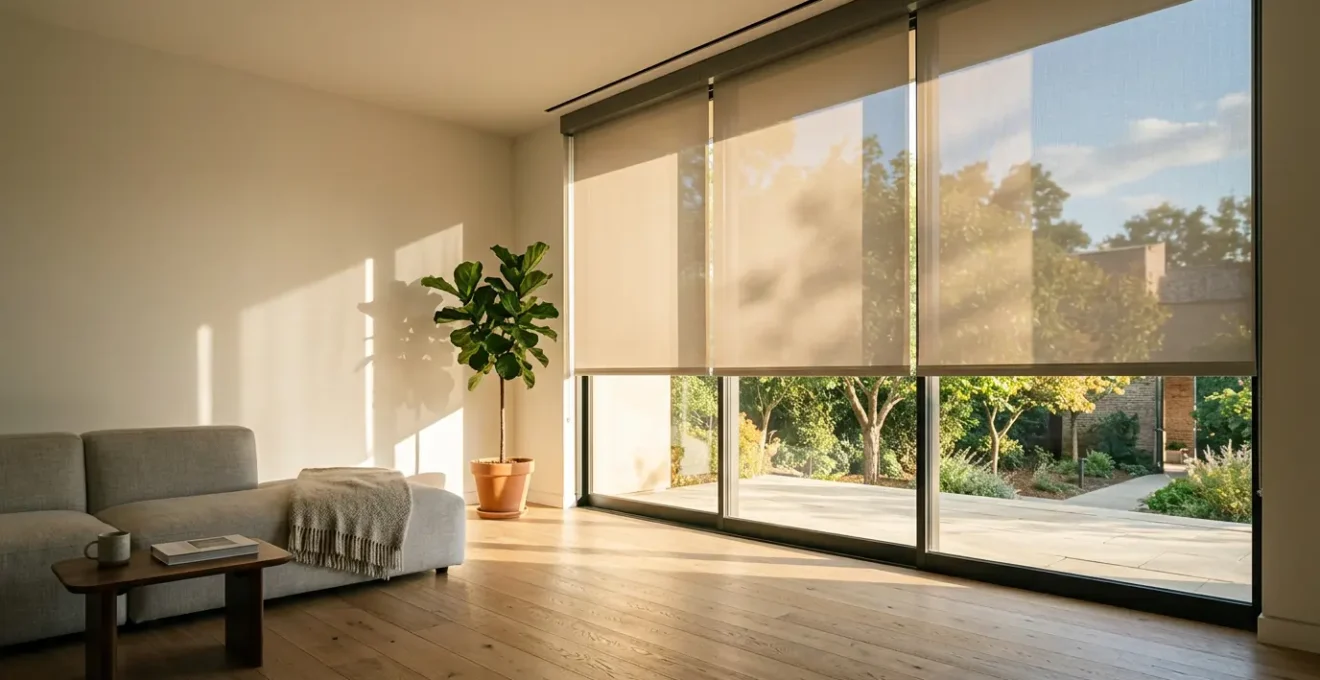
Motorized shades reduce cooling costs not just by blocking light, but by acting as a dynamic thermal barrier that actively manages Solar Heat Gain Coefficient (SHGC).
- Strategic automation based on sun-path and sensors can cut solar heat gain through windows by up to 77%.
- Choosing the correct fabric opacity (e.g., 1-3%) for sun-facing windows is more critical than color for blocking thermal energy.
Recommendation: Focus on programming shades to counteract peak sun exposure on west and south-facing windows between 2-4 PM to achieve the most significant impact on your AC load.
For homeowners with large, beautiful windows, the summer sun is a double-edged sword. It floods rooms with natural light but also relentlessly drives up indoor temperatures, turning your air conditioning system into a loud, expensive, and constantly running utility. Many people try to solve this with standard blinds or curtains, a static solution for a dynamic problem. You might even consider window films or exterior awnings, but these often compromise your view or exterior aesthetic permanently.
The common advice focuses on simply blocking the sun, but this overlooks the core thermal dynamics at play. The real challenge isn’t just visible light; it’s the invisible infrared radiation that heats every surface it touches. In cooling seasons, a study reveals that approximately 76% of sunlight that falls on standard double-pane windows enters to become heat, putting an immense load on your HVAC system. The key isn’t just to cover the window, but to manage this energy transfer with precision.
But what if the true solution was to transform your windows from a thermal liability into a high-performance, passive cooling asset? This is where motorized shades move beyond convenience and become an essential part of your home’s thermal envelope. By focusing on automated control of a key metric—the Solar Heat Gain Coefficient (SHGC)—you can create a dynamic barrier that responds to the sun’s position throughout the day. This is not about just creating shade; it’s about deploying an intelligent system designed for thermal efficiency.
This guide will deconstruct how a properly specified and programmed motorized shade system can realistically lower your summer AC bill by 15% or more. We will explore the critical decisions from power sources and programming logic to the science behind fabric opacity, giving you the framework to implement a system that pays for itself in energy savings.
This article delves into the essential components of creating an efficient automated shade system. Follow along as we break down the technical choices and programming strategies that deliver real thermal performance.
Summary: How Motorized Shades Can Lower Your AC Bill by 15% in Summer?
- Hardwired vs. Battery: Is It Worth Opening Walls for Power Shades?
- How to Program Shades to Close Automatically at Sunset for Privacy?
- The Convenience of “Movie Mode”: Closing Blackout Blinds With a Voice Command
- 1%, 3%, or 5%: Which Solar Shade Opacity Preserves the View?
- Do Motorized Shades Make Too Much Noise for a Nursery?
- Why Dark Decking Colors Are a Mistake in Southern Climates
- Shutters or Sheers: Which Window Treatment Defines Hamptons Style?
- Can Human-Centric LEDs Actually Improve Your Sleep Quality?
Hardwired vs. Battery: Is It Worth Opening Walls for Power Shades?
The first fundamental decision in any motorized shade project is the power source. This choice dictates not only installation complexity but also long-term performance, reliability, and cost. While battery-powered shades offer an attractive, low-impact entry point, a hardwired solution provides a robust foundation for a true whole-home thermal management system. The primary trade-off is between upfront investment and ongoing maintenance and performance limitations.
Battery-powered shades are ideal for retrofits or in homes where opening walls is not feasible. Their main advantage is simple, DIY-friendly installation without the need for an electrician. However, this convenience comes with recurring costs and responsibilities. Batteries require replacement every 1-2 years, and the motors themselves often have a shorter lifespan. Furthermore, battery power can be insufficient for very large or heavy shades, potentially leading to slower or inconsistent operation, especially when multiple shades are commanded to move in unison.
Conversely, hardwired shades draw consistent power from your home’s electrical system. While this requires a professional electrician to run low-voltage wires, the benefits are significant. Hardwired motors deliver maximum torque for lifting the largest window treatments, ensure perfect synchronization across groups of shades, and eliminate the hassle of battery replacements. From a longevity standpoint, this approach is far superior; an industry analysis notes that properly installed hardwired motors have an average lifespan of 10-15 years. While the initial cost is higher, the near-zero ongoing maintenance and superior performance make it the definitive choice for new construction or homeowners committed to a comprehensive passive cooling strategy.
To fully understand the financial implications, a 10-year cost analysis provides a clear picture of the total investment for each option.
| Factor | Battery-Powered Shades | Hardwired Shades |
|---|---|---|
| Initial Cost (per shade) | Lower – No electrician fees | Higher – Add $100-$200 per shade for electrician |
| Installation Complexity | Simple DIY, 30-60 min per window | Professional required, wiring through walls |
| Battery Replacement | Every 1-2 years, motor replacement 3-5 years | None – draws from home power |
| Annual Operating Cost | $20-40 for battery replacements | Less than $10 electricity annually for entire home |
| Power & Performance | Limited for large/heavy shades | Maximum lift capacity, consistent torque |
| Group Synchronization | Potential delays or staggered movement | Instantaneous, perfectly synchronized |
| 10-Year Total Cost | Lower upfront + $200-400 maintenance | Higher upfront, minimal ongoing cost |
| Best For | Renters, retrofits, small-medium windows | New construction, large windows, whole-home automation |
For a system designed to actively manage thermal gain, the reliability and instantaneous response of a hardwired system provide a clear performance advantage that aligns with the goal of maximizing energy efficiency.
How to Program Shades to Close Automatically at Sunset for Privacy?
Once your shades are powered, the next step is to program their “brain.” Effective automation is not about simple timers; it’s about creating layered rules that respond intelligently to your location, the seasons, and real-time conditions. The goal is a set-and-forget system that maximizes both privacy and energy efficiency without requiring daily manual input. The core of this intelligence is the astronomical clock feature available in most smart shade systems.
Unlike a standard timer that closes shades at the same time every day, an astronomical clock dynamically adjusts its schedule based on your home’s precise geographic location. It automatically calculates the exact time of sunrise and sunset each day of the year. This allows you to create a rule like “close all shades 15 minutes after sunset,” ensuring perfect privacy year-round without ever needing to adjust a schedule. This feature alone transforms the system from a novelty into a reliable part of your daily routine.
However, truly advanced programming goes further by layering additional rules. For instance, you can combine the astronomical clock with sensor-based triggers. A sun sensor can be programmed to override the schedule and close west-facing shades in the afternoon if it detects intense sunlight, proactively preventing heat buildup. Similarly, an indoor temperature sensor can trigger shades to close if the room exceeds a certain threshold, like 75°F (24°C), providing another layer of thermal defense. This multi-layered approach ensures your home is always optimized for comfort and efficiency, reacting to actual conditions, not just a pre-set time.
This concept of layered automation is key to unlocking the full potential of your system, turning it into a proactive manager of your home’s environment.
As the visual suggests, the most effective systems blend time-based rules with sensor-driven responses, creating a web of logic that anticipates and reacts to changing conditions. The following checklist outlines how to implement this expert-level programming.
Action Plan: Layering Time-Based and Sensor-Based Rules
- Set up the Astronomical Clock feature: Configure your system to adjust daily based on precise sunset/sunrise times for your location, with customizable offsets (e.g., ‘close 20 minutes before sunset’).
- Create seasonal paradox rules: Program East-facing shades to open at sunrise in winter for free solar heat, but close at sunset for insulation and privacy.
- Layer sensor-based overrides: Combine sunset rules with temperature sensors (e.g., close when indoor temp exceeds 75°F) or sun sensors to manage high-intensity sunlight proactively.
- Implement Natural Light Optimization: Use location data to adjust shades throughout the day, minimizing glare while maintaining optimal ambient light.
- Set up weekday vs. weekend schedules: Configure different automation patterns based on your family’s routine, allowing the system to adapt to occupancy automatically.
Ultimately, a well-programmed system should feel invisible, seamlessly enhancing your privacy and comfort while silently working to reduce your energy consumption.
The Convenience of “Movie Mode”: Closing Blackout Blinds With a Voice Command
While the primary driver for investing in motorized shades is thermal efficiency, their integration into a smart home ecosystem unlocks a new level of convenience. Voice-activated “scenes” like “Movie Mode” are a popular example, but their true power lies in stacking multiple commands to amplify energy savings. A single voice command can initiate a sequence of events across different systems, creating a home that responds holistically to your needs.
A “Movie Mode” scene, for example, does more than just close the blackout shades. A properly configured command given to a voice assistant like Alexa or Google Assistant can simultaneously dim the lights to 10%, lower the shades, and even adjust the thermostat slightly to account for the heat generated by the projector or television. This creates an immersive experience with one simple phrase, eliminating the need to juggle multiple remotes or apps. It demonstrates how shades become a key player in your home’s overall smart environment.
The real efficiency gains, however, come from applying this scene-based logic to thermal management. You can create an “AC Saver” or “Peak Sun” mode. A command like, “Hey Google, it’s hot,” can be programmed to automatically lower shades on all sun-facing (south and west) facades, turn on ceiling fans to increase air circulation, and adjust the thermostat up by a degree or two. This multi-system coordination has a compounding effect on energy reduction. The shades reduce the incoming solar load, the fans create a cooling effect that allows for a higher thermostat setpoint, and the thermostat works less hard. This integrated approach is where significant savings are realized.
Case Study: Multi-Device Scene Integration
A real-world implementation demonstrates the power of ‘stacked’ voice commands where a single command like ‘Activate Summer Afternoon’ simultaneously lowers shades on sun-facing facades, adjusts the smart thermostat up by 2 degrees, and activates ceiling fans. This multi-system coordination can multiply efficiency gains beyond shades alone, with one homeowner reporting a 3-year payback period on the system, thanks to an HVAC reduction of 20-30% achieved through this scheduled, integrated operation.
By thinking of shades not as standalone products but as integral components of a larger smart home strategy, their value extends far beyond simple automation, becoming a cornerstone of both comfort and energy management.
1%, 3%, or 5%: Which Solar Shade Opacity Preserves the View?
Perhaps the most critical specification for a solar shade’s thermal performance is its openness factor, or opacity. Expressed as a percentage (typically 1%, 3%, 5%, or 10%), this number indicates how much light is allowed to pass through the fabric’s weave. While it directly impacts the clarity of your view, its most important function is determining the shade’s Solar Heat Gain Coefficient (SHGC)—the measure of how much solar radiation it blocks. A lower openness factor means a tighter weave, less visibility, and, most importantly, a lower SHGC and better heat rejection.
Choosing the right opacity is a balancing act between preserving your view and maximizing thermal performance. A 10% openness shade will offer an almost unobstructed view but will do very little to block heat. Conversely, a 1% openness shade provides maximum heat rejection but significantly reduces outward visibility, rendering the view blurry and indistinct. For most applications, the sweet spot lies in the 3% to 5% range, but the optimal choice depends entirely on the window’s orientation.
For intense, direct sun exposure on west-facing windows, a 1% or 3% openness factor is essential to achieve significant AC savings. This is where the most aggressive heat blocking is needed. Government data on window treatments confirms the massive impact of shading on these facades; a simple exterior awning, for example, can reduce solar heat gain by up to 65% on south-facing windows and 77% on west-facing windows. A 1% solar shade aims to replicate this effect from the interior. For south-facing windows, a 3% shade often provides the best balance of heat control and view preservation. For north or east-facing windows, where solar heat gain is less of a concern, a 5% or even 10% shade can be used to control glare while maintaining the view.
This performance matrix breaks down the trade-offs between opacity, SHGC, and view quality, helping you specify the right fabric for each window in your home.
| Shade Opacity | SHGC Range (est.) | View Quality | Glare Control | Heat Management | Best Window Orientation |
|---|---|---|---|---|---|
| 1% Openness | 0.10-0.15 | Minimal – Significantly reduced visibility | Excellent – Blocks 85-90% of light | Maximum – Blocks up to 77% solar heat gain on west windows | West-facing (hot climates) – Essential for 15% AC savings |
| 3% Openness | 0.20-0.30 | Moderate – Good visibility with some view detail | Very Good – Reduces glare while maintaining view | High – Blocks 65-70% of solar heat gain | South & West-facing – Optimal balance for most climates |
| 5% Openness | 0.35-0.45 | Excellent – Clear outward visibility preserved | Good – Diffuses harsh light without darkening room | Moderate – Allows more natural light, less heat rejection | North & East-facing – Where heat gain is less critical |
| 10% Openness | 0.50-0.60 | Maximum – Nearly unobstructed view | Fair – Minimal glare reduction | Limited – Better for winter passive solar gain | North-facing – Perfect for maintaining view with minimal heat concern |
Ultimately, specifying shades on a window-by-window basis according to sun exposure, rather than a one-size-fits-all approach, is the professional strategy that unlocks real, measurable energy reduction.
Do Motorized Shades Make Too Much Noise for a Nursery?
A common concern for homeowners, particularly parents, is the operational noise of motorized shades. The fear of a loud motor waking a sleeping baby is a valid one, but it’s largely based on outdated technology. Modern, high-quality motorized shades are engineered for near-silent operation, making them perfectly suitable for noise-sensitive environments like nurseries, bedrooms, and home offices.
The noise level of a motor is measured in decibels (dB). For context, a quiet library is about 40 dB, and a human whisper is around 30 dB. The industry’s leading “ultra-quiet” motors are designed to operate well below this threshold. According to performance data, the quietest smart shades operate at below 35 decibels, a sound level that is virtually imperceptible in a normal room. This is achieved through advanced motor technology, often including features like ‘soft start and stop’, which eliminates the abrupt ‘click’ sound as the motor begins or ends its travel.
As industry experts from Insolroll note, the technology has evolved dramatically:
Today’s quiet shade motors are significantly quieter than shade motors of the past. You used to have to trade convenience for noise, but increases in technology have made motorized shades extremely quiet.
– Insolroll, Insolroll Quiet and Ultra Quiet Shade Motorization Technical Guide
Beyond specifying a quiet motor, programming can further enhance the experience in a nursery. A ‘Nap Time’ scene can be programmed for a slow, gentle movement that won’t startle a child. Even more beneficial is a ‘Gentle Wake-Up’ routine, where the shades open gradually over 5-10 minutes in the morning. This simulates a natural sunrise, which can help regulate a child’s circadian rhythm for healthier sleep patterns, all without making a disruptive sound. The ability to control the shades remotely via an app also means a parent can make adjustments without entering the room and risking waking the baby.
By choosing a premium quiet motor and leveraging smart programming, motorized shades can become a silent, beneficial addition to a child’s room, enhancing both sleep quality and comfort.
Why Dark Decking Colors Are a Mistake in Southern Climates
Anyone living in a southern climate understands the simple physics of a dark surface on a sunny day. A dark-colored deck or asphalt driveway can become scorchingly hot to the touch because it absorbs a huge amount of solar energy. This is a perfect real-world analogy for understanding the heat gain that happens through your windows. Your windows, especially large, unprotected ones, act like dark surfaces, absorbing solar radiation and transferring it into your home as heat. The key to passive cooling is to stop this absorption before it happens.
This principle of solar absorption is why dark decking is a design mistake in hot climates—it creates a massive thermal mass that radiates heat long after the sun has gone down. Your windows do the same thing. Unprotected glass allows infrared energy to pass through and be absorbed by your floors, furniture, and interior walls. These surfaces then heat up and radiate that energy back into the room, forcing your AC to work overtime. The goal of an effective shade is to serve as the first line of defense, rejecting that solar energy before it can be absorbed by the surfaces inside your home.
This is where an exterior shading strategy, like an awning, and an interior strategy, like motorized shades, can work in concert. A case study on multi-layered passive cooling shows how this combination creates a powerful thermal barrier.
Case Study: Multi-Layered Passive Cooling
A comprehensive approach to passive cooling demonstrates how combining exterior and interior window treatments creates a multi-layered defense. Exterior window awnings, like shading a “deck,” can reduce solar heat gain by up to 77% on west-facing windows. When paired with interior motorized cellular shades that can reduce solar heat gain by up to 60%, homeowners create a synergistic system. This dual approach—shading exterior surfaces and adding a high-performance interior barrier—dramatically reduces the heat load on the windows, making the promised 15% AC bill reduction highly achievable.
By treating your windows with the same thermal respect you would an exterior surface, you can begin to implement strategies that have a meaningful and measurable impact on your home’s cooling load.
Shutters or Sheers: Which Window Treatment Defines Hamptons Style?
From a design perspective, the “Hamptons style” often evokes images of classic plantation shutters or light, airy sheer curtains. While both contribute to this coveted aesthetic, their thermal performance characteristics are vastly different. As a passive solar consultant, the question isn’t just about style; it’s about which option functions as a better component of the home’s thermal envelope. When motorized for convenience and automation, the performance gap widens significantly.
Motorized plantation shutters offer a timeless, architectural look. When their louvers are closed, they provide a moderate level of insulation and light control. However, they are not primarily designed for thermal efficiency. Their construction inherently has gaps that allow for air and heat transfer. While better than an uncovered window, they cannot compete with materials specifically engineered for insulation.
On the other hand, the modern interpretation of Hamptons style often involves layering—pairing decorative sheer curtains with a high-performance, motorized cellular (or honeycomb) shade. This is where style meets science. Cellular shades are the top performers in terms of insulation. Their unique honeycomb-shaped pockets trap air, creating a significant barrier to heat transfer. In winter, this means less heat loss; data from the Department of Energy shows that in heating seasons, tightly installed cellular shades can achieve a 40% reduction in heat loss, translating to about 10% in heating energy savings. In summer, they work in reverse, preventing heat from entering. A motorized cellular shade, especially one with a solar-reflective exterior fabric, can reduce unwanted solar heat gain by up to 60%.
This table compares the two options purely on their thermal performance metrics, demonstrating why layered cellular shades are the superior choice for an efficiency-focused home.
| Performance Metric | Motorized Plantation Shutters | Motorized Cellular (Honeycomb) Shades |
|---|---|---|
| R-Value (Insulation) | Moderate – Depends on louver closure | Highest – R-value of all window coverings |
| Heat Loss Reduction (Winter) | 15-25% with closed louvers | Up to 40% when tightly installed |
| Solar Heat Gain Reduction | Moderate – Partial light filtering | Up to 60% with appropriate fabric |
| SHGC (Solar Heat Gain Coefficient) | Variable with louver angle | Can achieve 0.15-0.30 with solar fabrics |
| Hamptons Aesthetic | Classic, architectural, timeless | Modern when paired with decorative sheers |
| Heating Energy Savings | Moderate | Approximately 10% annually |
| Layering Capability | Limited | Excellent – Ideal for dual-shade systems |
| Best Use Case | Style-first, moderate efficiency | Maximum energy efficiency with Hamptons layering |
By layering a high-performance cellular shade behind a decorative sheer, homeowners can achieve the desired Hamptons aesthetic without compromising on the critical goal of thermal management.
Key Takeaways
- Motorized shades function as a dynamic thermal barrier, not just a window covering, actively managing solar heat gain.
- The key to performance is smart automation using astronomical clocks and sensors, combined with the correct fabric opacity (SHGC) for each window’s orientation.
- Modern quiet motors and integrated smart home “scenes” make the system a seamless and powerful tool for both comfort and significant energy savings.
Can Human-Centric LEDs Actually Improve Your Sleep Quality?
The conversation around home wellness has recently focused on human-centric lighting (HCL), where LED lights shift their color temperature throughout the day to support our natural circadian rhythm. While this is a powerful concept, it often overlooks the most influential light source of all: the sun. A truly effective wellness design strategy integrates automated shade control as the primary driver of human-centric lighting, with LEDs acting as a supplement, not the primary tool.
As the design firm Eheart Interior Solutions notes in their analysis of modern home trends, there’s a major shift toward this integrated approach:
One of the biggest shifts we’ve seen at Eheart is the move toward Wellness Design. Motorized shades allow you to align your home with your natural circadian rhythm.
– Eheart Interior Solutions, Are Motorized Shades Worth It in 2026? Cost vs. ROI Guide
This alignment is achieved by programming shades to manage natural light exposure in a way that mimics our ancestral environment. This means programming bedroom shades to open slowly in the morning, providing a gentle, natural wake-up signal that is far more powerful than any artificial light. During the day, the automation manages glare and optimizes ambient light levels to boost focus and productivity. In the evening, the shades close to signal to our bodies that it’s time to wind down, protecting our internal clocks from disruptive artificial light from outdoors.
Case Study: Wellness Design Integration
A cutting-edge “bio-hacking” home environment was created by integrating motorized shades with human-centric LEDs. The system coordinates natural light management via shades with the shifting color temperature of artificial lights. This design is built on the principle that “sunlight is the original human-centric light,” recognizing that the intensity and full spectrum of natural light has a far greater impact on circadian rhythm than LEDs alone. The system’s ‘gentle wake-up’ scene, which slowly raises bedroom shades with the sun, has been shown to improve sleep patterns and daytime alertness, demonstrating that passive efficiency extends to user well-being beyond just energy savings.
By prioritizing the management of natural sunlight, motorized shades become the most powerful human-centric lighting device in your home, delivering benefits that extend from your energy bill all the way to your sleep quality.