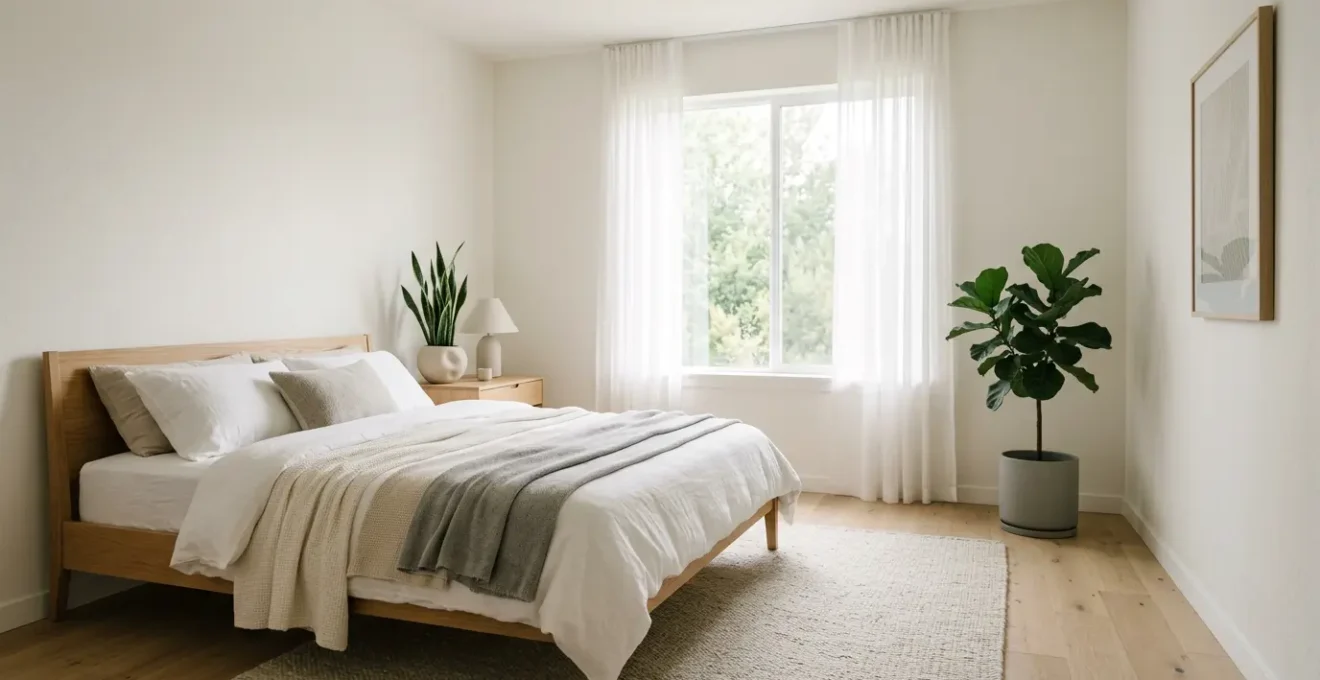
A Scandinavian bedroom’s power to improve sleep isn’t about aesthetics; it’s a science-backed strategy to reduce sensory input and lower cortisol.
- Minimalist design directly reduces the cognitive load and decision fatigue that disrupt rest.
- Warm, automated lighting syncs your body’s natural circadian rhythm, signaling it’s time for sleep.
Recommendation: Start by auditing your nightstand—removing just one non-essential item tonight can be the first step toward a more restorative space.
For many stressed professionals, the bedroom is no longer a sanctuary. It’s an extension of the office, a place where the day’s cognitive load follows you, and a racing mind keeps sleep at bay. You’ve likely heard the standard advice: get a better mattress, try blackout curtains, or use a white noise machine. While helpful, these suggestions often treat the symptoms rather than the root cause—an environment that is not psychologically conducive to rest.
But what if the design of your room itself could be your most powerful tool for better sleep? What if the key wasn’t adding more things, but intentionally removing them? This is the core principle of a true Scandinavian-inspired bedroom. It moves beyond a simple aesthetic of neutral colors and minimalist furniture to become a practice in wellness design. It’s about consciously crafting a low-stimulation sensory environment that actively signals to your nervous system that it is safe to power down.
The true magic lies in understanding the science behind the style. This guide will walk you through the core pillars of a sleep-promoting Scandinavian bedroom, explaining not just what to do, but *why* it works. We will explore how to harness the power of light to regulate your internal clock, how to eliminate the hidden psychological stress of clutter, and how to use texture and nature to create a space that doesn’t just look calm, but genuinely feels calm.
This article provides a detailed roadmap for transforming your bedroom into a genuine sanctuary. Explore the sections below to understand the science and practical steps behind each element of this restorative design philosophy.
Contents: A Guide to Your Sleep Sanctuary
- Cool White vs. Warm White: Which Suits North-Facing Rooms?
- The ‘Just in Case’ Items You Should Remove From Your Nightstand Now
- How to Layer Bedding for Warmth Without Looking Cluttered?
- Why Mixing Too Many Wood Tones Ruins the Scandinavian Vibe
- What Are the Best Low-Light Plants for a Minimalist Aesthetic?
- How to Automate Color Temperature to mimic the Sun From Dawn to Dusk?
- Can Vertical Gardens Support Local Wildlife?
- How to Add Warmth to a Sterile Room Using Only Texture?
Cool White vs. Warm White: Which Suits North-Facing Rooms?
The choice between cool and warm white paint is far more than an aesthetic decision; it’s a critical tool for regulating your body’s sleep-wake cycle, or circadian rhythm. Cool, blue-toned whites (often above 4000K in lighting terms) mimic the bright, energizing light of midday. While this can feel crisp and clean, exposing your brain to this type of light in the evening can actively suppress the production of melatonin, the hormone that tells your body it’s time to sleep. In fact, research published in Scientific Reports demonstrates a significantly greater melatonin decline when exposed to blue-enriched light compared to warm light.
For any bedroom, but especially a north-facing room that receives cooler, indirect natural light, the answer is unequivocal: opt for a warm white. Look for paints with soft, yellow, or pink undertones. These shades create a gentle, cocooning effect that feels psychologically comforting. They don’t fight the room’s natural light but rather enhance it, making the space feel inviting and cozy instead of stark and clinical.
Think of your bedroom lighting and wall color as a cohesive system designed to support rest. During the day, you can open the blinds to get natural light, but as evening approaches, your environment should transition to warmer tones. A warm white on the walls provides the perfect backdrop for soft, ambient lighting from lamps with bulbs rated at 2700K or lower. This strategy creates a visual signal for your brain to begin unwinding from the day’s stimulation and prepare for deep, restorative sleep.
The ‘Just in Case’ Items You Should Remove From Your Nightstand Now
Your nightstand is not a storage unit; it is the last landscape your brain processes before you close your eyes. A cluttered nightstand, filled with “just in case” items, sends a constant, low-level signal of unresolved tasks and potential problems. That pile of books you mean to read, the charging cables, the laptop, and even allergy medication all contribute to a higher cognitive load. Your brain subconsciously registers them as things to do, remember, or worry about, making it significantly harder to transition into a restful state.
This isn’t just a feeling; it’s backed by science. Environments of high visual complexity keep our minds on alert. In fact, research presented at the Sleep conference showed that regular de-cluttering habits were a predictor of increased sleep quality and fewer sleep-related problems. The act of removing these items is an act of intentional reduction, telling your brain that there is nothing left to do but rest. The goal is to achieve a state of visual silence.
As this image demonstrates, a truly restorative nightstand contains only the absolute essentials for sleep and waking. This could be a small glass of water, a gentle alarm clock (non-digital if possible), and perhaps a single, calming object like a small plant. Everything else—your phone, work documents, and unsorted mail—belongs elsewhere. This practice of clearing your sleep surface is a powerful nightly ritual that sets the stage for a calm mind and deeper sleep.
Your 5-Step Audit: Clearing Your Nightstand for Pure Rest
- Itemize Everything: Make a physical list of every single item currently on or in your nightstand.
- Categorize by Function: Group items into categories: Technology (phone, chargers), To-Do (books, mail), Health (‘just-in-case’ pills), and Decor.
- Apply the Sleep Test: For each item, ask: “Does this object directly contribute to my calm or the act of sleeping?” Be brutally honest.
- Assess Emotional Impact: Identify items that are sources of stress (like a work phone) versus items that bring peace (like a cherished photo). The former must go.
- Execute the Relocation Plan: Physically move every non-essential item to a designated home far from your bedside. The goal is an almost empty surface.
How to Layer Bedding for Warmth Without Looking Cluttered?
The essence of Scandinavian bedding is achieving tactile warmth and comfort without creating visual clutter. The secret is not in the number of layers, but in the quality and texture of the materials. A visually “loud” bed with too many mismatched pillows and throws can be as mentally stimulating as a messy room. The goal is a calm, inviting nest that regulates your temperature effectively throughout the night.
Start with a base of high-quality, breathable natural fibers. Linen and organic cotton are ideal for sheets and duvet covers. Linen, in particular, has a beautiful, slightly rumpled texture that adds visual softness without looking messy. It’s also highly breathable and moisture-wicking, which is crucial for thermoregulation. The color palette should remain simple and cohesive—shades of white, soft grey, oat, or other muted earth tones work best.
The layering itself should be intentional. Follow the “Rule of Three” for a balanced look:
- The Foundation: Your fitted and top sheets.
- The Main Layer: A duvet in a simple, high-quality cover. This provides the primary warmth.
- The Textural Accent: A single, beautifully crafted throw or quilt folded neatly at the foot of the bed. This is where you introduce a contrasting texture, such as a chunky wool knit or a classic waffle weave cotton.
This minimalist approach ensures you have the necessary layers for warmth and comfort while maintaining a serene, uncluttered aesthetic. The focus is on the sensory experience of the materials—the softness of the cotton, the weight of the wool—rather than a riot of patterns and colors.
Why Mixing Too Many Wood Tones Ruins the Scandinavian Vibe
Wood is the heart of Scandinavian design, bringing natural warmth and texture into a minimalist space. However, this warmth can quickly turn into visual chaos when too many different wood tones are used in a single room. A floor of dark walnut, a bed frame of light pine, a nightstand in medium oak, and a cherry wood dresser create a disjointed and busy environment. This visual discord increases cognitive load, subtly undermining the sense of peace you are trying to cultivate.
Our brains are hardwired to seek patterns and order. When confronted with a jumble of competing colors and grains, the mind has to work harder to process the environment. This constant, low-level effort can lead to a state of heightened alertness and even stress. A study from Princeton University found that cluttered environments can increase cortisol levels, the body’s primary stress hormone. While “clutter” often refers to objects, a chaotic mix of finishes and materials has a similar effect on our subconscious.
To maintain a serene Scandinavian feel, the key is to create a dominant wood story. Ideally, choose one primary wood tone for the largest elements in the room, such as the flooring and the main piece of furniture (like the bed frame or a large dresser). You can then introduce one, at most two, accent woods. To ensure harmony, select woods that share a similar undertone. For example:
- Warm Tones: Pair light oak with white-washed ash or maple.
- Cool Tones: Pair grey-toned woods with darker, almost-black finishes.
This curated approach ensures that the natural beauty of the wood adds to the room’s tranquility instead of detracting from it. The result is a space that feels cohesive, intentional, and profoundly restful.
What Are the Best Low-Light Plants for a Minimalist Aesthetic?
Bringing plants into the bedroom is a cornerstone of biophilic design—the practice of connecting with nature indoors to improve well-being. For a stressed professional, the benefits are tangible. Plants are not just decorative; they are active agents of calm. A 2025 study published in Frontiers demonstrated that biophilic interventions, including the presence of indoor plants, have beneficial effects in reducing psychological and physiological stress levels. They can improve air quality, add a touch of humidity, and provide a non-stimulating focal point for a tired mind.
However, in a minimalist Scandinavian bedroom, the choice of plant is crucial. The goal is to add life without adding clutter. This means selecting plants with strong, simple, and sculptural forms that act as living art. They should also be low-maintenance and thrive in the lower-light conditions typical of a bedroom. A fussy, demanding plant can easily become another source of stress.
The best choices are plants that make a statement through their form and resilience. Here are a few top contenders that fit both the low-light and minimalist criteria:
- Snake Plant (Sansevieria): With its strong, vertical leaves, the Snake Plant is the epitome of architectural greenery. It’s an air-purifying powerhouse that is famously tolerant of neglect and low light.
- ZZ Plant (Zamioculcas zamiifolia): Known for its waxy, dark green leaves and modern structure, the ZZ Plant is nearly indestructible and thrives in low-light corners.
- Pothos (Epipremnum aureum): Highly adaptable, a Pothos can be trained to climb or allowed to trail elegantly from a simple shelf, adding a soft, organic line to the room.
- Fiddle Leaf Fig (Ficus lyrata): For a larger statement, a single-stem Fiddle Leaf Fig in a simple ceramic pot offers a dramatic, sculptural presence without overwhelming the space.
Pair these plants with simple, neutral-colored pots in materials like matte ceramic, concrete, or terracotta to maintain the serene aesthetic.
How to Automate Color Temperature to mimic the Sun From Dawn to Dusk?
Manually switching to warm lighting in the evening is a good first step, but the ultimate goal in a wellness-focused bedroom is to make this transition effortless and automatic. Automating your lighting to mimic the sun’s natural color cycle—from cool and bright in the morning to warm and dim at night—is one of the most effective ways to support your body’s circadian rhythm. This process, known as circadian lighting, removes the need for conscious effort and ensures your environment is always working to promote either alertness or rest at the appropriate time.
The most accessible way to achieve this is with smart bulbs and smart home systems. Brands like Philips Hue, Wyze, and Cync offer “tunable white” bulbs that allow you to adjust not just the brightness but also the color temperature, typically from a cool 6500K to a very warm 2200K. Using their respective apps, you can set up a daily schedule:
- Morning (e.g., 7 AM – 9 AM): Schedule the lights to turn on at a cool, bright white to help you wake up naturally and suppress any lingering sleepiness.
- Daytime (e.g., 9 AM – 5 PM): Keep the light at a neutral or cool white to support focus and energy.
- Evening (e.g., 5 PM onwards): Program the lights to gradually shift to a warmer temperature and dim in brightness as the evening progresses.
- Bedtime (e.g., 10 PM): Have the lights dim to their lowest, warmest setting (an amber or candle-like glow) for the hour before you go to sleep.
This automated schedule creates a powerful, passive wellness ritual. Your environment gently guides your biological clock without you having to think about it. The simple, tactile act of interacting with a warm lamp in the evening becomes a cherished moment of winding down, reinforcing the brain’s association between warm light and the coming rest. This seamless integration of technology and well-being is the hallmark of modern Scandinavian design.
Can Vertical Gardens Support Local Wildlife?
The concept of a vertical garden often conjures images of lush, exterior “green walls” on buildings, which can indeed be designed to support local wildlife by providing habitat and food for insects and birds. However, when we bring this concept indoors to a Scandinavian bedroom, the focus and benefits shift entirely from supporting external ecosystems to enhancing the occupant’s inner well-being. An indoor vertical garden or a curated collection of wall-mounted plants does not support local wildlife, but it provides profound psychological and restorative benefits for you.
The value of indoor greenery is rooted in its ability to create a sense of refuge and calm. It taps into our innate human connection to nature, a principle known as biophilia. Simply being in a room with plants can lower stress, improve mood, and enhance our sense of restoration. A study analyzing 331 adults found that rooms with greenery were perceived as more restorative and were associated with more positive affective qualities compared to rooms without plants. An indoor “vertical garden”—which could be as simple as a series of wall-mounted planters or a climbing Pothos—brings these benefits into your direct line of sight without taking up valuable floor space.
To create a minimalist vertical garden, focus on simplicity and form. Use a few identical wall-mounted planters in a geometric arrangement, or train a single trailing plant like a Pothos or Philodendron to climb along a discreet wall trellis. The goal is not to replicate a dense jungle but to create an intentional, living art installation. This brings a powerful element of biophilic restoration into the room, helping to clear the mind and create a tranquil atmosphere perfect for unwinding after a demanding day.
Key takeaways
- Light temperature is a tool: Use warm light (under 3000K) in the evening to protect melatonin production.
- Clutter is a stressor: A cluttered environment can increase cortisol levels; remove anything from your nightstand that isn’t essential for sleep.
- Texture over color: Add warmth and psychological comfort with tactile materials like wool and linen, not just with more objects or colors.
How to Add Warmth to a Sterile Room Using Only Texture?
A common pitfall of minimalist design is creating a space that feels sterile, cold, and unwelcoming. In a Scandinavian bedroom, the antidote to this is not more color or more objects, but a rich and intentional application of texture. Texture engages our sense of touch, creating a feeling of comfort, warmth, and security on a deep psychological level. It’s the difference between a room that just looks good and a room that feels like a genuine sanctuary.
Environmental psychology research highlights why this works. As one study notes, the right textures can have a powerful calming effect.
Soft, pliable textures (bouclé, cashmere, wool) mimic a comforting embrace, signaling to the nervous system that it can relax.
– Environmental Psychology Research, Bedroom design and sleep environment analysis
By layering different tactile surfaces, you create a sensory-rich environment that invites you to slow down and relax. The key is to vary the textures while keeping the color palette calm and cohesive. Contrast the smoothness of a linen duvet with the roughness of a jute rug, or the coolness of a plaster wall with the softness of a sheepskin throw.
A “sensory journey” map can help you place textures strategically throughout the room:
- Underfoot: A thick wool or natural sheepskin rug beside the bed provides immediate tactile comfort when you get in and out of bed.
- Bed Surface: Combine the smooth, breathable feel of a linen duvet cover with the nubby texture of a chunky-knit wool or cotton throw blanket.
- Furniture: Choose a nightstand or bench in a lightly finished or rough-hewn wood to introduce an organic, natural texture.
- Windows: Sheer linen curtains with a visible weave pattern diffuse light beautifully while adding visual texture and softness to the room’s edges.
This deliberate layering of textures is what transforms a minimalist space from sterile to soulful, creating a true haven for rest and rejuvenation.