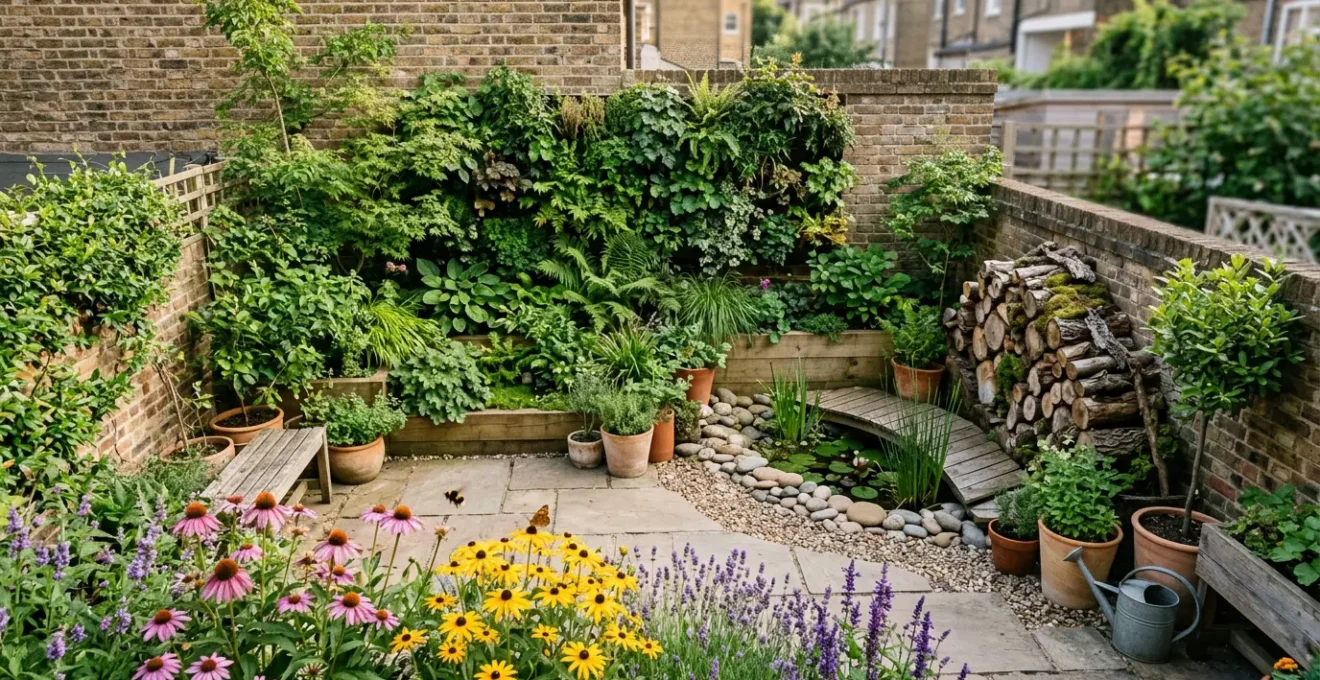
In summary:
- Stop thinking about adding individual “wildlife-friendly” items; start designing an interconnected, multi-layered habitat.
- Every square inch matters. Use vertical space, choose native plants, and build a healthy soil foundation to create a self-regulating system.
- A small, well-designed water source can attract as much wildlife as a much larger body of water.
- Embrace “structured chaos” by creating intentional habitats like log piles that serve wildlife without looking messy.
- Building a resilient ecosystem reduces maintenance and eliminates the need for harmful pesticides.
For city dwellers with a small concrete yard, the desire to support nature can feel at odds with the reality of limited space. The common advice often feels insufficient: plant a few flowers for bees, maybe add a bird bath. While well-intentioned, these isolated actions rarely create the vibrant, bustling environment you imagine. You might see a few visitors, but the garden doesn’t truly feel *alive*. It doesn’t become a self-sustaining pocket of nature that buzzes with activity from the soil to the sky.
The frustration comes from treating the garden as a collection of separate parts rather than a whole. But what if the key wasn’t just adding more things, but connecting them with purpose? The true shift happens when you stop being just a gardener and become an urban ecosystem engineer. This approach isn’t about grand, complicated projects; it’s about making deliberate, micro-scale choices where every plant, every scoop of mulch, and every drop of water contributes to a layered, self-regulating habitat. It’s about designing a miniature world, perfectly adapted to your 500 square feet.
This guide will walk you through the core principles of engineering that thriving micro-ecosystem. We’ll explore how to stack habitats vertically, recruit a natural pest control team, create vital water sources, and build the soil foundation that underpins it all. By the end, you will have a clear blueprint for transforming your small urban space into a resilient and biodiverse sanctuary.
To help you navigate these principles, here is a breakdown of the key strategies we will cover to build your miniature ecosystem.
Summary: Engineering Your Urban Micro-Ecosystem
- Can Vertical Gardens Support Local Wildlife?
- Ladybugs vs. Aphids: How to Encourage Predatory Insects?
- Bird Baths or Ponds: What Water Feature Attracts the Most Life?
- Why Leaving a Messy Corner in Your Garden Boosts Biodiversity
- How Mulch Encourages Earthworms and Why You Need Them?
- Neonicotinoids in Nursery Plants: How to Buy Safe Flowers?
- American vs. Japanese Wisteria: Which Is Less Invasive?
- Why Native Flora Saves You 50 Hours of Gardening Per Year?
Can Vertical Gardens Support Local Wildlife?
In a 500 sq ft garden, horizontal space is a premium. The most effective strategy is to think vertically. Vertical gardens are not just a trendy way to grow herbs; they are a powerful tool for habitat stacking. By layering plants on walls or trellises, you create new niches for wildlife, effectively multiplying your garden’s usable area. This approach is essential for anyone with a small balcony or concrete patio, turning a barren wall into a ladder of life for insects and spiders.
The effectiveness of this strategy is not just theoretical. A purpose-built vertical garden on a residential building, designed with specific plants, successfully became a bustling habitat for various butterfly species. It proves that with careful planning—incorporating the right flowers, nesting opportunities, and water—a vertical space can be incredibly effective. The size of your garden floor doesn’t have to limit its ecological output; in fact, research confirms that nectar production in gardens is not dependent upon their size. A well-planned vertical garden can produce as much food for pollinators as a much larger, horizontal one.
Think of your vertical garden as a multi-story apartment building for wildlife. Some insects will feed on the flowers, others will hunt on the leaves, and spiders will build webs in the structural gaps. You are creating a complex, three-dimensional environment that offers food, shelter, and breeding grounds in a space that was previously empty.
Ladybugs vs. Aphids: How to Encourage Predatory Insects?
One of the cornerstones of a self-regulating ecosystem is a natural system of checks and balances. Instead of reaching for a pesticide at the first sign of aphids, an ecosystem engineer recruits a team of natural predators. Encouraging beneficial insects like ladybugs, lacewings, and hoverflies creates a state of pesticide-free resilience. These creatures are your garden’s free, 24/7 security force, managing pest populations before they get out of control.
Attracting these allies is a matter of providing the right menu. While their larvae are voracious predators, the adults often feed on nectar and pollen. Planting a succession of specific flowers is the key. The image below shows a lacewing larva—a tiny but mighty “aphid lion”—actively hunting, a perfect example of this functional biodiversity in action.
To build your own predatory insect army, focus on creating a continuous buffet throughout the seasons. Incorporate a mix of the following plants:
- Aster Family Flowers: Plants like Coneflower (Echinacea), Coreopsis, Cosmos, and Yarrow have small, accessible flowers that are perfect for tiny beneficial insects.
- Flowering Herbs: Allowing herbs like dill, fennel, parsley, and thyme to flower provides a crucial food source that many predators love.
- Legume Family Plants: Cover crops like sweet clover and hairy vetch are highly attractive to a wide range of beneficials.
- Undisturbed Nurseries: Leave small patches of bare soil or specific plants to act as “nurseries” where insects like ground beetles and lacewings can complete their life cycles.
Bird Baths or Ponds: What Water Feature Attracts the Most Life?
If there is one single element that will dramatically increase the life in your garden, it’s a reliable source of water. Even a small dish of water can become an oasis for birds, bees, butterflies, and other invertebrates, especially during hot, dry weather. While a pond is fantastic, it’s not always feasible in 500 square feet. The good news is that you don’t need a large feature to make a huge impact. A simple bird bath or even a shallow ground-level bowl can become a vital community hub.
The key is accessibility and safety. Birds need a shallow edge (no more than 1-2 inches deep) to bathe and drink safely. Placing a few stones or pebbles in the water provides perches for smaller insects like honeybees, which can otherwise drown. The location is also important; place it near a shrub or trellis to give birds a quick escape route from predators. Regularly changing the water every couple of days prevents mosquito larvae from developing and keeps the source clean and inviting.
Don’t underestimate the power of your small contribution. According to a citizen science survey, over 70% of participating gardens had at least one water source, with bird baths and ponds being the most common. Crucially, a 2023 study found that 43 different species visited both urban lakes and garden water sources, revealing that small residential water features are just as important as large urban lakes for supporting local wildlife. Your tiny oasis is a critical lifeline in the concrete jungle.
Why Leaving a Messy Corner in Your Garden Boosts Biodiversity
The idea of a “messy” garden is often a hard sell for urban dwellers who value tidiness in their small space. This is where we reframe the concept as “structured chaos”. It’s not about letting your entire garden run wild; it’s about intentionally designing a small, dedicated area to provide shelter and food for the creatures at the base of the food web: decomposers and hibernating insects. A log pile, a small stack of stones, or a patch of leaf litter can become a five-star hotel for beetles, spiders, centipedes, and solitary bees.
A log pile is one of the easiest and most effective ways to create this type of habitat. Instead of a random heap of debris, you can arrange logs of different sizes into a sculptural, aesthetically pleasing structure that looks intentional. This pile provides a myriad of microclimates: dark, damp spaces for fungi and worms; dry, hollow crevices for hibernating ladybugs; and a hunting ground for predatory beetles.
Creating this habitat is simple and puts garden waste to good use. It’s a perfect example of closing the loop in your micro-ecosystem, turning “waste” into a resource.
Action Plan: Building Your High-Value Log Pile
- Source Materials: Gather logs and branches from your own garden pruning or ask neighbors for offcuts. Avoid taking wood from existing wild habitats to prevent disruption.
- Choose a Location: Select a spot in partial shade. This helps keep the pile moist, which attracts the greatest variety of wildlife. A location that spans both sun and shade will create diverse microhabitats.
- Lay the Foundation: Place the largest, thickest logs at the base for stability. For an even richer habitat, you can partially bury this first layer in the soil.
- Build Upwards: Stack smaller logs, sticks, bark, and leaves on top, creating a stable, pyramid-like shape with plenty of gaps and crevices.
- Maintain Moisture: During extended dry spells, give the log pile a light watering to keep the internal environment damp and hospitable for decomposers.
How Mulch Encourages Earthworms and Why You Need Them?
A thriving garden ecosystem is built from the ground up. The life teeming beneath the surface is just as important as the butterflies and bees you see above it. Earthworms are your most valuable underground engineers. They tirelessly aerate the soil, create channels for water to penetrate, and process organic matter into nutrient-rich castings that feed your plants. A healthy earthworm population means healthy, resilient soil. And the best way to encourage them is with a generous layer of organic mulch.
Mulch—whether it’s wood chips, shredded leaves, or compost—acts as a protective blanket for your soil. It insulates it from extreme temperatures, conserves moisture, and suppresses weeds. Most importantly, it provides a constant food source for earthworms and other decomposers. As they consume the mulch, they draw it down into the soil, improving its structure and fertility. This process is the engine of a healthy soil food web.
The link between what you plant above ground and the life below is direct. A 2019 study of urban gardens found that high plant diversity had a positive effect on soil fauna, supporting a greater number of earthworm and springtail species. By planting a variety of native plants and consistently applying mulch, you are actively feeding the subterranean ecosystem that supports your entire garden. This synergy is the essence of ecosystem engineering.
Neonicotinoids in Nursery Plants: How to Buy Safe Flowers?
You can do everything right—plant the perfect native flowers, provide water, and build a log pile—but still inadvertently harm the wildlife you want to attract. The hidden danger lies in systemic pesticides, particularly neonicotinoids (or “neonics”), which are often used in commercial nurseries. These pesticides are absorbed into every part of the plant, from its roots to its pollen and nectar. When a bee or other pollinator visits a treated flower, it ingests a neurotoxin that can be lethal.
Buying “bee-friendly” plants is not enough, as this label is often unregulated and can be misleading. To truly protect your micro-ecosystem, you must become a vigilant consumer. This means asking direct questions at the nursery and prioritizing sources you know are pesticide-free. Building a safe haven for wildlife starts with ensuring the building blocks themselves aren’t poisoned.
To avoid bringing these harmful chemicals into your garden, you need a clear vetting process for any new plant. Here are the key questions and actions to take:
- Ask Directly: Always ask nursery staff, “Are these plants treated with neonicotinoids or other systemic pesticides?” Be specific and don’t settle for vague terms like “eco-friendly.”
- Request Proof: If they claim their plants are neonic-free, ask for supplier information or any certification they have to back it up.
- Prioritize Organic: Seek out and support certified organic growers. The standards for organic certification prohibit the use of synthetic systemic pesticides.
- Quarantine New Plants: As a final precaution, keep new plants isolated from your main garden for a few weeks. This allows you to observe them and ensure they don’t have any negative effects on visiting insects before you fully integrate them.
American vs. Japanese Wisteria: Which Is Less Invasive?
Plant selection is one of the most critical decisions an ecosystem engineer makes. The right plant can provide food and shelter for dozens of species, while the wrong one can become an invasive monster that chokes out everything else. Wisteria is a classic example. The Asian varieties (Japanese and Chinese wisteria) are notoriously aggressive, with powerful vines that can damage structures and escape into the wild, displacing native vegetation. While beautiful, they often create a monoculture that offers little value to local wildlife.
The solution is not to give up on beautiful flowering vines, but to choose a native alternative. American wisteria (Wisteria frutescens) is a far better-behaved species. It is less aggressive, its flowers are a food source for native pollinators, and it acts as a host plant for certain butterfly and moth caterpillars. This is a perfect illustration of a core principle: for almost any ornamental exotic plant, there is a native alternative that provides similar aesthetic beauty with far greater ecological benefits.
By choosing native plants, you are plugging your garden directly into the local food web that has evolved over thousands of years. Here are some excellent native vine alternatives to invasive wisteria that are well-suited for a 500 sq ft space:
- Trumpet Honeysuckle (Lonicera sempervirens): This non-aggressive vine produces brilliant red, tubular flowers that are a magnet for hummingbirds. It also provides berries for other birds later in the season.
- Crossvine (Bignonia capreolata): An evergreen climber with stunning trumpet-shaped flowers, it’s a fantastic early-season nectar source for pollinators.
- Native Clematis Species: Various native Clematis vines offer beautiful flowers and attractive, fluffy seed heads without the destructive growth habit of their exotic cousins.
- Coral Honeysuckle: Offering similar visual appeal to the Trumpet Honeysuckle, its controlled growth makes it an excellent choice for smaller structures and trellises.
Key Takeaways
- A thriving urban garden is an engineered system, not a random collection of plants.
- Focus on layering habitats through vertical gardening, mulch, and “structured chaos” to maximize a small space.
- Choosing the right native plants and providing a clean water source are the two most impactful actions you can take.
Why Native Flora Saves You 50 Hours of Gardening Per Year?
When you shift your mindset to that of an ecosystem engineer, an amazing thing happens: your garden starts to take care of itself. The ultimate reward for choosing native plants, encouraging predators, and building healthy soil is not just a garden teeming with life, but also one that demands significantly less work from you. Native plants are adapted to your local climate, soil, and rainfall patterns. They don’t need constant watering, fertilizing, or coddling. They are naturally resilient.
Think of the time saved. You’ll spend less time fighting pests because your predatory insects are managing them for you. You’ll water less because native plants have deep root systems adapted to local conditions, and your mulch layer is conserving moisture. You’ll stop weeding as much because your dense, healthy native plantings will outcompete invasive species. This is the beauty of a self-regulating system; it finds its own equilibrium. As Dr. Shalene Jha, a leading researcher in the field, notes, this approach has profound benefits beyond your own fence.
What we’re seeing is that urban gardens present a critical opportunity to both support biodiversity and local food production.
– Dr. Shalene Jha, Associate Professor of Integrative Biology, University of Texas at Austin
Your 500 square feet might seem small, but it becomes a vital node in a larger network of urban green spaces, creating wildlife corridors that help species move through the cityscape. You are not just creating an isolated island of nature; you are contributing to a more resilient, biodiverse city. The 50 hours saved per year is a conservative estimate when you factor in all the work a self-sustaining ecosystem does on your behalf.
By applying these principles of ecosystem engineering, you transform your role from a simple gardener to a vital caretaker of urban biodiversity, creating a thriving, low-maintenance sanctuary for both you and your local wildlife.