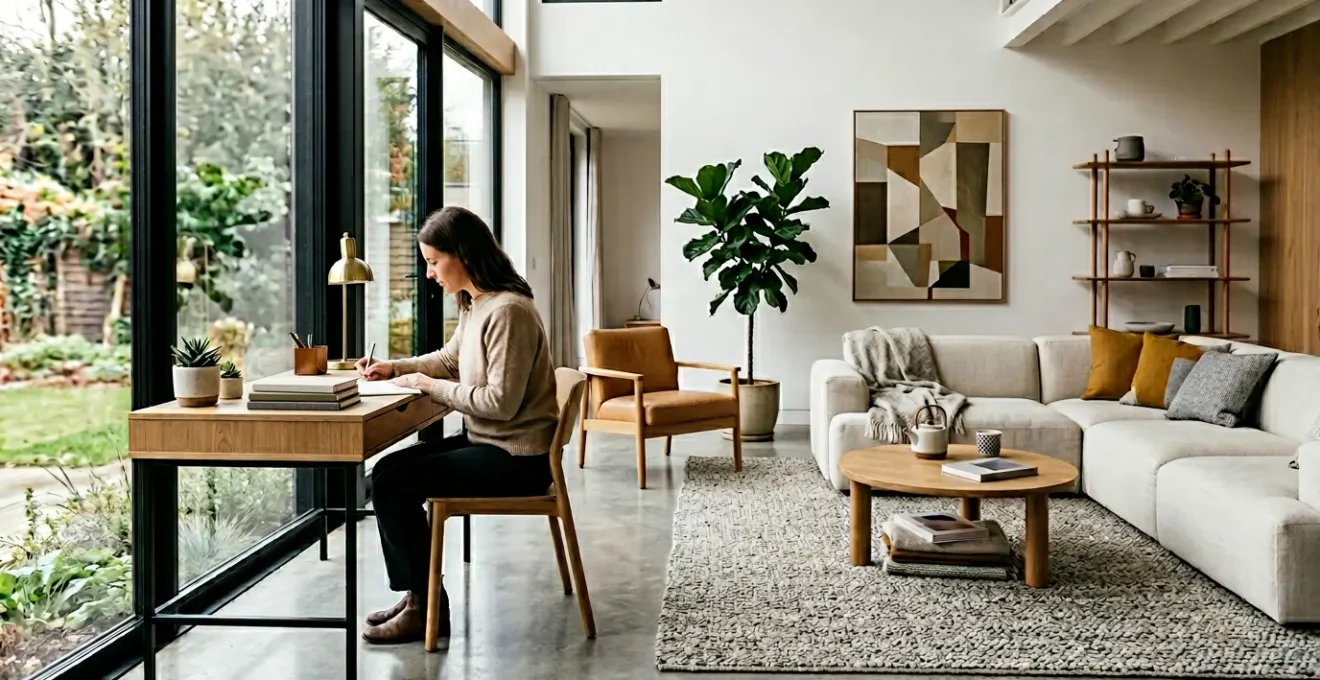
The key to successful open-plan living isn’t adding barriers, but mastering the invisible forces of light, sound, and flow.
- Layered lighting and acoustic dampening create psychological, not physical, boundaries that define work and relaxation areas.
- An effective furniture layout dictates intuitive behavioral pathways and should adapt dynamically to your changing lifestyle needs.
Recommendation: Stop thinking about dividing your room and start thinking about curating its distinct experiences.
The modern open-plan living room is a marvel of architectural freedom, but for many remote workers, it has become a source of daily friction. The line between your office and your sanctuary has blurred into a single, chaotic space where work-life balance feels impossible. You’ve likely tried the standard advice: placing a rug to anchor the seating area or positioning a console table behind the sofa to create a subtle divide. Yet, the feeling of being perpetually “at work” lingers, and your living room fails to be a space for either true productivity or genuine relaxation.
This struggle stems from a common misconception. We’ve been taught to think about zoning as a purely visual exercise—a matter of drawing lines on the floor with furniture. But what if the most powerful tools for separating your space are entirely invisible? The true secret to creating distinct zones for work and play lies not in building physical barriers, but in shaping the sensory experience of each area. It’s about designing separate functional atmospheres through the strategic manipulation of traffic flow, acoustics, and light.
This guide moves beyond the superficial to give you a consultant’s framework for reclaiming your open-plan space. We will explore how to manage behavioral pathways with intelligent sofa placement and how to use soft furnishings to sculpt the room’s acoustics. You’ll learn to paint with “light scapes” to create mood-based boundaries and choose furniture that adapts to your life, from focused workdays to relaxed movie nights. Prepare to stop dividing your room and start designing its experiences.
This article breaks down the core principles of non-physical zoning. The following sections provide actionable strategies to transform your open-plan area into a multi-functional, harmonious environment.
Summary: How to Flawlessly Zone an Open-Plan Living Room
- Why Poor Sofa Placement Ruining Your Living Room Traffic Flow?
- How to Reduce Echo in High-Ceiling Rooms Without Installing Foam Panels?
- Bookshelves or Screens: Which Room Divider Maximizes Light in Studio Apartments?
- When to Reconfigure Your Layout: 3 Signs Your Home No Longer Fits Your Lifestyle
- The Lighting Error That Leaves the Center of Your Room in Shadow
- Why Matte Black Lampshades Provide Less Ambient Light Than Glossy Ones
- How to Reconfigure a Modular Sofa for Movie Nights vs. Cocktail Parties?
- How to Choose a Low-Profile Sofa That Is Actually Comfortable?
Why Poor Sofa Placement Ruining Your Living Room Traffic Flow?
The single biggest mistake in an open-plan layout isn’t the choice of furniture, but its placement. A poorly positioned sofa can disrupt the entire room’s energy by creating awkward or blocked behavioral pathways—the invisible routes we naturally take to navigate a space. When you’re constantly squeezing past a sofa arm or walking around a coffee table to get to your desk, your brain registers this friction as stress. This subtly undermines the feeling of ease and flow that open-plan living is meant to provide.
Effective zoning starts with defining clear, unobstructed channels for movement. Before placing anything, visualize the primary “desire lines” in your room: from the entrance to the kitchen, from the sofa to the balcony, and from your living area to your workspace. The goal is to arrange your furniture to honor these paths, not obstruct them. A sofa’s back, for instance, can act as a powerful “soft wall,” but if it forces a detour through your designated work zone, it’s creating a problem, not solving one.
The key is to create a layout that feels intuitive. A well-placed sofa guides movement effortlessly around a designated “lounge” zone, keeping foot traffic out of the “work” zone. To ensure comfort and avoid a cramped feeling, design experts recommend maintaining walkways with at least 30-40 inches of clearance. This simple rule prevents bottlenecks and establishes a clear psychological separation between zones, making the entire space feel more organized and intentional without a single physical divider.
Ultimately, your sofa shouldn’t be an obstacle but a director, orchestrating the flow of movement to create a harmonious and functional living environment.
How to Reduce Echo in High-Ceiling Rooms Without Installing Foam Panels?
High ceilings and large open spaces exude grandeur, but they often come with a significant acoustic drawback: echo. Sound waves bounce off hard surfaces like wood floors, large windows, and bare walls, creating a cavernous, distracting environment. In a multi-functional space, this is disastrous. The clatter of kitchen activity can bleed into a work call, and a conversation can feel unpleasantly loud. Studies show that in rooms of this size, you can have an RT60 (reverberation time) of 1.5 to 2.5 seconds, which is far too long for comfort or clarity.
The solution isn’t to cover your walls in unsightly foam panels. Instead, the answer lies in acoustic zoning through the strategic addition of soft, sound-absorbing materials. Think of your room as a pinball machine for sound; your job is to add “bumpers” that trap and deaden the sound waves. Every soft surface you introduce contributes to a quieter, more intimate atmosphere. This is one of the most effective ways to create a psychological boundary between your work and relaxation zones.
As the image above illustrates, layering different textures is key. Start with the largest surfaces: a plush area rug or carpet runner immediately absorbs footfalls and breaks up the sound pathway between the floor and ceiling. Upholstered furniture, like fabric sofas and armchairs, acts as a giant sponge for ambient noise. Beyond the basics, consider these elements:
- Heavy Curtains: Thick drapes made of velvet or lined linen do an excellent job of absorbing sound reflecting off windows.
- Textile Wall Hangings: A large tapestry or fabric art piece can be as effective as it is beautiful.
- Throw Pillows and Blankets: Don’t underestimate the power of scattering numerous plush pillows and thick blankets.
- Dense Foliage: Large houseplants with irregular, dense leaves, like a Fiddle Leaf Fig or Monstera, are surprisingly effective at diffusing sound waves.
This approach not only solves the echo problem but also adds warmth, texture, and personality to your space, transforming an acoustic challenge into a design opportunity.
Bookshelves or Screens: Which Room Divider Maximizes Light in Studio Apartments?
When physical division becomes necessary, especially in a compact studio, the primary challenge is to create separation without sacrificing precious natural light. A solid wall or a bulky piece of furniture can cast a large shadow, making a small space feel dark and cramped. The choice between a classic bookshelf and a decorative screen hinges on one critical factor: light permeability. The best divider is one that suggests a boundary while allowing light to flow freely through it.
An open-back bookshelf, like the iconic IKEA KALLAX, is a popular choice for a reason. It offers a dual function of storage and separation. By strategically leaving some cubes empty or filling them with translucent objects like glass vases, you create a permeable barrier that delineates space without creating a solid wall of shadow. It provides a sense of structure while maintaining a visual connection and allowing light to filter through, preserving the airy feel of the open plan.
Folding screens, however, offer unmatched versatility and control over light. Their effectiveness depends entirely on their material. As one buying guide explains, sheer fabrics or perforated metals filter light, while opaque materials create a full visual barrier. A screen made of linen, rice paper (like a Japanese shoji screen), or laser-cut metal provides privacy and separation while diffusing light beautifully, casting soft shadows rather than a hard, dark line. This option is ideal for sectioning off a sleeping area or a desk that needs to feel distinct but not isolated.
Ultimately, a bookshelf offers functional, structured separation, while a screen provides flexible, aesthetic, and often superior light-diffusing division. For maximizing brightness in a small studio, a light-filtering screen is almost always the more effective solution.
When to Reconfigure Your Layout: 3 Signs Your Home No Longer Fits Your Lifestyle
Your living space should be a dynamic environment that evolves with you. Too often, we treat our furniture layout as a permanent decision, even when our daily habits and needs have completely changed. If your open-plan home is starting to feel more like an obstacle course than a sanctuary, it’s a clear signal that your layout has stopped serving your lifestyle. Recognizing the signs of a dysfunctional layout is the first step toward reclaiming your space.
There are three critical indicators that it’s time for a change:
- Daily Frustration: This is the most telling sign. If you’re constantly bumping into the corner of your coffee table, if your kitchen feels cramped during meal prep, or if the flow from your desk to the coffee machine is awkward, your layout is working against you. These minor daily annoyances accumulate, creating a subtle but persistent sense of stress.
- Unused or “Dead” Zones: Do you have a formal dining area that only collects dust? Or a corner that has become a dumping ground for miscellaneous items? These unused rooms or zones are a clear sign that your home’s design doesn’t align with how you actually live. A successful layout activates every square foot with purpose.
- Constant Mental Critiques: If you can’t walk into your home without mentally rearranging it—noting the lack of storage, the oversized chair that blocks a walkway, or the poor lighting—your subconscious is telling you something is wrong. When you spend more time critiquing your space than enjoying it, a reconfiguration is overdue.
Addressing these issues often involves simple but transformative changes, like eliminating wasted space and rearranging fixtures to better suit your actual behavioral pathways. This ensures your floor plan promotes a healthy, functional lifestyle aligned with your current needs.
Your 5-Step Layout Audit: A Plan to Reclaim Your Space
- Points of Contact: List every activity you do in the space (work, relax, eat, exercise) and the furniture or areas they require.
- Collecte: Inventory your existing furniture. Measure key pieces like your sofa, desk, and dining table.
- Coherence: Draw your room’s floor plan. Place cutouts of your furniture on it. Does the layout create clear, wide pathways between your activity zones?
- Mémorabilité/Émotion: Identify the “dead zones” and points of daily frustration. Are there any areas that feel cluttered or unused?
- Plan d’intégration: Experiment with new layouts on paper. Prioritize creating clear traffic flows and giving purpose to every zone before moving a single piece of furniture.
Don’t be afraid to radically rethink your space. A simple weekend of rearranging can transform a frustrating environment into one that supports and enhances your daily life.
The Lighting Error That Leaves the Center of Your Room in Shadow
One of the most common lighting mistakes in open-plan homes is relying on a single, central overhead fixture—often called “builder’s basic” lighting. This approach inevitably creates a harsh pool of light directly underneath the fixture while leaving the corners and the center of the room in shadow. This creates a visually flat and uninviting environment. More importantly for zoning, it fails to define any distinct areas. True spatial definition comes from creating deliberate “light scapes” through a multi-layered approach.
Instead of trying to illuminate the entire room with one source, think like a theater designer: use light to highlight specific “stages” for different activities. The darkness in between is just as important as the light, as it acts as a natural, invisible separator. By creating distinct pools of light, you can establish a work zone, a reading nook, and a conversation area that all feel separate, even with no physical dividers between them.
To achieve this, you need to implement a three-layer lighting strategy. Each layer serves a unique purpose in building your room’s functional atmosphere:
- Ambient Lighting: This is your base layer of general illumination. Instead of one central fixture, use multiple sources like recessed lights or a track system spread across the ceiling to provide a soft, even glow.
- Task Lighting: This is focused, functional light for specific activities. Place a desk lamp in your work area, a floor lamp next to a reading chair, or under-cabinet lighting in the kitchen. This is crucial for creating a highly functional “work” zone.
- Accent Lighting: This is the “magic” layer. Use spotlights or uplights to highlight architectural features, artwork, or plants. These create the dramatic pools of light that define zones and add depth and character to the room.
Crucially, install dimmer switches on as many fixtures as possible. This gives you the power to transform the mood of the entire space instantly—bright and energetic for work, soft and intimate for relaxation.
This method turns a lighting problem into your most powerful zoning tool, proving that what you don’t illuminate is as important as what you do.
Why Matte Black Lampshades Provide Less Ambient Light Than Glossy Ones
The material and finish of a lampshade can dramatically alter a room’s lighting profile, a fact often overlooked when selecting fixtures. A common surprise for homeowners is discovering that their stylish matte black lampshade provides very little general, or ambient, light. This isn’t a design flaw; it’s a deliberate function of physics that can be leveraged for effective zoning. The difference between a matte black and a glossy white shade is the difference between a spotlight and a lantern.
The science is straightforward: light-colored, glossy surfaces reflect light, while dark, matte surfaces absorb it. A glossy white or metallic interior on a lampshade will bounce light rays around, scattering them to illuminate a wider area. This creates soft, diffuse ambient light that raises the overall brightness of a room. It’s ideal for general lighting or for making a space feel larger and more open.
A matte black lampshade does the opposite. Its non-reflective interior surface essentially traps and absorbs most of the light that travels upwards and sideways from the bulb. Consequently, the light is channeled downwards in a highly focused, concentrated beam. This makes it an exceptional tool for task lighting. As lighting experts note, this focused beam is perfect for illuminating a specific spot without creating ambient glare.
Matte black surfaces absorb light, while glossy or light-colored surfaces reflect it. A matte black shade essentially ‘traps’ light, directing it in a focused beam, making it ideal for task lighting where you want to illuminate a specific spot without ambient glare.
– Interior Design Lighting Analysis, Lampshade Material and Light Reflection Properties
Therefore, choosing a matte black shade over your desk or reading chair is a strategic move. It creates a bright, focused work zone while keeping the light contained, preventing it from spilling into and disrupting the more relaxed “lounge” atmosphere nearby. It’s a perfect example of using a design detail to reinforce your zoning goals.
How to Reconfigure a Modular Sofa for Movie Nights vs. Cocktail Parties?
The modular sofa is the ultimate tool for dynamic reconfiguration in an open-plan space. Its inherent flexibility allows your living area to transform based on the occasion, shifting from an intimate private space to a social public hub in minutes. The key is to think of your sofa not as a single piece of furniture, but as a collection of building blocks. Mastering a few core configurations will allow you to adapt your layout to perfectly suit any event.
For different social scenarios, you need two primary modes: one designed for immersion and one designed for interaction. Each mode uses the same sofa modules but arranges them to support a completely different set of behaviors.
- Fortress Mode (Movie Nights): The goal here is to maximize comfort and create a single, shared focal point—the screen. Push chaise lounges and corner pieces together to form a large, inward-facing “U” shape or a cozy “nest.” This configuration encourages lounging, minimizes distractions, and creates an immersive, cinema-like experience. Supplement with moveable ottomans for footrests and floor cushions for extra seating to complete your comfort fortress.
- Social Hub Mode (Cocktail Parties): For a party, the objective is the opposite: you want to break up the monolith and encourage flow and mingling. Deconstruct the sofa into smaller, independent seating groups. Create two or three separate L-shapes or use individual modules as standalone chairs. Dispersing these pods throughout the space creates multiple small conversation zones, preventing guests from clumping in one area and promoting movement and interaction. Deploy slim C-tables that can tuck over a seat arm to hold drinks, eliminating the need for a central coffee table.
By embracing this adaptive mindset, your sofa becomes an active participant in your social life, ensuring your living space is always perfectly tailored to the moment, whether it’s a quiet night in or a bustling get-together.
Key Takeaways
- Effective zoning is about creating distinct “functional atmospheres” through sensory cues, not just physical dividers.
- Layered “light scapes” and “acoustic zoning” with soft materials are your most powerful, non-structural tools for defining space.
- A truly functional layout supports your “behavioral pathways” and is dynamic, designed to be reconfigured as your lifestyle needs change.
How to Choose a Low-Profile Sofa That Is Actually Comfortable?
Low-profile sofas are a favorite among designers for open-plan spaces because their low back and sleek lines don’t visually obstruct the room, preserving that airy, uncluttered feel. However, their stylish appearance often comes with a reputation for being uncomfortable. The challenge is finding a sofa that delivers on aesthetics without sacrificing the deep-seated comfort needed for true relaxation. The secret lies in looking past the silhouette and focusing on three crucial construction details: seat depth, cushion composition, and back support.
First, don’t confuse a low back with a shallow seat. A truly comfortable low-profile sofa should have a generous seat depth (ideally 23 inches or more). This allows you to curl up and lounge properly, rather than feeling like you’re perched on a bench. A deeper seat compensates for the lower back, providing the support your body needs for extended periods of sitting. Always test a sofa by sitting all the way back; your feet should be able to rest comfortably on the floor without your knees being pushed up.
Second, investigate the cushion filling. The cheapest foam cushions will compress and flatten quickly, offering little support. Look for high-density foam cores wrapped in a softer material like down, feathers, or a synthetic equivalent (dacron). This combination provides the best of both worlds: a firm, supportive base that won’t sag, and a soft, plush top layer that provides that immediate “sink-in” feeling of comfort. High-resiliency (HR) foam is a hallmark of a quality, long-lasting cushion.
Finally, assess the back support. Even on a low-profile model, the back shouldn’t be an afterthought. Check if the back cushions are substantial enough to provide lumbar support or if the sofa’s design includes loose throw pillows that you can arrange for personalized comfort. By prioritizing these three elements—seat depth, cushion quality, and back support—you can confidently choose a low-profile sofa that is both a stunning design statement and a truly comfortable sanctuary for relaxation.