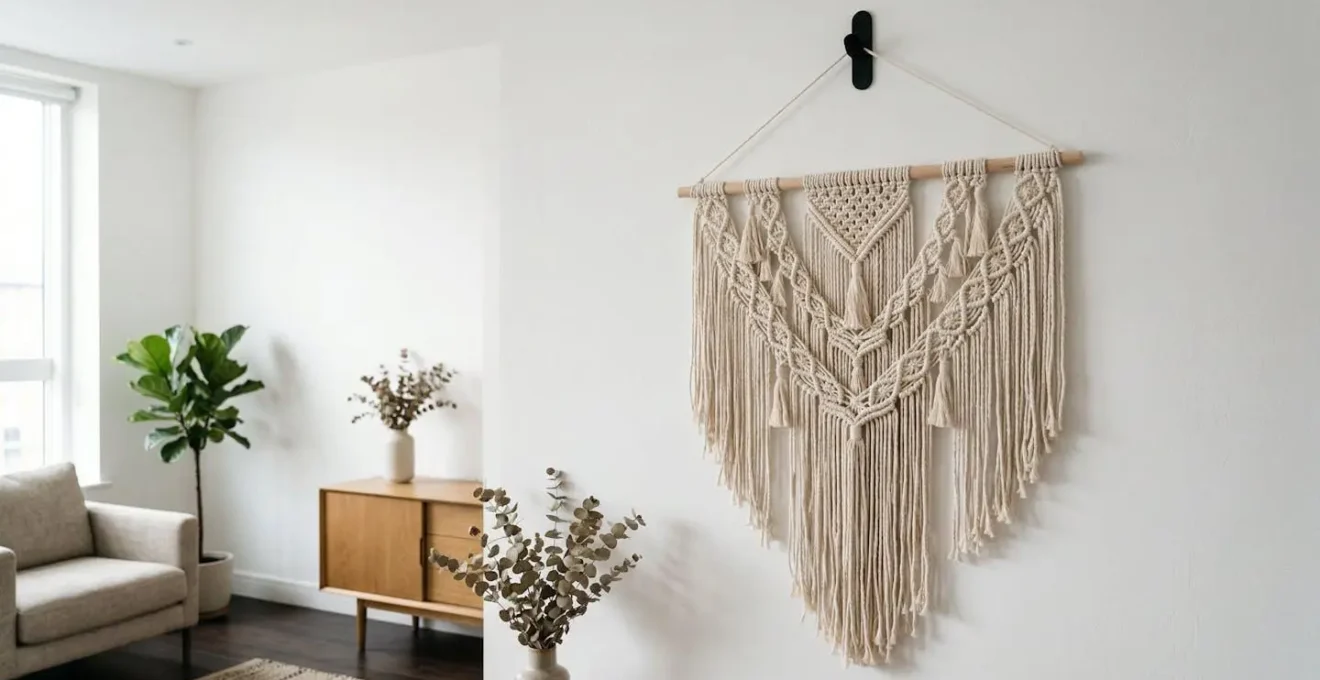
In summary:
- Stop searching for a single “magic hook”; the key is understanding weight distribution and leverage.
- Assess the macramé’s true weight (including plants and moisture) and structural integrity before hanging.
- Use toggle bolts for heavy items on drywall, as they distribute the load across a wider, hidden surface area.
- For exposed brick, drilling into the solid brick offers more security for heavy pieces than drilling into the weaker mortar.
- Modernize your macramé and integrate it into your decor by choosing hanging hardware that acts as a strategic design element.
That large, beautiful macramé wall hanging you found is meant to be the centerpiece of your living room, adding texture and warmth. But as a renter, your excitement is quickly replaced by anxiety. The thought of drilling large, unforgiving holes into a wall you don’t own—and the potential of a failed hook, a damaged wall, and a lost security deposit—is enough to leave that fiber art rolled up in a closet. You’ve likely searched for solutions, finding the usual advice to use heavy-duty adhesive hooks, which often fail under real weight, or tension rods, which limit placement drastically.
These common solutions fail because they treat a complex problem with a simple, and often inadequate, tool. They don’t address the fundamental physics of hanging a heavy object on a fragile surface like drywall. But what if the secret wasn’t in the hook itself, but in the strategy? What if you could hang your art with confidence by thinking less like a decorator trying to hide a nail and more like an engineer focused on weight distribution and structural leverage? This approach shifts the focus from a single, high-stress anchor point to a system that safely spreads the load, protecting your walls and your peace of mind.
This guide will walk you through that engineering mindset. We’ll explore how to assess your macramé for quality and potential weak points, understand the true weight of your art (especially with plants), and select the right, minimally invasive hardware for different wall types like drywall and brick. By mastering these principles, you can transform your rental space with beautiful, heavy fiber art without leaving a trace.
Summary: A Renter’s Guide to Hanging Heavy Fiber Art
- Why Macramé Can Look Dated and How to Make It Look Modern
- How to Clean a Macramé Plant Hanger Without Unraveling the Fringe?
- Cotton vs. Jute Cord: Which Is Best for Outdoor Plant Hangers?
- Can a Large Macramé Wall Hanging Reduce Echo in a Home Office?
- The Knotting Mistake That Signals Low-Quality Macramé
- What Are the Best Low-Light Plants for a Minimalist Aesthetic?
- How to Drill Into Brick Without Cracking the Mortar?
- How to Mix Patterns and Eras in a Living Room Without It Looking Messy?
Why Macramé Can Look Dated and How to Make It Look Modern
Sometimes the hesitation to hang a macramé piece isn’t just about wall damage; it’s the fear that it might look dated. The classic 1970s combination of jute rope on a gnarled driftwood dowel can feel heavy and out of place in a contemporary home. However, modernizing macramé often has less to do with the knotting itself and more to do with the context and, most importantly, the hanging hardware you choose. The right hardware not only provides a secure anchor but also acts as a critical design element that bridges the gap between bohemian textile and modern interior.
Think of the hardware as the frame for your artwork. Swapping a rustic wooden dowel for a sleek copper pipe or a minimalist acrylic rod instantly updates the entire piece. The same goes for the mounting brackets or hooks. Dated, shiny brass can be replaced with matte black metal for an industrial feel or brushed brass for a touch of quiet luxury. These finishes should echo other metallic elements in the room, such as lamp bases or furniture legs, creating a cohesive visual language.
Furthermore, an advanced technique is to create a “floating” effect using invisible mounting systems like French cleats. This removes the visual clutter of hooks and brackets entirely, allowing the texture of the macramé to stand out against the wall. By treating the installation hardware as a deliberate stylistic choice, you elevate the macramé from a simple craft object to a sophisticated piece of wall decor that feels intentional and current.
How to Clean a Macramé Plant Hanger Without Unraveling the Fringe?
A macramé plant hanger, especially one made of natural cotton, is a magnet for dust, pollen, and, in a kitchen, a fine layer of grease. The challenge is cleaning it without turning the pristine fringe into a tangled mess or weakening the fibers. The most effective strategy isn’t about a specific cleaning technique, but about a smart installation choice from the start: making the hanger easily removable. A piece that can be taken down in seconds is far more likely to be cleaned regularly than one that is permanently fixed to the ceiling.
This is where a renter-friendly mindset provides a superior solution. Instead of screwing a hook directly and permanently into the ceiling, consider a two-part system. First, install a secure ceiling anchor (like a toggle bolt hook). Then, use a decorative S-hook or a small, elegant carabiner to connect the macramé hanger to the permanent hook. This allows you to unhook the entire plant hanger for maintenance without any tools.
This approach was highlighted in a practical setup where an enthusiast used this exact removable system. The case study notes that by choosing galvanized or powder-coated hardware, the owner also prevented rust stains that can occur from watering. This demonstrates how a thoughtful installation focused on easy maintenance not only simplifies cleaning but also preserves the beauty of both the plant hanger and the surrounding ceiling. Once removed, the macramé can be gently shaken out outdoors, spot-cleaned with a damp cloth and mild soap, or hand-washed in cold water if necessary, then laid flat to dry completely before re-hanging.
Cotton vs. Jute Cord: Which Is Best for Outdoor Plant Hangers?
When selecting a macramé plant hanger for an outdoor space like a balcony or covered patio, the choice between cotton and jute cord is critical. It’s not just a matter of aesthetics; it’s a decision that directly impacts the hanger’s durability and safety. While both are natural fibers, their inherent properties make them suitable for very different environments. Understanding this difference is the first step in preventing a beautiful hanger from degrading and failing under the elements.
This detailed image shows the fundamental textural differences between the two fibers.
As you can see, cotton cord (often seen in a cream color) is soft, pliable, and has a smooth finish. It’s ideal for indoor use where it’s protected from moisture. However, outdoors, cotton acts like a sponge. It readily absorbs water, becoming extremely heavy and stretching under the weight. This constant moisture retention leads to mold, mildew, and eventual rot, compromising the structural integrity of the knots. In contrast, jute cord is coarser, more rigid, and has a rustic, fibrous texture. While it also absorbs water, its natural resilience and rougher composition make it more resistant to rot and mildew, allowing it to withstand outdoor humidity and temperature fluctuations much better than cotton. For any outdoor application, especially one bearing the weight of a heavy, watered plant, jute is the structurally sound and safer choice.
Can a Large Macramé Wall Hanging Reduce Echo in a Home Office?
In a minimalist home office with hard surfaces—wood floors, a large desk, bare walls—sound tends to bounce around, creating an echo that can be distracting during calls. While often chosen for its aesthetic value, a large, dense macramé wall hanging can serve a powerful secondary function: acoustic absorption. The soft, uneven texture of the knotted textile is naturally effective at trapping and dampening sound waves, reducing flutter echo and creating a calmer auditory environment.
However, you can dramatically amplify this effect with a specific installation technique. The key is to create an air gap between the macramé and the wall. Instead of hanging the piece flush against the drywall, use standoff brackets to mount it one to three inches away from the surface. This creates a pocket of still air that acts as a highly effective sound trap.
As this illustration conceptualizes, when sound waves pass through the macramé’s fibers, they are initially dampened. The remaining waves travel into the air gap, bounce off the hard wall surface, and are forced to pass back through the macramé a second time, effectively doubling the acoustic absorption. This “macramé-as-acoustic-panel” strategy is a perfect example of multifunctional design, where a single decorative element solves both an aesthetic and a practical problem. For a renter, this is a damage-free way to improve room acoustics without resorting to permanent foam panels.
The Knotting Mistake That Signals Low-Quality Macramé
Before you even think about how to hang a heavy macramé piece, you must first assess its quality. A poorly constructed piece is a safety hazard, as its weak points will be the first to fail under its own weight. The most critical area to inspect is the structural knotting at the top, where the entire piece connects to its dowel or hanging loop. This is where the full load is concentrated, and it’s the most common point of failure in low-quality macramé.
A tell-tale sign of poor craftsmanship is inconsistent or insufficient knotting at this attachment point. Look for knots that are loose, unevenly spaced, or appear too sparse to support the weight below. Often, makers of cheap macramé will hide these weak structural knots behind a curtain of decorative fringe. You must lift this fringe and inspect the load-bearing knots beneath. They should be tight, uniform, and densely packed. Uneven tension throughout the piece is another red flag; it can cause the macramé to hang crookedly, putting undue stress on specific anchor points and knots.
Before entrusting your wall and your safety to a piece of fiber art, performing a quick quality audit is non-negotiable. This simple check ensures the piece is sound and worthy of a secure installation.
Your Action Plan: Quality Inspection for Macramé Hanging Points
- Inspect the connection point between the macramé body and the dowel or hanging loop for loose, insufficient, or inconsistent knots.
- Check for uneven knot tension throughout the piece, which creates crooked hanging and uneven weight distribution on anchor points.
- Lift any dense or long fringe at the top attachment area to ensure it’s not hiding weak or poorly executed structural knots.
- Gently tug on the hanging loops to test their security before mounting heavy pieces on drywall.
What Are the Best Low-Light Plants for a Minimalist Aesthetic?
Choosing a plant for your macramé hanger involves more than just aesthetics; for a renter concerned with wall integrity, the primary consideration must be total weight. The “wet weight” of a plant—the combined weight of the pot, soil, and the plant itself after a thorough watering—can be surprisingly heavy and is the true load your anchor must support. For a minimalist aesthetic, you need plants with strong, clean lines that thrive in low light and, crucially, don’t become excessively heavy.
Snake Plants (Sansevieria) and ZZ Plants (Zamioculcas zamiifolia) are excellent choices. Their strong vertical forms and sculptural leaves align perfectly with minimalist design, and they are famously tolerant of low-light conditions. However, they can become quite heavy as they mature. A smaller 6-inch Snake Plant might weigh 8-12 pounds when wet, which is manageable for a standard toggle bolt. A larger 10-inch Cast Iron Plant, while beautiful, could easily reach 18-25 pounds, requiring a much more robust, heavy-duty anchor. Cascading plants like Pothos are lighter options, but their visual impact is more diffuse.
The following table provides a crucial overview for any renter, linking plant choice directly to pot size, estimated wet weight, and the type of anchor required. As an analysis of low-light plants shows, matching the plant to both the aesthetic and the structural capacity of your wall is key to a successful and safe installation.
| Plant Name | Pot Size | Estimated Wet Weight (lbs) | Minimalist Aesthetic Match | Recommended Anchor Type |
|---|---|---|---|---|
| Snake Plant (Sansevieria) | 6-inch pot | 8-12 lbs | Excellent – Architectural vertical form | Standard toggle bolt (1/8″) |
| ZZ Plant (Zamioculcas) | 8-inch pot | 15-20 lbs | Excellent – Glossy sculptural leaves | Toggle bolt (3/16″) |
| Pothos (Epipremnum) | 6-inch hanging pot | 5-8 lbs | Good – Cascading minimalist vines | Ceiling hook with expansion anchor |
| Cast Iron Plant (Aspidistra) | 10-inch pot | 18-25 lbs | Excellent – Clean dark green blades | Heavy-duty toggle bolt (1/4″) |
| Spider Plant | 8-inch hanging pot | 6-10 lbs | Good – Arching linear foliage | Toggle bolt (1/8″) |
How to Drill Into Brick Without Cracking the Mortar?
If you’re a renter in a loft or a building with exposed brick walls, you have a robust and beautiful surface for hanging art. However, the common fear is causing permanent damage by cracking the brick or crumbling the old mortar. The secret to a secure, damage-free installation lies in understanding the structural difference between the two materials: you should almost always drill into the solid brick, not the mortar. While mortar is softer and easier to drill, it’s also weaker, more prone to crumbling, and cannot reliably support heavy loads.
The brick itself provides a far superior anchor point. To do this safely, you need a hammer drill and a proper masonry drill bit. The process involves drilling a pilot hole that is the correct diameter for your chosen masonry anchor or sleeve. This anchor expands inside the brick, creating an incredibly secure hold capable of supporting significant weight. When you leave, the small hole in the brick is far less noticeable and easier to patch with a dab of colored caulk or mortar than a large, crumbled section of the mortar joint.
This “brick, not mortar” strategy is the professional standard for valuable or heavy items, providing unparalleled security. For renters with heirloom-quality art, this is the only truly safe method.
Brick Installation for Heirloom Macramé: Mortar vs. Brick Strategy
An interior designer tasked with hanging a 35 lb vintage macramé in an industrial loft opted to drill directly into the brick. According to details on anchor types like those used in professional installations, using masonry anchors rated for over 100 pounds provided maximum security for the valuable piece. This strategic choice was contrasted with lighter items under 15 lbs, for which the designer used the simpler but less secure method of drilling into the mortar. The hardware—hand-forged iron hooks—was chosen to complement both the rustic brick and the fiber art, demonstrating how the installation method can be integrated into the overall design aesthetic.
Key takeaways
- The security of your heavy macramé depends on strategy (weight distribution), not just a single product (a hook).
- Always assess the macramé’s structural knots and the true “wet weight” of any included plants before choosing a hanging method.
- For drywall, use toggle bolts that anchor behind the wall. For brick, drill into the solid brick, not the weaker mortar, for heavy items.
How to Mix Patterns and Eras in a Living Room Without It Looking Messy?
One of the biggest challenges in eclectic interior design is making a room feel cohesive rather than chaotic. How do you place a bohemian, 1970s-inspired macramé hanging in a room with a mid-century modern armchair and a patterned Persian rug without it looking like a jumble of disconnected styles? The solution can be found in a concept known as the “hardware-as-bridge” strategy. This is where the hardware you use to hang your macramé becomes a unifying element that ties disparate pieces together.
The first step is to select a distinctive finish for your macramé’s hanging rod or brackets—for example, brushed brass or matte black. Then, you repeat that exact same finish in at least two or three other small elements throughout the room. This could be the base of a floor lamp, the legs of a side table, or the frames of other pictures on the wall. This repetition creates a subtle but powerful visual thread that connects the different zones and styles of the room, making them feel intentionally curated. As noted in an article on using fabric art in decor, this kind of thoughtful layering is key.
In this context, the macramé itself, with its single-color, knotted surface, acts as a “textural neutral.” It provides a calming visual buffer between busier elements like a vibrant rug and patterned throw pillows. By carefully choosing your hanging hardware and repeating its finish, you transform the macramé’s installation from a purely functional task into a sophisticated design move that brings harmony to an eclectic space.
By applying these principles of weight distribution, material assessment, and strategic hardware selection, you can confidently display your heavy macramé art. The next step is to thoughtfully assess your own space and artwork to choose the right approach for a secure and beautiful installation.