In summary:
- The ‘sensation’ of pressure is more important than the GPM (gallons per minute) rating. Modern tech creates a strong spray with less water.
- Look for showerheads with air-induction (aeration) or oscillating nozzle technologies to mimic high-pressure flow.
- True home efficiency goes beyond the shower. Simple fixes like finding toilet leaks and installing faucet aerators offer huge savings.
- Upgrading key appliances like toilets and water heaters with modern, efficient technology further reduces waste without sacrificing performance.
The promise of a water-efficient showerhead often comes with a silent dread: trading a powerful, invigorating spray for a weak, unsatisfying drizzle. For years, homeowners have felt forced to choose between being environmentally conscious and enjoying their daily shower. Many believe that “low-flow” is just a synonym for “low pressure.” This common frustration leads many to stick with old, water-guzzling fixtures, assuming it’s the only way to get the performance they want. The standard advice—”just look for a WaterSense label”—often feels incomplete because it doesn’t address this core fear of a ruined shower experience.
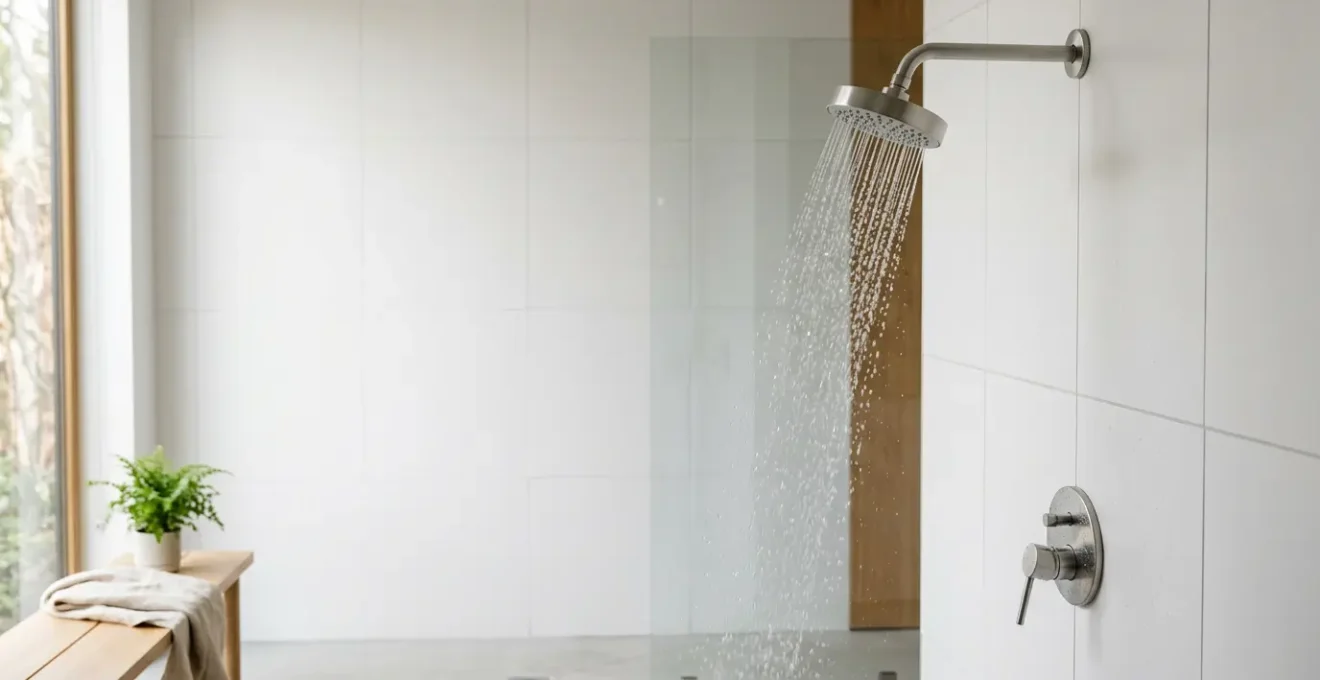
But what if this entire premise is wrong? The secret to a great, efficient shower isn’t about the sheer volume of water (measured in Gallons Per Minute or GPM), but about the physics of how that water is delivered. It’s about the sensation of pressure, not the raw flow rate. Modern engineering has developed specific technologies, like air-induction and focused oscillating streams, that use water more intelligently. These designs increase water velocity and coverage, creating the feeling of a much stronger shower while using a fraction of the water. This means you no longer have to compromise.
This guide demystifies the technology behind high-performance, water-saving fixtures. We’ll start by exploring the showerhead technologies that deliver a satisfying experience, but we won’t stop there. True home efficiency is a holistic system. We will then uncover the other critical, often-overlooked areas in your home—from silent toilet leaks to smart water heaters—where you can make significant cuts to your water and energy bills without ever feeling like you’re making a sacrifice.
Contents: Beyond the Showerhead – A Whole-Home Efficiency Guide
- The Toilet Dye Test: How to Find a Leak Wasting 200 Gallons a Month?
- Aerators: The $5 Gadget That Cuts Sink Water Usage by 30%
- Dual Flush vs. Pressure Assist: Which Toilet Clogs Less?
- Smart Sprinkler Controllers: Are They Worth It for Small Lawns?
- Recirculation Pumps: How to Get Instant Hot Water and Stop Waiting?
- Shower vs. Kitchen Sink: Which Water Is Safe for Graywater reuse?
- How Much Money Can You Save by Scheduling Your Water Heater?
- How to Identify Energy Waste in a Smart Home That Should Be Efficient?
The Toilet Dye Test: How to Find a Leak Wasting 200 Gallons a Month?
Before you even think about bigger upgrades, it’s crucial to find the silent resource vampires in your home. The number one culprit is often the toilet. A constantly running toilet, even if it’s completely silent, can be a massive source of water waste. According to some EPA-backed reports, a single leaky toilet can waste as much as 200 gallons of water per day. That’s thousands of gallons a month from a problem you might not even know you have. The cause is usually a faulty or degraded flapper—the rubber seal at the bottom of the tank—that no longer creates a watertight seal, allowing water to slowly trickle into the bowl.
Fortunately, identifying this costly problem is incredibly simple and takes less than 15 minutes. The toilet dye test is a foolproof method that requires nothing more than some food coloring or a dye tablet specifically made for this purpose. It’s the first step any homeowner should take in a home water audit. Fixing this leak is often a simple DIY job, typically involving replacing the flapper, which costs only a few dollars and can save you a significant amount on your next water bill.
Your Action Plan: The 10-Minute Toilet Leak Test
- Add Color to the Tank: Carefully remove the toilet tank lid and place it somewhere safe. Drop a dye tab or about 10-12 drops of food coloring into the tank water. Do not flush.
- Wait Patiently: Set a timer for 10 to 15 minutes. During this time, it is critical that no one uses or flushes the toilet.
- Check the Bowl: After the time is up, look inside the toilet bowl. If you see any trace of color, you have a flapper leak.
- Assess the Severity: The intensity of the color can give you a clue about the leak’s size. A faint tint means a small leak, while a dark, rich color indicates a more significant one.
- Flush and Clean: Once the test is complete, flush the toilet a couple of times to send the colored water away. It’s a good idea to scrub the bowl afterward to prevent any potential staining from the food coloring.
Aerators: The $5 Gadget That Cuts Sink Water Usage by 30%
While the shower gets most of the attention, your bathroom and kitchen faucets are also major points of water consumption. Every time you wash your hands, brush your teeth, or rinse vegetables, you could be using more water than necessary. The solution is one of the cheapest, easiest, and most effective water-saving upgrades available: a faucet aerator. This small, screw-on gadget fits onto the tip of your faucet and works by mixing air into the water stream. This maintains the sensation of a strong, full flow while significantly reducing the actual volume of water being used. It’s the same principle used in high-efficiency showerheads, applied to your sink.
Installing a WaterSense-labeled aerator is a game-changer. Standard faucets can have a flow rate of 2.2 GPM, but according to EPA data, an efficient aerator can achieve a 30 percent or more reduction in water usage without any noticeable difference in performance. This simple swap can take less than five minutes and costs only a few dollars, offering an immediate return on investment through lower water and water-heating bills.
The technology behind these devices is what makes them so effective. As shown in the image, many modern aerators create a laminar flow—a clear, non-splashing stream that feels substantial and provides excellent rinsing power. This is far more efficient than the turbulent, splash-prone flow of older, non-aerated faucets. The result is a better user experience that also happens to be far more sustainable.
Dual Flush vs. Pressure Assist: Which Toilet Clogs Less?
When it’s time to replace an old, inefficient toilet, homeowners are faced with a choice between two dominant water-saving technologies: dual-flush and pressure-assist. While both are vast improvements over older models that used 3.5 gallons per flush (GPF) or more, they operate on completely different principles, which directly impacts their performance, especially when it comes to preventing clogs. Your choice depends on your household’s priorities: maximum water conservation or maximum clog-clearing power.
A dual-flush toilet offers two flush options: a low-volume flush (typically around 0.8 GPF) for liquid waste and a full-volume flush (up to 1.6 GPF) for solid waste. This is great for conservation, but its gravity-based system can sometimes lack the force needed to clear the bowl in a single flush, especially in homes with older plumbing. A pressure-assist toilet, on the other hand, uses compressed air within the tank to create a powerful, forceful flush with just over 1 GPF. This blast of water is exceptionally effective at preventing clogs but comes at the cost of being significantly louder. This table breaks down the key differences to help you decide.
| Feature | Dual-Flush | Pressure-Assist |
|---|---|---|
| Flush Mechanism | Optimized Gravity (0.8 GPF liquid / 1.6 GPF solid) | Engineered Power – Compressed Air (1.1-1.4 GPF) |
| Clog Resistance | Moderate – may require occasional double-flushing | High – forceful flush prevents clogs effectively |
| Water Efficiency | Excellent for households prioritizing conservation | Very good – uses less water with stronger performance |
| Best For | Water-Conscious Small Families | High-Traffic Households |
| Maintenance | Simple – readily available parts, lower cost | More complex – specialized repairs may be needed |
| Noise Level | Quiet | Louder due to rapid air/water release |
Beyond the flush mechanism, an expert on a plumbing forum pointed out another critical design element for clog prevention, which applies to both types. As one user noted in a discussion comparing toilet technologies:
The secret is a wider, fully-glazed trap and a wide (3 inch) flapper.
– BobIsTheOilGuy forum discussion, Toilet shopping comparison discussion
This highlights that a smooth, wide path for waste is just as important as the force of the flush itself, proving that good design is about more than just one feature.
Smart Sprinkler Controllers: Are They Worth It for Small Lawns?
For homeowners with yards, outdoor irrigation is by far the largest source of residential water consumption. Traditional sprinkler timers are notoriously inefficient; they run on a fixed schedule regardless of the weather, often watering the lawn during a rainstorm or on a cool, cloudy day when it’s not needed. Smart sprinkler controllers solve this problem by using technology to water more intelligently. These devices connect to the internet to access real-time local weather data, automatically adjusting the watering schedule based on rainfall, temperature, humidity, and wind.
For a large lawn, the return on investment is a no-brainer. But are they worth it for smaller yards? Absolutely. Even on a small plot, the waste from a “dumb” timer adds up quickly. Smart controllers can lead to 20% or more water savings, which not only lowers your bill but also promotes a healthier, more resilient lawn by preventing overwatering and fungus growth. Many water utilities even offer substantial rebates for installing a WaterSense-certified smart controller, which can cover a significant portion of the device’s cost, making the financial decision even easier for owners of any size lawn.
Case Study: The Hyperlocal Weather Data Advantage
The effectiveness of a smart sprinkler controller hinges on the quality of its weather data. In an analysis of leading models, Consumer Reports testing reveals that controllers capable of tapping into hyperlocal weather stations consistently outperform those that rely on broader, regional data (like from a nearby airport). For a small lawn, which may have unique microclimates due to sun exposure, shade from a house, or specific soil types, this precision is critical. A controller that knows it rained half a mile away might skip watering, but a more advanced one using hyperlocal data will know it didn’t rain on *your specific street* and will water accordingly, ensuring the lawn gets exactly what it needs without waste.
This shows that for small lawns, choosing a controller with the most granular weather intelligence is key to maximizing both water savings and lawn health.
Recirculation Pumps: How to Get Instant Hot Water and Stop Waiting?
One of the most common—and wasteful—household rituals is running the tap and waiting for hot water to arrive. Whether you’re about to shower, wash dishes, or wash your hands, those seconds or minutes of running cold water down the drain add up to a significant amount of waste. This delay is caused by hot water cooling down in the pipes after previous use. A hot water recirculation pump solves this problem by creating a loop that keeps hot water constantly moving through your pipes, so it’s available instantly at any faucet.
This isn’t just a matter of convenience; it’s an issue of both water and energy efficiency. The energy used to heat water is a substantial part of a home’s utility costs, with some research indicating that showers can account for 15% of total household energy use. Every gallon of lukewarm water you run down the drain while waiting is water you paid to heat. By delivering hot water on demand, a recirculation system eliminates this dual waste. There are several types of systems, each with different benefits:
- On-Demand System: Activated by a button or motion sensor, this is the most efficient type. It circulates water only when you signal that you need hot water, delivering it in seconds and maximizing energy savings.
- Timer-Based System: This system operates on a programmable schedule, circulating water during peak usage times like early mornings and evenings. It offers good convenience with moderate energy costs.
- Dedicated Return Line: This is the most effective but also most complex system. It requires a professional to install a separate, dedicated pipe from the furthest fixture back to the water heater, creating a true plumbing loop.
- Existing Line System: A simpler-to-install option that uses the existing cold water line as the return path for the hot water. It’s a common retrofit solution, though it can sometimes cause the cold water to be slightly lukewarm temporarily.
Shower vs. Kitchen Sink: Which Water Is Safe for Graywater reuse?
As homeowners become more focused on sustainability, the concept of graywater reuse is gaining traction. Graywater is gently used water from your bathroom sinks, showers, tubs, and washing machines. It is distinct from “blackwater,” which is water from toilets and kitchen sinks that is contaminated with pathogens or significant amounts of grease and food particles. When handled correctly, graywater can be safely repurposed for non-potable uses, most commonly for landscape irrigation, helping to reduce fresh water consumption significantly.
However, safety is paramount. The key question is, which sources are truly safe? Water from showers, tubs, and bathroom sinks is generally considered the best source for graywater. It contains soaps, shampoos, and dirt, but it’s relatively low in organic matter and pathogens. Water from the laundry is also a common source, but it requires more caution. You must use biodegradable, low-sodium, and non-toxic detergents, as the chemicals in standard laundry products can harm plants and soil.
The one major source to almost always avoid for simple graywater systems is the kitchen sink. Water from washing dishes is contaminated with fats, oils, grease, and high concentrations of food waste. This mixture can not only damage your soil and plants but also quickly clog irrigation systems and lead to foul odors as it decomposes. For this reason, in most residential graywater systems, kitchen sink water is classified alongside toilet water as blackwater and sent directly to the sewer or septic system.
How Much Money Can You Save by Scheduling Your Water Heater?
Your water heater is one of the biggest energy consumers in your home, constantly working to keep a large tank of water hot, 24/7. This is incredibly inefficient, especially during long periods when no one is home or when everyone is asleep. Why pay to heat water for eight hours while you’re at work? Scheduling your water heater allows you to align its operation with your household’s actual hot water needs, significantly reducing this “standby heat loss” and cutting your energy bill.
You can achieve this in a few ways. Many modern water heaters have built-in scheduling features or “vacation modes.” If yours doesn’t, you can install an inexpensive timer on an electric water heater or upgrade to a smart water heater controller. By programming the heater to turn off or lower its temperature during predictable off-peak hours—like overnight or during the workday—you can save a substantial amount of energy without ever noticing a difference in hot water availability. The key is to create a schedule that reflects your family’s unique lifestyle.
| User Profile | Recommended Schedule | Peak Hours | Energy Savings Strategy |
|---|---|---|---|
| 9-to-5 Commuter | Heat: 5:30-8:30 AM, 5:30-10 PM | Morning shower, evening activities | Allow cooling during 8-hour workday |
| Work-From-Home Parent | Heat: 6-9 AM, 11 AM-1 PM, 5-9 PM | Morning routine, lunch prep, dinner/baths | Reduce temperature mid-morning and overnight |
| Night Shift Worker | Heat: 4-7 PM, 12-2 AM | Pre-work preparation, post-shift shower | Cool during daytime sleeping hours |
Customizing a schedule ensures you are only using energy when you actually need hot water. This simple act of planning can lead to significant savings over the course of a year, making it one of the most effective energy conservation strategies for any household.
Key Takeaways
- True efficiency is a system: Small fixes like leak detection and aerators provide a foundation for bigger savings.
- Technology solves experience problems: Modern fixtures use physics—like aeration and pressure-assist—to improve performance while reducing consumption.
- Aligning energy use with lifestyle is crucial: Scheduling appliances like water heaters and sprinklers eliminates waste during off-peak hours.
How to Identify Energy Waste in a Smart Home That Should Be Efficient?
One of the great promises of the smart home is greater efficiency. Smart thermostats learn your schedule, smart lighting turns off when you leave a room, and smart plugs can cut power to devices. Yet, many smart homeowners find their energy bills aren’t as low as they expected. This is because a smart home can also create new, hidden sources of energy waste. The very devices meant to save energy can themselves become “vampire loads,” and poorly configured automations can end up working against each other.
Identifying this waste requires looking beyond the obvious. The first place to check is for vampire drain. Every smart plug, hub, voice assistant, and connected camera draws a small amount of power 24/7 just to stay connected to your network. While a single device’s consumption is tiny, a house full of them can add up. The second area of concern is automation conflicts. For instance, you might have an automation that opens smart blinds in the afternoon to let in light, while your smart thermostat simultaneously works harder to cool the room now filled with hot sunlight. These routines, created in isolation, can cancel out each other’s benefits.
The key to finding these inefficiencies is to use the “smart” features of your home for auditing. Many smart home apps and energy monitoring systems provide detailed reports on device runtime and energy consumption. Analyzing your smart thermostat’s history might reveal it’s cycling on and off constantly, pointing not to a faulty thermostat but to an air leak or poor insulation near the device. A plug-in energy monitor can help you pinpoint which of your always-on gadgets are the biggest power hogs. A truly efficient smart home isn’t just one with smart devices; it’s one where those devices are configured to work in harmony.
To put these strategies into practice, the next logical step is to conduct a systematic audit of your own home’s water and energy use, starting with the simplest fixes and moving toward larger opportunities.
Frequently Asked Questions About Smart Home Energy Waste
Do smart devices themselves consume significant energy?
Yes, smart plugs, hubs, voice assistants, and always-on devices create ‘vampire drain’ even when not actively used. A plug-in energy monitor can help identify these hidden costs.
Can smart thermostats indicate problems beyond the device itself?
Absolutely. Frequent cycling shown in runtime reports may not indicate a bad thermostat, but rather poor insulation or air leaks near the device affecting temperature readings.
What are the most overlooked sources of smart home inefficiency?
Security cameras streaming in HD 24/7, smart hubs placed far from routers (using more power to maintain signal), and automated routines creating conflicts like AC turning on while smart windows open.