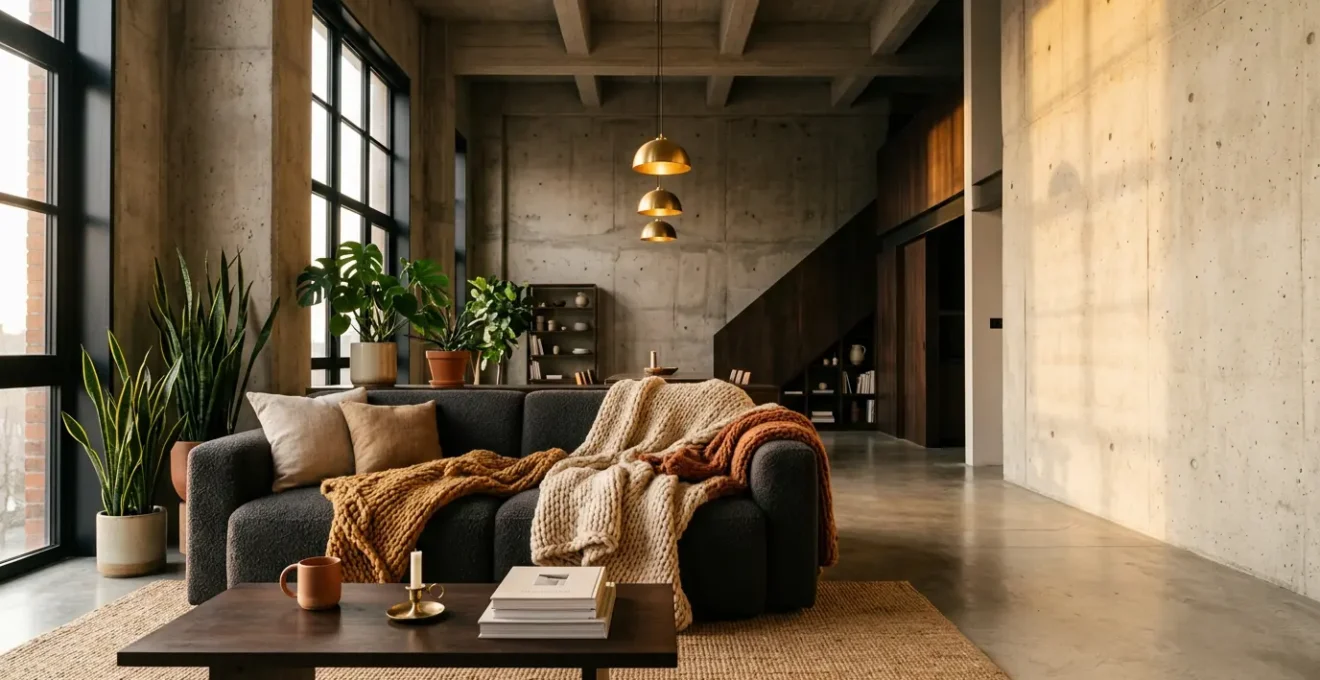
Making a brutalist loft cozy for winter isn’t about hiding the concrete; it’s about strategically mastering its thermal, acoustic, and luminous properties.
- Fight echo and chill with high-pile textiles that provide both acoustic damping and haptic contrast.
- Sculpt the space with layered, indirect lighting and embrace radiant floor heating to work with the concrete’s thermal mass, not against it.
Recommendation: Stop fighting the material. Start thinking like an energy strategist to transform your raw space into a sanctuary.
You fell for the raw honesty of it. The monumental scale, the unyielding texture, the stark beauty of board-formed concrete. But now winter is closing in, and your brutalist loft feels less like a minimalist sanctuary and more like a high-design parking garage. The echo of your footsteps seems louder, a persistent chill radiates from the walls, and the open space feels vast and impersonal. It’s the fundamental paradox of industrial living: loving the aesthetic but struggling with the lived reality, especially when the temperature drops.
The common advice is to simply “soften” the space—throw down a rug, add some pillows, maybe buy a plant. While well-intentioned, this approach barely scratches the surface. It treats the concrete as a flaw to be covered up. The truth is, your loft’s greatest challenge is also its greatest strength. The key isn’t to fight the material, but to understand and manage its inherent energies: thermal, acoustic, and luminous.
This guide reframes the problem. We won’t be just “decorating.” We will be implementing a strategy. Instead of seeing a cold, hard surface, you’ll learn to see thermal mass. Instead of an echo, you’ll see an opportunity for acoustic damping. Instead of a dark void, you’ll see a canvas for luminous sculpting. By mastering these principles, you can transform your space from a sterile shell into a deeply comfortable, warm, and sophisticated haven that honors its brutalist soul.
This article provides a strategic blueprint for achieving that transformation. We will dissect the core challenges of living with concrete and provide actionable, design-forward solutions for each. From tactile textiles and layered lighting to efficient heating and biophilic zoning, you’ll find everything you need to make your loft truly livable.
Summary: A Strategic Guide to Warming Your Industrial Concrete Loft
- Why Concrete Walls Need Velvet or Wool to Avoid the ‘Parking Garage’ Look
- How to Light a Room With Dark Walls Without Creating Glare?
- Gallery Wall or Large Canvas: What Works Best on a 15-Foot Concrete Wall?
- The Heating Error That Costs Loft Owners Thousands in Energy Bills
- How to Define a Bedroom in a Studio Loft Using Only Rugs and Plants?
- How to Pair Rough Stone With Sleek Glass for Modern Contrast?
- What Are the Best Low-Light Plants for a Minimalist Aesthetic?
- How to Mix Metal Finishes in Lighting Without Clashing?
Why Concrete Walls Need Velvet or Wool to Avoid the ‘Parking Garage’ Look
The infamous “parking garage” feel of a raw concrete interior isn’t just a visual problem; it’s an auditory one. Concrete is an incredibly hard, non-porous material, which means it reflects sound waves instead of absorbing them. This creates harsh echoes and high reverberation times, making conversations feel strained and the space feel cold and unwelcoming. In fact, concrete walls can absorb as little as 3% of sound, while heavy acoustic textiles absorb up to 70%. This is where the strategic use of fabric becomes non-negotiable.
Introducing materials like velvet, bouclé, or high-pile wool is an act of acoustic damping. These textiles, with their deep, soft fibers, trap sound waves and stop them from bouncing around the room. Think large-scale, heavy drapes that pool on the floor, oversized wool rugs, or even upholstered wall panels. The goal is to introduce significant soft surface area. This tactic not only quiets the space but also provides essential haptic contrast—the sensory play between the cold, unyielding concrete and the plush, inviting fabric. This contrast is what creates a feeling of luxury and comfort.
The visual impact is just as crucial. A cascade of deep emerald velvet or a thick cream-colored wool throw doesn’t just absorb sound; it absorbs light differently, creating a visual softness that balances the starkness of the concrete. It’s about creating moments of sensory relief and indulgence. As one project demonstrated, the effect is tangible and transformative.
Acoustic Transformation in a Hong Kong Penthouse
In a Hong Kong penthouse with stark concrete walls, the installation of eight acoustic art pieces with textile-blended composites cut reverberation time by more than 40 percent. This single change transformed the concrete living room into a cozy retreat. The homeowners reported clearer conversations, a noticeable reduction in street noise, and an improved sense of intimacy during gatherings, proving that textiles are a functional necessity, not just a decorative choice.
How to Light a Room With Dark Walls Without Creating Glare?
Lighting a room with dark, light-absorbing walls like concrete is a delicate art. The default solution—blasting the space with bright, overhead light—is a critical mistake. This approach flattens the texture of the concrete, eliminates all sense of mood, and creates harsh glare as light reflects off any polished surfaces. The key is not to flood the space, but to engage in luminous sculpting. This means using multiple, lower-intensity light sources to create layers, define zones, and celebrate the material’s unique character.
Forget the central ceiling fixture. Instead, build your lighting scheme from the ground up. Start with low-level lighting: floor lamps that cast warm pools of light, or uplights placed behind furniture to wash a wall with a soft glow. Then, add a middle layer with table lamps or sconces at eye level to create intimate, human-scale nooks. The final layer can be focused, directional light from track systems, aimed at art or architectural features, but never directly into the room. This layered approach creates depth, mystery, and comfort.
One of the most effective techniques for brutalist interiors is wall grazing. This involves placing light fixtures very close to the concrete wall to cast light down it at a sharp angle. This technique is a masterclass in revealing texture, turning the subtle imperfections, board forms, and aggregate of the concrete into a dramatic, three-dimensional landscape of light and shadow. It’s an act of celebrating the material, not hiding it. For those battling the psychological effects of darker winter months, supplementing with the right kind of light is also a wellness strategy. As research from the Brain Health Institute confirms, a 10,000-lux light box used in the morning can help reset circadian rhythms and boost mood, providing a functional dose of “daylight” before you transition to moody evening lighting.
Action Plan: Mastering the Wall Grazing Technique
- Position fixtures within 12 inches (30 cm) or less from the concrete wall surface to achieve a dramatic effect.
- Use narrow beam angles, typically 10 degrees or less, to create the crisp, defined shadows that define the grazing look.
- Apply the 1:1 spacing-to-setback ratio: ensure the spacing between fixtures is equal to or less than their distance from the wall for even coverage.
- Aim fixtures at a steep angle to create strong highlights and deep shadows that reveal the depth and character of the concrete.
- For tall walls (10-20 feet), use a moderate output of 150-200 lumens per linear foot to highlight texture without creating a blinding “hotspot”.
Gallery Wall or Large Canvas: What Works Best on a 15-Foot Concrete Wall?
A 15-foot concrete wall isn’t a problem; it’s an opportunity. The sheer scale and raw texture provide an unparalleled backdrop for art, but the choice of how to use it is critical. Do you go with a single, monumental statement piece or a dynamic, personal gallery wall? The answer depends entirely on the atmosphere you want to cultivate. Neither is wrong, but each serves a different strategic purpose in humanizing the space.
A large-scale canvas or artwork—think 6×8 feet or larger—is a power move. It embraces the monumental scale of the architecture rather than fighting it. A single, bold piece acts as an anchor for the entire room, a focal point that commands attention and injects a massive dose of color, personality, and emotion. This approach is best for creating a sophisticated, gallery-like feel. It declares that the space is confident and curated. The key is proportion; the art must be large enough to hold its own against the concrete and not look like a postage stamp on a fortress wall.
Conversely, a gallery wall offers a more intimate, evolving, and personal narrative. It breaks down the monolithic wall into a collection of smaller, human-scale moments. This approach is excellent for making a vast space feel cozier and more lived-in. You can mix mediums—photography, prints, oil paintings, even textile art—and frame styles to create texture and rhythm. The trick on a concrete wall is planning. You can’t simply knock in nails. This often requires professional installation with masonry drill bits or, for a more flexible and industrial-chic solution, using a picture rail system or simply leaning oversized framed pieces against the wall. As designer Greg Natale notes in an interview with Living Etc on brutalist interiors, this is about leveraging the architecture itself.
minimalist architecture can be an amazing canvas for expression
– Greg Natale, Interior Designer, Living Etc
The Heating Error That Costs Loft Owners Thousands in Energy Bills
The single biggest mistake loft owners make in winter is trying to heat their space with a conventional forced-air system. This approach is fundamentally at odds with the physics of concrete. Concrete has high thermal mass, meaning it’s excellent at absorbing and storing thermal energy, but it does so slowly. A forced-air system blows hot air into the room, which rises immediately to the high ceilings, leaving the lower living area—and the massive concrete slab under your feet—perpetually cold. The thermostat works overtime, burning through energy while you remain chilled. It’s an expensive and losing battle.
The solution is to work *with* the thermal mass, not against it. This is where radiant floor heating becomes the game-changer. By embedding heating elements within the floor, you turn the entire concrete slab into a massive, gentle, and incredibly efficient radiator. It heats the objects and people in the room from the ground up, creating an unparalleled sense of ambient warmth and comfort. There are no drafts, no noise, and no wasted energy heating the empty space near the ceiling.
The efficiency gains are staggering. Because it eliminates the significant heat loss associated with ductwork, radiant floor heating delivers 20-40% better efficiency than typical forced-air systems. Once the concrete slab reaches its target temperature, it retains that heat for hours, requiring very little energy to maintain it. This translates directly into lower utility bills, with homeowners often reporting savings of 25% to 50% after upgrading. While the upfront cost can be higher, it’s an investment in both long-term financial savings and, more importantly, in making a brutalist space truly, deeply comfortable in winter.
How to Define a Bedroom in a Studio Loft Using Only Rugs and Plants?
In a wide-open studio loft, creating the psychological boundary of a bedroom without erecting walls is a classic design challenge. The solution lies in “zoning”—using sensory cues to signal a shift in function and atmosphere. Rugs and plants are your most powerful, non-structural tools for this task, a strategy often referred to as biophilic zoning. It’s about creating an “island” of comfort and privacy within the larger space.
A large, high-pile rug is the foundation of your bedroom zone. It must be substantial enough to fit your bed, nightstands, and a small bench or chair, with room to spare. When you step off the hard, cool concrete and onto a plush, soft surface, your brain receives a powerful sensory signal: you have entered a different territory, a space for rest and quiet. The rug’s texture (think shag, wool, or sheepskin) provides haptic and acoustic comfort, absorbing sound and feeling warm underfoot. It visually anchors the sleeping area, drawing a clear line in the sand.
Plants are the “walls” in this strategy. By strategically placing a cluster of large-scale plants, you can create a living, breathing screen that offers a sense of enclosure without blocking light. A row of tall, slender Snake Plants (Sansevieria), a large Fiddle Leaf Fig, or a collection of hanging plants at varying heights can form a porous, green barrier. This not only provides a degree of visual privacy but also taps into our innate psychological connection to nature, making the “bedroom” feel like a protected, restorative oasis. This was effectively demonstrated in a project by ACE DESIGN.
Zoning a Brutalist Villa in Chengdu
A brutalist villa in Chengdu successfully used a raw concrete backdrop with strategic plant placement and soft furnishings to create distinct zones. In the open-plan living area, a large, smooth gray rug was used to define the seating area against the polished concrete floor, demonstrating clear spatial division through texture. This principle of using floor coverings and biophilic elements to delineate function without walls creates a sophisticated and livable open-concept space.
How to Pair Rough Stone With Sleek Glass for Modern Contrast?
Introducing other materials into a brutalist interior is about creating a dialogue with the concrete. Pairing rough, natural stone with sleek, modern glass is a masterstroke in this regard. This combination of opposites—opaque vs. transparent, ancient vs. modern, textured vs. smooth—creates a powerful design tension that is both sophisticated and deeply satisfying. It’s a way to add layers of complexity and refinement without undermining the raw power of the brutalist shell.
The key to a successful pairing is to let each material shine. Use rough stone, like slate, travertine, or split-face granite, for a singular, high-impact application. This could be a feature wall behind a bed, a fireplace surround, or a monolithic kitchen island. The stone’s inherent texture and irregularity provide a focal point of organic warmth and visual interest. Its primary role is to be a tactile anchor, a piece of the natural world brought indoors. This texture also serves a crucial acoustic function.
rough, porous, or irregular surfaces scatter and absorb sound energy, softening the acoustic environment and improving clarity
– ASI Architectural, Acoustic Textures in Interior Design
Glass should then be used as the counterpoint. A sleek, frameless glass partition to define a home office, a minimalist glass coffee table, or smoked glass shelving can be used to add a sense of lightness and reflection. The glass doesn’t compete with the stone; it complements it by offering a moment of visual quiet and polish. The transparency of glass allows the texture of the stone and concrete to remain visible, creating layers of visual information. This juxtaposition elevates both materials, making the stone feel more rugged and the glass feel more ethereal.
What Are the Best Low-Light Plants for a Minimalist Aesthetic?
In a minimalist, often low-light brutalist loft, plants are not just decoration; they are living sculptures. The goal is to choose specimens with strong, architectural forms that complement, rather than clutter, the space. You need resilient plants that can thrive with indirect light and don’t require constant attention. These plants provide a vital touch of biophilic green without detracting from the clean lines of the interior.
Here are the top contenders for a minimalist, low-light environment:
- The Snake Plant (Sansevieria trifasciata): This is the undisputed king of minimalist plants. Its stiff, upright, sword-like leaves provide a powerful vertical accent that contrasts beautifully with the horizontal lines of modern furniture. It’s incredibly hardy, tolerates low light, and requires infrequent watering. Varieties like ‘Laurentii’ with yellow edges or the dark ‘Black Coral’ offer subtle variations.
- The ZZ Plant (Zamioculcas zamiifolia): With its wide, dark green, glossy leaves that grow in a wand-like pattern, the ZZ plant has a distinctly modern and sculptural feel. It stores water in its rhizomes, making it extremely drought-tolerant. It’s one of the best plants for very low-light corners where little else will survive.
- The Cast Iron Plant (Aspidistra elatior): As its name suggests, this plant is nearly indestructible. It features large, deep green, lance-shaped leaves that rise directly from the soil, creating a lush but controlled appearance. It thrives on neglect and low light, making it a perfect set-and-forget option for a busy loft dweller. Its classic shape adds a touch of timeless elegance.
When placing these plants, think like a sculptor. A single, large Snake Plant in a simple, cylindrical pot can act as a focal point in a corner. A row of ZZ plants can create a low, structural green border along a wall. The key is to give each plant space to be appreciated as an object in its own right. They are the soft, living counterpoint to the hard, static concrete.
Key Takeaways
- Master Haptic Contrast: Use high-pile, sound-absorbing textiles like wool and velvet not just for visual softness, but as a strategic tool for acoustic damping.
- Practice Luminous Sculpting: Abandon single-source overhead lighting. Instead, layer multiple, indirect light sources and use wall grazing to celebrate the concrete’s texture.
- Embrace Thermal Mass: Work with your concrete, not against it. Radiant floor heating is far more efficient and comfortable than forced air for high-ceilinged lofts.
How to Mix Metal Finishes in Lighting Without Clashing?
In an industrial space, metal is an unavoidable and essential element. But the fear of clashing finishes often leads people to a safe, yet sterile, single-metal scheme. The designer’s secret is that mixing metals—like brass, matte black steel, and chrome—is not a mistake; it’s a technique. A well-executed mix adds a layer of curated depth, patina, and visual interest that a uniform look can never achieve. The key is to be intentional, not accidental.
The first rule is to establish a dominant metal. This will be your primary finish, likely tying into existing architectural elements like window frames or ductwork. This might be matte black or raw steel. This finish will act as the neutral base for about 60% of your metal accents. Then, choose one or two accent metals to layer in. A warm metal like aged brass or copper is an excellent choice to contrast with cool concrete and black steel. It adds a touch of warmth and glamour.
The second rule is to create separation and repetition. Don’t place two different finishes right next to each other where they might clash. For instance, if you have a black track lighting system, use brass for a floor lamp across the room. The physical distance allows each finish to breathe. Then, repeat your accent metal in at least two or three places to make the choice feel deliberate. A brass floor lamp, brass cabinet pulls, and a small brass bowl on a coffee table create a cohesive thread. This strategy embraces a core design philosophy of finding harmony in opposition.
by not ignoring it, but rather embracing it and letting the opposites play off each other. I love the juxtaposition of the rough with the refined to give a design depth
– Lane McNab, Interior Designer, Living Etc
By shifting your perspective from simple decoration to strategic energy management, you can unlock the true potential of your brutalist loft. It is about making conscious choices that honor the integrity of the architecture while catering to the human need for warmth, quiet, and comfort. Your home can be both a powerful design statement and a deeply personal sanctuary. To start transforming your space, the next logical step is to audit your current environment and identify the biggest opportunities for improvement.