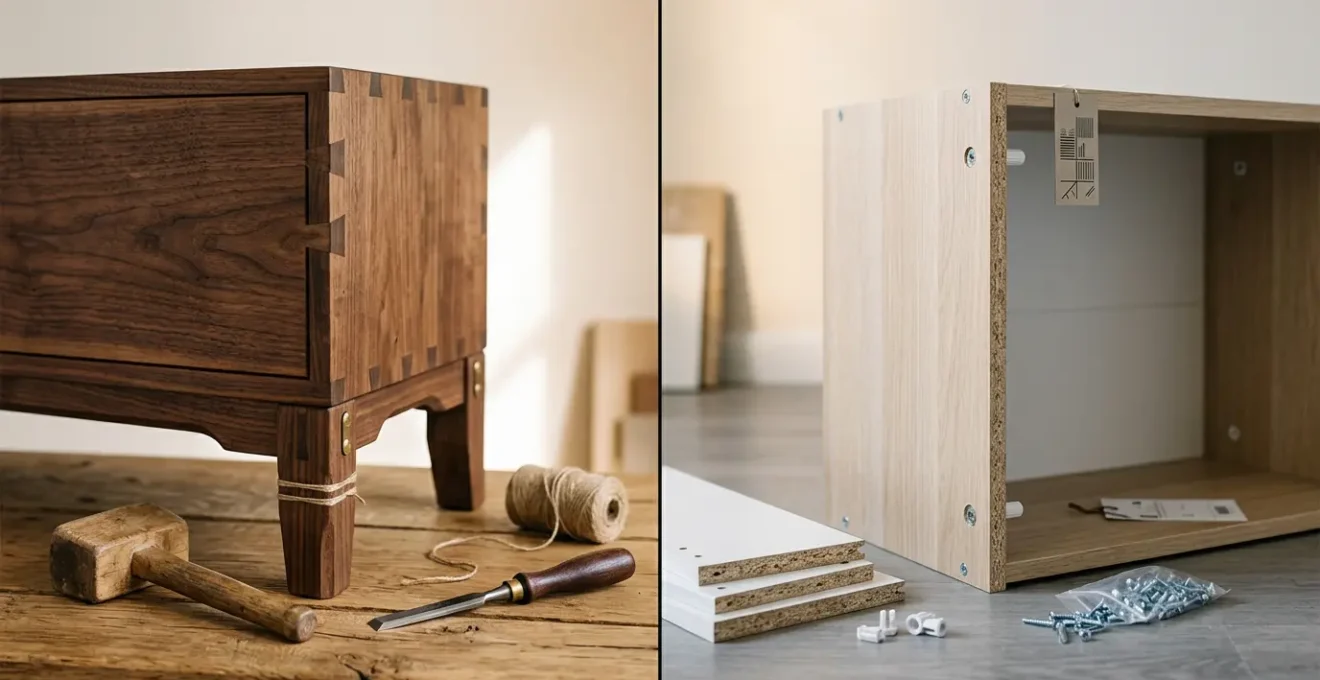
The true value of furniture isn’t its price tag, but its “Value-Holding DNA”—the measurable quality that separates a lifelong asset from a disposable trend.
- Lasting quality is found in invisible details like frame weight and joinery, which are better predictors of longevity than surface aesthetics.
- The total lifecycle cost of a single high-quality piece is often significantly lower than the cumulative cost of repeatedly replacing “fast furniture.”
Recommendation: Shift your mindset from a short-term consumer to a long-term curator by learning to perform a simple quality audit before you invest.
For the discerning buyer, the furniture market presents a paradox. It’s saturated with visually appealing, trend-driven pieces at tempting prices, yet finding items with genuine staying power feels like a search for a needle in a haystack. Many shoppers focus on aesthetics or an attractive price, only to find their stylish new sofa sagging and creaking within a few years—a victim of “fast furniture.” This cycle of buying, regretting, and replacing is not only costly and wasteful but also deeply unsatisfying.
The common advice—”buy what you love”—is well-intentioned but incomplete. An emotional connection is important, but it doesn’t guarantee a piece will withstand daily life or retain its value. The real challenge is distinguishing between fleeting style and enduring substance. To do this, you must adopt the mindset of an investor, not just a consumer. This means learning to look past the surface and audit a piece for its “invisible quality”—the hidden markers of craftsmanship and superior materials that are the true foundation of a future classic.
This guide moves beyond generic tips to provide a strategic framework for identifying furniture that represents a sound investment. We will deconstruct the key elements that define longevity, from the structural integrity of the frame to the ergonomics of comfort. By learning how to assess these factors, you can build a collection of furniture that not only brings you joy today but also delivers returns in durability and timeless style for decades to come.
To help you navigate this investment-focused approach, this article breaks down the essential audit points. Each section provides the knowledge you need to evaluate furniture with an expert eye, ensuring every piece you bring into your home is an asset, not a liability.
Summary: An Investor’s Guide to Furniture That Lasts
- Why a Heavy Sofa Frame Lasts 10 Years Longer Than a Light One
- How to Mix Contemporary Chairs With an Antique Dining Table?
- Leather or Performance Fabric: Which Is Better for Homes With Pets?
- The Measurement Mistake That Makes New Furniture Look Too Big
- When Is the Best Time of Year to Buy Designer Furniture on Sale?
- Dovetail vs. Stapled: How to Check Drawer Construction in Seconds?
- Why Poor Sofa Placement Ruining Your Living Room Traffic Flow?
- How to Choose a Low-Profile Sofa That Is Actually Comfortable?
Why a Heavy Sofa Frame Lasts 10 Years Longer Than a Light One
The single most important indicator of a sofa’s long-term value is its “invisible quality”—and that starts with the frame. When you lift the corner of a sofa, its weight tells a story. A heavy, rigid frame signals the use of dense, solid hardwood, while a light, flexible frame suggests cheaper materials like particleboard or soft pine. This isn’t just about feel; it’s about longevity engineering. A robust frame is the skeleton that supports everything else, preventing the bowing, warping, and joint failure that plague fast-furniture pieces.
Materials like kiln-dried oak, maple, or ash are the gold standard. The kiln-drying process removes most of the wood’s moisture, making it stable and resistant to environmental changes. This structural integrity is why quality hardwood frames can last 20+ years, often outliving their upholstery multiple times over. In contrast, frames made of particleboard or stapled pine are designed for a limited lifespan. They are susceptible to moisture, cannot support reupholstery, and are fundamentally disposable.
As a furniture investor, think of the frame as the chassis of a car. A high-performance engine is useless on a bent frame. By prioritizing a heavy, well-constructed frame, you are not just buying a sofa; you are investing in a platform that can serve your home for a generation. It’s the foundational decision that ensures your investment has the structural DNA to become an heirloom.
How to Mix Contemporary Chairs With an Antique Dining Table?
Creating a room with lasting appeal isn’t about perfectly matching sets; it’s about masterful curation. The ability to blend old and new is a hallmark of sophisticated design, but it requires a strategic eye. The key to successfully pairing contemporary chairs with an antique table is to create intentional contrast, unified by a common element. Instead of trying to match styles, focus on creating a dialogue between the pieces.
Start by identifying the dominant characteristic of your antique table. Is it heavy and ornate, or is it rustic with clean lines? Your contemporary chairs should act as a counterpoint. For a heavy, carved-leg table, choose chairs that are visually light and airy, such as those with slender metal legs or transparent polycarbonate seats. This contrast prevents the setting from feeling visually cluttered and allows each piece to be appreciated for its unique form. Conversely, a simple, unadorned antique table can be energized by chairs with a bold, sculptural quality.
The final step is to introduce a “unifying thread” that ties the disparate elements together. This could be:
- Color: The upholstery of the chairs could pick up a subtle color from the wood grain of the table.
- Material: A metallic finish on the chair legs could echo a new, modern pendant light fixture above the table.
- Shape: The gentle curve of a chair’s back might mirror the soft arch of a nearby doorway.
This third element acts as a visual bridge, transforming a collection of individual items into a cohesive and intentional design statement.
As this image demonstrates, the juxtaposition of different eras creates a dynamic tension that is far more interesting than a matched set. It signals confidence and a curatorial approach, which are essential components of creating a space that is truly timeless and personal.
Leather or Performance Fabric: Which Is Better for Homes With Pets?
When investing in a cornerstone piece like a sofa, its “skin”—the upholstery—is a critical factor in its lifecycle cost, especially in a home with pets. The debate between leather and performance fabric often centers on initial aesthetics, but an investor’s perspective demands a look at long-term durability and maintenance. While a cat’s claws can damage any surface, the two materials age very differently under the pressures of daily pet life.
Performance fabrics are engineered to resist stains and moisture, which is a significant advantage. However, their woven nature makes them a tempting target for claws, leading to pulls and snags that are difficult to repair. Over time, repeated cleaning can also degrade the fabric’s finish. In contrast, top-grain leather offers a different value proposition. It is exceptionally durable and easy to clean—pet hair wipes right off, and minor spills don’t soak in. While susceptible to scratches, many types of quality leather develop a patina over time, where minor marks blend in and add to the character of the piece. In fact, some customer reports show leather pieces look better after 5 years than many fabrics do after just one.
The most compelling argument for leather, however, is the total cost of ownership. A cheap fabric sofa may seem like a bargain, but if it needs to be replaced every 3-5 years, the long-term cost skyrockets. A quality leather piece is a significant upfront investment, but its extended lifespan makes it far more economical over time.
| Material Type | Initial Cost | Lifespan | Maintenance | 30-Year Total Cost |
|---|---|---|---|---|
| Quality Leather Sofa | $6,000 | 20-30 years | Conditioning + potential reupholstery | ~$10,000 |
| Performance Fabric Sofa | $1,000 | 3-5 years each | Deep cleaning every 2-3 years | ~$16,000 (replaced 6-10 times) |
| Top-Grain Leather (pets) | $4,000 | 15-25 years | Scratch buffing + conditioning | ~$8,000 |
This data from a comparative analysis of furniture lifecycle costs makes it clear. For a pet owner, investing in a high-quality top-grain leather sofa isn’t a splurge; it’s a calculated financial decision that pays dividends in both longevity and lower long-term expense.
The Measurement Mistake That Makes New Furniture Look Too Big
One of the most common and costly mistakes in furniture buying has little to do with quality and everything to do with scale. A buyer meticulously measures the length and width of a space, confirms a sofa will “fit,” yet upon delivery finds it visually overwhelms the room. This happens because they’ve only considered two dimensions. The critical error is ignoring the third dimension: visual volume and its impact on circulation.
A piece of furniture doesn’t just occupy a footprint on the floor; it takes up cubic space. A sofa with a high back, deep seats, and thick arms has a much larger visual volume than a sleek, low-profile piece with the same footprint. This perceived bulk can make a room feel cramped and disrupt its natural flow. To avoid this, you must develop dimensional awareness, moving from a 2D floor plan to a 3D mental model.
Before purchasing, use painter’s tape to mark the furniture’s exact length and width on the floor. Then, stack cardboard boxes to simulate its height and depth. Live with this “ghost” of the furniture for a day. Can you walk around it comfortably? Does it block a window or a key pathway? A functional living space requires clear traffic lanes—typically 36 inches for main routes and a minimum of 24 inches between furniture items. This simple 3D mockup makes abstract dimensions tangible, allowing you to feel the true scale of the piece within your home and prevent a very expensive scaling mistake.
When Is the Best Time of Year to Buy Designer Furniture on Sale?
For the value-driven investor, timing the market is as important as selecting the right asset. The furniture industry operates on a predictable seasonal cycle, and understanding it can unlock significant savings on high-end pieces without compromising on quality. While holiday promotions are common, the most substantial discounts are tied to the industry’s own trade calendar.
The two most important events are the High Point Market in April and October. This is where retailers and designers see the upcoming collections. To make room for new inventory arriving after these markets, showrooms must clear out older stock. As a result, industry insiders reveal that January and July are prime hunting seasons for designer furniture. During these months, retailers often slash prices on floor models and previous-season stock by 30-60%.
A savvy buyer can use this calendar to plan their investments strategically:
- January-February: This is the best time for post-holiday clearances. Retailers are aggressive in clearing space for the spring collections previewed at the October High Point Market.
- July-August: A second major clearance wave hits as stores prepare for the arrival of fall collections shown in April. This is an excellent time to find deals on indoor and outdoor furniture.
- Before Major Design Fairs: In the weeks leading up to major international fairs like Salone del Mobile in Milan (typically April), high-end showrooms often sell off floor models to make a fresh impression.
- Year-Round Opportunity: Always be on the lookout for “discontinued colorway” sales. A classic sofa design in a phased-out fabric can be discounted by 40-70% while offering the exact same frame and construction quality.
Setting alerts on premier resale platforms like Chairish or 1stDibs for specific designers is another pro-level strategy. The regular appearance of a piece on the secondary market is itself a confirmation of its value-holding DNA.
Dovetail vs. Stapled: How to Check Drawer Construction in Seconds?
Sometimes, the entire philosophy of a furniture maker can be understood by examining a single, small detail. The way a drawer is joined at the corners is one of the most reliable and rapid indicators of a piece’s overall construction quality. It’s a test that separates true craftsmanship from mass-produced “fast furniture” in an instant.
The gold standard is the dovetail joint, an interlocking pattern of “pins” and “tails” cut directly into the wood. This ancient technique creates an incredibly strong mechanical bond that resists being pulled apart. It is labor-intensive and requires precision, so its presence signals a commitment to longevity. At the other end of the spectrum are drawers held together by staples and glue. This method is fast and cheap, but it offers minimal structural integrity and is a hallmark of disposable furniture. When you see staples, you can be confident that corners were cut elsewhere in the construction as well.
You don’t need to be a woodworker to assess this. A quick physical test, known as “racking the drawer,” can reveal the truth in seconds. Pull a drawer halfway out and gently push and pull on it from side to side. A dovetailed drawer will feel solid and rigid, moving as a single, unyielding box. A stapled drawer will shift and flex, often contorting into a slight parallelogram shape. This weakness is a clear sign that the piece is not a long-term investment.
Your 5-Second Drawer Quality Audit
- Visual Inspection: Pull the drawer halfway out and look at the side corners. Can you see the interlocking “teeth” of a dovetail joint, or do you see the thin metal lines of staples?
- The Racking Test: With the drawer extended, gently push it from side to side. A dovetailed drawer will remain a rigid, solid box, while a stapled drawer will flex and shift.
- Joinery Hierarchy Check: Mentally rank the joinery you see. Dovetail is best, followed by box joints, dowels, and screws. Staples alone are a major red flag for fast furniture.
- Look for Dust Panels: Check for thin wood panels separating the drawers inside the cabinet. Their presence is a hidden marker of quality construction and a craftsman’s philosophy.
- The Philosophy Test: Remember that visible quality predicts invisible quality. A maker who perfects a hidden dovetail joint is committed to longevity throughout the entire piece.
Why Poor Sofa Placement Ruining Your Living Room Traffic Flow?
After you’ve invested in a quality piece, its value is either maximized or diminished by its placement. The single most common placement error, according to interior designers, is pushing all furniture flat against the walls. This “wallflower syndrome” is born from a desire to make a room feel bigger, but it paradoxically achieves the opposite. It creates a dead, unused space in the center of the room and forces awkward, inefficient traffic patterns around the perimeter.
The solution is often counter-intuitive: pull the sofa away from the wall. This act of “floating” the furniture is a key principle of intentional design. By creating space behind the sofa, you define a clear pathway and allow the room to breathe. This simple move transforms a static layout into a dynamic one, creating distinct zones for conversation, passage, and quiet reflection. It respects the room’s architecture and the natural “desire lines”—the paths people instinctively want to take.
Case Study: The ‘Floating’ Sofa Transformation
Interior designers consistently identify pushing furniture against the walls as the number one living room mistake. A documented case from design professionals at Camille Styles shows that pulling a sofa just 18-24 inches off the wall dramatically transforms a room’s perceived size and functionality. This single adjustment breaks the “wallflower syndrome,” which creates visual barriers that make spaces feel smaller. Floating the sofa defines a conversational zone and establishes proper traffic pathways of 30-36 inches for main routes, signaling a shift from accidental arrangement to intentional design.
Proper placement is an investment in your home’s functionality. A well-placed sofa doesn’t just look better; it works better. It facilitates social interaction, improves flow, and makes the entire room feel more considered and harmonious. It’s the final step in activating the potential of a beautifully crafted piece, ensuring it enhances your daily life, not just your decor.
The image above illustrates this principle perfectly, showing how floating the main seating piece creates clear circulation paths and a more inviting, functional living zone.
Key Takeaways
- Audit the Frame: The weight and rigidity of a frame are direct indicators of its material (solid hardwood vs. particleboard) and its potential lifespan.
- Examine the Joinery: A quick “racking test” on a drawer can reveal its construction (dovetail vs. staples), serving as a proxy for the entire piece’s quality.
- Calculate Lifecycle Cost: Consider the total cost of ownership over decades. An expensive leather sofa is often cheaper than replacing a fabric one multiple times.
- Think in 3D: Measure for visual volume, not just footprint. Use tape and boxes to simulate a piece’s scale and ensure it doesn’t overwhelm your space.
How to Choose a Low-Profile Sofa That Is Actually Comfortable?
Low-profile sofas are a cornerstone of modern and mid-century design, prized for their clean lines and ability to make a room feel more open. However, their sleek aesthetic often comes at the expense of comfort. Many trendy, low-backed sofas look great but fail the simple test of providing genuine, long-term support. For an investor, a piece that sacrifices function for form is a failed asset. The challenge is to find a design that delivers both sophisticated style and true ergonomic comfort.
The secret lies in a combination of seat depth and the quality of the internal components. A low back can provide adequate lumbar support if the seat is deep enough to allow you to recline properly. As a rule, look for designs where the comfortable low-profile sofas require a minimum seat depth of 23 inches. This geometry allows your body to be supported by the cushion structure rather than relying solely on a tall backrest. A seat depth of 24-25 inches is even better for lounging.
Beyond geometry, the “invisible” comfort components are paramount. Don’t be afraid to ask a salesperson about what’s inside the cushions. Look for these signs of quality:
- High-Resiliency (HR) Foam: A dense HR foam core provides a supportive base that prevents sagging, often wrapped in softer foam or polyester for initial comfort.
- Down-Wrapped Cushions: The luxury standard, these feature a foam core wrapped in a layer of down and feathers, offering the perfect balance of “sink-in” softness and underlying support.
- 8-Way Hand-Tied Springs: This traditional, labor-intensive suspension system is the gold standard for comfort and durability, creating a responsive and supportive seat that distributes weight evenly.
A true future classic must succeed in two scenarios: it must be comfortable for sitting upright during a conversation and equally comfortable for lounging and relaxing. Always perform both “sit” and “lounge” tests in the showroom before making your final investment.
By shifting your perspective from that of a consumer to that of a curator, you transform furniture shopping from a disposable act into a meaningful investment. Learning to audit for frame integrity, joinery, material longevity, and ergonomic design empowers you to build a home filled with pieces that not only reflect your taste but also hold their value for a lifetime. To put these principles into practice, the next logical step is to create a prioritized list of pieces you wish to acquire and begin researching them with this new, critical eye.