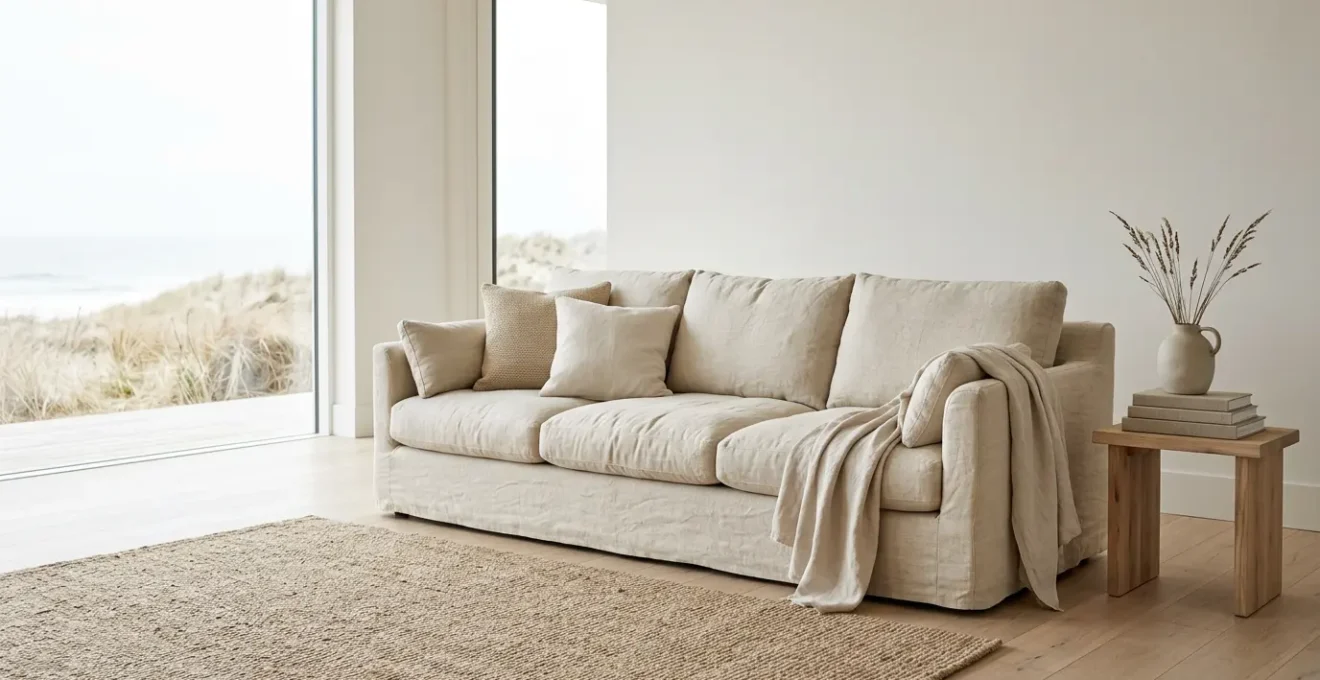
The bad news is you can’t truly stop a 100% linen sofa from wrinkling—it’s inherent to the fiber. The good news is you can manage it to achieve an intentional, elegant look instead of a messy one.
- The tendency to wrinkle is rooted in the molecular structure of flax fibers, a feature known as “textile memory.”
- Effective management relies on choosing the right linen quality, sofa construction (slipcovered is best), and a consistent care routine.
Recommendation: Shift your mindset from fighting wrinkles to curating them. Focus on high-quality, long-fiber linen and use textural layering in your styling to turn wrinkles into a sophisticated design element.
The appeal of a linen sofa is undeniable. It evokes images of breezy, sun-drenched rooms and an air of relaxed, sophisticated elegance. But for the perfectionist, the reality can be a constant battle. You stand up, and a network of creases immediately appears, transforming that chic centerpiece into a rumpled mess. You find yourself constantly smoothing, plumping, and steaming, wondering if this beautiful fabric is more trouble than it’s worth. The common advice is often to buy a synthetic blend or to simply “embrace the wrinkles,” but neither solution satisfies the desire for both the authentic beauty of pure linen and a sense of order.
The truth is, trying to prevent linen from wrinkling is like trying to stop the tide. The fabric’s tendency to crease is not a flaw; it’s a fundamental characteristic of the flax fiber’s molecular structure—its textile memory. The real secret to living happily with a linen sofa isn’t to fight its nature, but to understand and manage it. It’s about making strategic choices from the moment you buy the sofa to the way you care for and style it in your home.
This guide moves beyond the futile fight against wrinkles. Instead, we’ll explore a holistic system for curating a “managed wrinkle” aesthetic. We will delve into the science of the fiber, compare practical choices like slipcovers versus upholstery, and reveal how to protect and even soften your linen over time. By understanding the material’s behavior, you can achieve that coveted look of effortless elegance that feels intentional, not untidy.
To help you master your linen furniture, this article breaks down the key decisions and care techniques into logical sections. Explore the topics below to build a comprehensive strategy for a beautiful, livable linen sofa.
Table of Contents: How to Stop a Linen Sofa From Wrinkling Immediately After Sitting?
- Belgian vs. French Linen: Is the Price Difference Worth It for Upholstery?
- Slipcovered vs. Upholstered: Which Linen Sofa Is Better for Families?
- The Sun Damage Risk: Where Not to Place a Dark Linen Sofa
- Velvet or Cotton: Mixing Textures on a Linen Sofa
- Why Linen Can Feel Scratchy Initially and How to Soften It
- Shutters or Sheers: Which Window Treatment Defines Hamptons Style?
- Vinegar and Baking Soda: The Science Behind Why Mixing Them Is Useless
- Teak vs. Aluminum: Which Weatherproof Material Lasts Longer in Coastal Climates?
Belgian vs. French Linen: Is the Price Difference Worth It for Upholstery?
The journey to managing wrinkles begins before the sofa even enters your home; it starts with the quality of the fiber itself. Not all linen is created equal, and when it comes to upholstery that needs to withstand daily life, the origin and quality of the flax can make a significant difference. Belgian and French linens are often considered the gold standard, and for good reason. They are typically grown in the ideal climate of the Western European “flax belt,” which produces plants with exceptionally long fibers.
Why does fiber length matter? Longer fibers create stronger, smoother, and more resilient yarns. A fabric woven from long-staple flax has greater tensile strength and is less prone to breaking or pilling. While it will still wrinkle, its “bounce-back” or fiber resilience is superior, meaning creases can be softer and more easily released with steaming or smoothing. According to textile research, flax fibers from this region often exceed 80 cm in length, a stark contrast to the shorter fibers used in lower-quality linens that can lead to a rougher texture and more stubborn creases.
While both are premium, there are subtle distinctions. As textile specialists at SELVANE note, the perception of these regional linens varies. They explain:
Belgian linen is often distinguished by its extreme fineness, and Irish linen by its crispness, French linen often embodies a balance of robustness and refinement.
– SELVANE, Belgian vs Irish vs French Linen: Regional Differences
For upholstery, the “robustness” of French linen can be a particular advantage. So, is the price difference worth it? For a piece of furniture intended to last for years, investing in premium European linen is an investment in durability and manageability. You are paying for a superior raw material that will perform better, soften more beautifully over time, and give you a better foundation for achieving that desired “managed wrinkle” look.
Slipcovered vs. Upholstered: Which Linen Sofa Is Better for Families?
Once you’ve settled on the quality of your linen, the next critical decision is the sofa’s construction: should it be traditionally upholstered or feature removable slipcovers? For perfectionists and families alike, the answer is almost unequivocally a slipcovered sofa. This choice is less about aesthetics—as many modern slipcovered sofas are indistinguishable from their upholstered counterparts—and more about pure, unadulterated practicality and control.
An upholstered linen sofa presents a major challenge: it cannot be easily deep-cleaned. Spills must be spot-treated, and deep-set wrinkles from shipping or heavy use require an in-home steamer and significant effort. A slipcover, however, transforms sofa maintenance. It can be completely removed, allowing you to wash away dirt, allergens, and stains in your own washing machine. More importantly for the wrinkle-averse, it allows for superior wrinkle management. You can steam or iron the cover on a flat surface before putting it back on the sofa, a far more effective method than trying to treat an assembled piece of furniture.
This practicality also translates into remarkable longevity and cost-effectiveness, making it a superior choice for family life.
The ability to replace a slipcover extends the life of the entire sofa. Instead of needing to reupholster or buy a whole new piece of furniture due to a catastrophic stain or wear and tear, you can simply order a new cover. This not only saves money but is also a more sustainable approach to furniture ownership.
Case Study: The 12-Year Lifespan of a Washable Slipcovered Sofa
A documented case shows a family successfully maintaining a three-seater sofa for over a decade purely through the use of replaceable, washable slipcovers. The sofa frame remained in perfect condition, and the family was able to keep it looking fresh through spills and daily use by simply washing the covers. The original covers were only recently replaced after 12 years of service, demonstrating a significant cost saving compared to the alternatives of reupholstering or purchasing a new sofa entirely.
The Sun Damage Risk: Where Not to Place a Dark Linen Sofa
You’ve chosen your perfect linen sofa, but where you place it in your room is just as important as the fabric itself. Linen, being a natural cellulose fiber, is vulnerable to environmental factors, especially ultraviolet (UV) radiation from the sun. While we associate linen with sunny rooms, direct and prolonged sun exposure is one of the fastest ways to degrade the fabric, and this risk is magnified with darker-colored linens.
Sunlight doesn’t just fade color; it causes physical damage at a molecular level. The UV rays break down the chemical bonds within the flax fibers, causing them to become brittle and lose their tensile strength. This makes the fabric significantly more prone to tearing and abrasion. For a dark linen sofa—a navy, charcoal, or deep green—the effects are twofold. First, the fading will be much more obvious and uneven, leaving you with a patchy, sun-bleached piece of furniture. Second, as the fibers weaken, the everyday stress of sitting and stretching will cause wrinkles to look less like soft, casual rumples and more like sharp, damaged creases.
As the experts at furniture company Arlo & Jacob wisely advise, placement is a key part of linen care. Their recommendation is clear:
Linen furniture is not suited to places in direct sunlight as the fabric can become sun-damaged. If your living room is naturally bathed in sunlight, we would recommend choosing lighter coloured linen to prevent any obvious fading.
– Arlo & Jacob, How to Care for Linen Upholstery
The ideal spot for a linen sofa, especially a dark one, is in a location that receives only indirect or filtered sunlight. If your room layout demands it be near a window, investing in effective window treatments like UV-blocking films, sheers, or shutters becomes essential not just for ambiance, but for the longevity of your furniture.
Your 5-Step Sun Exposure Audit Plan
- Map the Light: Over the course of a full day, observe and note which areas of your room receive direct sunlight and for how long.
- Identify High-Risk Zones: Mark the spots where direct sun falls for more than 2-3 hours per day, especially during peak afternoon hours.
- Assess Your Furniture: Check your current layout. Is your linen sofa or any other valuable textile-based furniture sitting in a high-risk zone?
- Evaluate Window Treatments: Are your current curtains, blinds, or sheers sufficient to block or filter UV rays? Test how much direct light they let through.
- Create an Action Plan: Based on your findings, decide on a course of action: rearrange the furniture, install UV-protective window film, or upgrade to more effective window coverings.
Velvet or Cotton: Mixing Textures on a Linen Sofa
Once your linen sofa is in place, the art of styling becomes your most powerful tool for managing its appearance. A plain, unadorned linen sofa can make every wrinkle look prominent and accidental. However, by intentionally introducing other materials, you can re-contextualize the linen’s texture. This is the principle of textural layering: using contrast to turn the casual rumple of linen into a deliberate, sophisticated part of a larger design story.
The key is to pair the organic, slightly rough texture of linen with fabrics that are its opposite. Think smooth, plush, or sleek. A pile of velvet cushions, for example, creates an immediate and luxurious contrast. The deep, light-absorbing pile of the velvet makes the linen’s natural weave appear richer and more interesting. The wrinkles are no longer a sign of messiness; they are a background texture that highlights the smoothness of the velvet.
Similarly, a crisp, tightly-woven cotton throw or cushions with a smooth, almost polished finish can provide the same effect. The contrast between the relaxed linen and the sharp, clean lines of the cotton creates a dynamic visual tension. Even materials like leather or a chunky-knit wool can work, each bringing a different character to the mix. The goal is to create a composition where the linen is one of several textures working in harmony.
This strategy is a powerful psychological trick. By surrounding the linen with different textures, you are sending a clear visual signal that every element is intentional. The wrinkles are no longer an oversight to be corrected but an integral part of a thoughtfully curated textural palette. It’s the difference between a wrinkled shirt worn by accident and one that is part of a carefully layered outfit. One looks sloppy, the other looks stylish.
Why Linen Can Feel Scratchy Initially and How to Soften It
A brand-new linen sofa or slipcover can sometimes feel surprisingly crisp, even scratchy, to the touch. This can be disconcerting, especially when you’re expecting a soft, welcoming fabric. This initial stiffness is not a sign of poor quality; in fact, it’s a natural characteristic of new flax fibers. The pectin and other natural waxes that bind the fibers together are still intact, giving the fabric its initial rigidity. The magic of linen, however, is that it gets better with age.
Unlike many other fabrics that wear out, linen wears in. With each wash and with regular use, the fibers relax, the natural waxes break down, and the weave becomes softer, more supple, and more absorbent. This is a key part of the linen ownership experience—you are an active participant in the fabric’s journey to its final, buttery-soft state. As the team at LUXMII beautifully puts it:
The magic of linen is that the more you wash it and wear it, the softer it becomes. Unlike fast fashion items, which can only be donned a handful of times before they fall apart at the seams, linen is ultra-durable.
– LUXMII, How to Soften Linen: 4 Natural Methods for Buttery-Soft Results
While time and use are the best softeners, you can accelerate the process for your washable slipcovers using simple, natural methods. These techniques help to break down the rigid fibers and remove any residual chemicals from the manufacturing process, revealing the true softness of the linen beneath. It’s important to avoid commercial fabric softeners, as they can coat the fibers and reduce linen’s natural absorbency and breathability.
Here are some effective, natural methods to soften your linen slipcovers:
- Wash Regularly: The single most effective method. The mechanical action of the washing machine helps to break down stiff fibers. Always use a gentle cycle with cool or lukewarm water.
- Use White Vinegar: Add half a cup of white vinegar to the final rinse cycle. Vinegar is a natural fabric softener that helps to strip away detergent residue that can cause stiffness.
- Try Baking Soda: Add half a cup of baking soda directly to the wash cycle along with your detergent. It helps to balance the pH levels of the water, which in turn softens the fibers.
- Iron While Damp: If you iron your slipcovers, do it while they are still slightly damp. The combination of heat and moisture helps to relax and smooth the flax fibers, resulting in a softer feel.
Shutters or Sheers: Which Window Treatment Defines Hamptons Style?
The choice of window treatments in a room with a linen sofa is more than a finishing touch; it’s a critical component that controls light and defines the atmosphere. In the context of the breezy, coastal-inspired Hamptons style, both plantation shutters and simple sheer curtains are iconic choices, but they serve different functions that directly impact how your linen furniture looks and feels.
Plantation shutters are the workhorse of Hamptons design. Their louvered slats offer unparalleled light control. You can angle them to bounce light onto the ceiling, creating a bright, ambient glow without any direct, harsh rays hitting your sofa. This is the ultimate form of protection against the UV damage discussed earlier. Aesthetically, their crisp, architectural lines provide a structured counterpoint to the soft, relaxed texture of a linen sofa, creating a balanced and sophisticated look. They offer privacy while still allowing for airflow, reinforcing the easy-living vibe of the style.
Sheer curtains, on the other hand, play a different role. Their primary function is to diffuse, not block, light. A simple panel of white or off-white sheer fabric will soften and scatter harsh sunlight, bathing the room in a gentle, ethereal glow. This kind of light is incredibly flattering to a linen sofa, as it minimizes the harsh shadows that can accentuate every wrinkle, making the fabric’s texture appear softer and more uniform. While they offer less UV protection and privacy than shutters, sheers excel at creating an atmosphere of airy, effortless elegance.
So which one defines the style? The truth is, both do. The choice depends on your priority. If your primary goal is to protect a dark linen sofa and create a structured, classic look, shutters are the superior choice. If you want to create a soft, dreamy, light-filled space that celebrates the relaxed nature of a light-colored linen sofa, sheers are the perfect fit. Often, the most effective solution is to use both: shutters for functional light control and privacy, with sheer panels layered over them to add softness and movement.
Vinegar and Baking Soda: The Science Behind Why Mixing Them Is Useless
In the world of natural cleaning, vinegar and baking soda are often touted as a miracle duo. Many DIY recipes suggest mixing them to create a powerful, fizzing cleaner. However, when it comes to caring for your linen slipcovers, this is one piece of advice you should ignore. The dramatic bubbling reaction you see is actually the two substances neutralizing each other, leaving you with little more than salty water.
The science is straightforward. Baking soda (sodium bicarbonate) is a base, while vinegar (acetic acid) is an acid. When you mix them, they react to form carbon dioxide gas (the fizz), water, and sodium acetate. While the initial fizzing action might seem like it’s doing some heavy-duty cleaning, the resulting liquid has lost the individual cleaning and softening properties of its components. You’ve effectively cancelled out the benefits of both ingredients.
The key to harnessing their power for linen care is to use them separately within the washing process. As the experts at notPERFECTLINEN state succinctly:
Use them separately. Add vinegar to the rinse cycle, or add baking soda during the wash—but not together, as they neutralize each other.
– notPERFECTLINEN, How to Soften Linen Naturally
Used correctly, each ingredient offers distinct benefits. Baking soda, added during the wash cycle, is excellent for deodorizing fabrics and helping to lift stains by creating a slightly alkaline environment. White vinegar, added to the final rinse cycle, works to strip away any lingering detergent residue and mineral deposits from hard water, which are common culprits behind stiff, scratchy fabric. By relaxing the fibers in this final stage, it acts as a brilliant natural fabric softener. Think of them as two specialists that need to perform their jobs at different times, not as a team that works together.
Key Takeaways
- Wrinkles are an inherent feature of linen; the goal is to manage them for an intentional look, not to eliminate them.
- The foundation of a good-looking linen sofa is high-quality, long-fiber fabric and a slipcovered construction for easy maintenance.
- Protect your investment by avoiding direct sunlight, which degrades fibers, and by using proper, separate cleaning agents like vinegar and baking soda.
Teak vs. Aluminum: Which Weatherproof Material Lasts Longer in Coastal Climates?
The philosophy of choosing the right material for the job extends beyond your living room. When creating outdoor spaces, especially in harsh coastal climates with salt-laden air and intense sun, the battle between materials like teak and aluminum comes to the forefront. Just as you choose linen for its specific aesthetic and properties, your choice of outdoor furniture should be a deliberate decision based on performance, maintenance, and style.
Teak is the traditional choice for coastal environments for a reason. It is an incredibly dense hardwood, rich in natural oils that make it highly resistant to water, rot, and insects. When left to the elements, teak doesn’t splinter or decay; instead, it develops a beautiful, silvery-gray patina. This aging process is prized by many designers. However, teak requires maintenance to preserve its original honey color (regular oiling) and is a significantly heavier and more expensive material.
Aluminum, on the other hand, represents a modern, low-maintenance approach. It is lightweight, strong, and, when properly powder-coated, is completely rust-proof, making it ideal for salty air. It won’t rot, warp, or change color over time. Aluminum furniture offers a sleeker, more contemporary aesthetic and is generally more affordable than teak. Its primary downside is that it can get very hot in direct sun, and in high winds, its light weight can be a disadvantage.
So, which lasts longer? Both can have an exceptionally long lifespan in a coastal climate if chosen and cared for correctly. High-quality, grade-A teak can last for decades, with its durability proven on boat decks for centuries. Similarly, a well-constructed aluminum frame with a robust, marine-grade powder-coat finish will resist corrosion for an equally long time. The decision, therefore, comes down to your priorities: Do you prefer the evolving, natural aesthetic and weighty presence of teak, and are you willing to accept the maintenance and cost? Or do you value the static, modern look and set-and-forget ease of aluminum?
To truly achieve a home that is both beautiful and functional, approach every choice with this material-first mindset. Begin your next project not with a style in mind, but with a deep understanding of the materials that will bring that style to life authentically and durably.