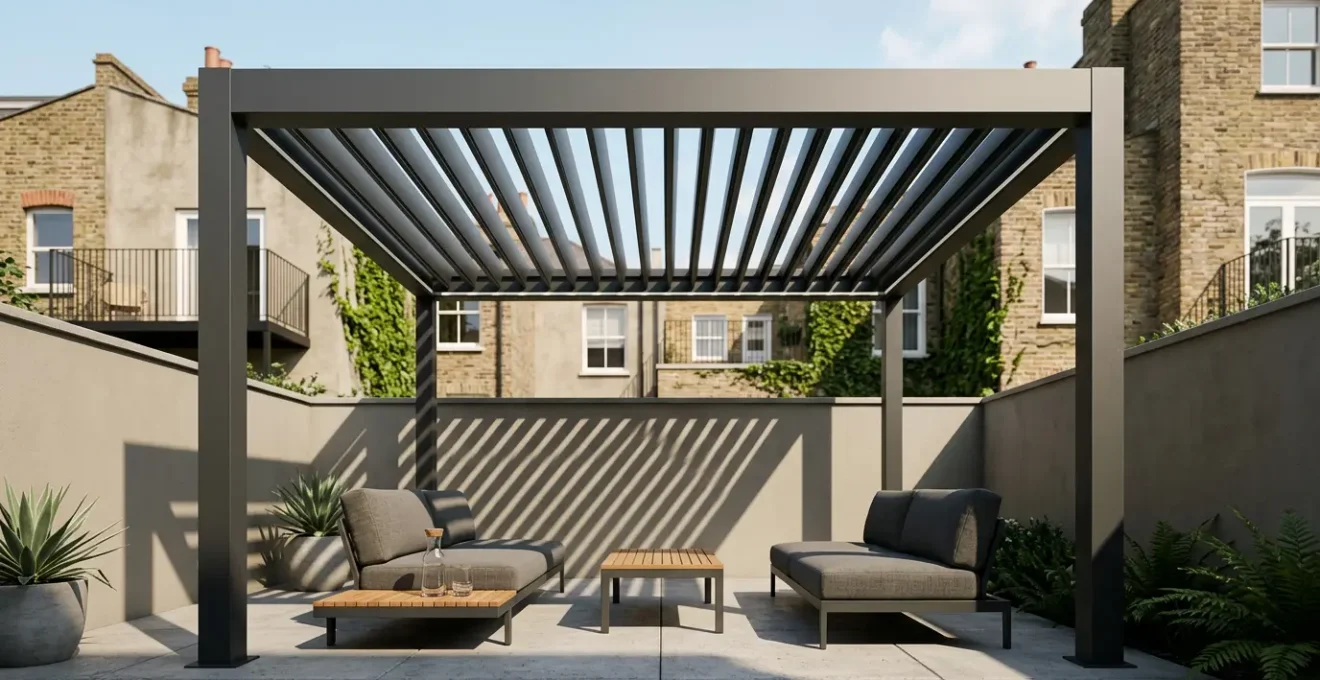
A bioclimatic pergola is a significant financial decision, but for a small patio, it delivers a return on investment that extends far beyond simple shade.
- It actively manages your home’s microclimate, potentially lowering energy bills and protecting valuable outdoor furniture.
- It transforms a constrained, weather-dependent area into a versatile, high-functioning, all-season living space.
Recommendation: Analyze the pergola not as a simple cost, but as a long-term investment in your property’s value and your daily lifestyle.
For homeowners with a compact patio or terrace, the dream of a perfect outdoor oasis often clashes with the reality of limited space and unpredictable weather. You see the sleek, modern lines of a bioclimatic pergola and wonder if it’s an extravagant expense or a genuinely smart upgrade. Traditional solutions like umbrellas or fixed awnings offer basic shade, but they are passive, often flimsy, and fail to truly extend your living area into an all-weather haven. The debate then shifts to high-ticket items, and the question becomes one of pure value.
Most discussions about pergolas focus on generic benefits like “style” or “shade.” They treat it as a static decorative element. But what if the true value of a bioclimatic pergola, especially for a small footprint, lies not in what it *is*, but in what it *does*? Its ability to dynamically control sun, shade, and rain makes it an active architectural asset. This isn’t just about covering your patio; it’s about actively managing your home’s microclimate, protecting your other investments, and unlocking the full potential of every square foot you own.
This article moves beyond the surface-level discussion. We will analyze a bioclimatic pergola as a financial and lifestyle investment. We will deconstruct the key technical features that deliver tangible returns, from automated rain protection and optimal louver orientation to smart home integration and clever drainage. By understanding the performance behind the price tag, you can accurately assess whether this high-tech structure is the right strategic move for maximizing the value and enjoyment of your small outdoor space.
To help you make an informed decision, this guide breaks down the essential factors that determine the real-world value of a bioclimatic pergola on a small patio. Explore the topics below to understand the mechanics, costs, and benefits.
Summary: A Financial and Lifestyle Analysis of Bioclimatic Pergolas
- How Rain Sensors on Pergolas Protect Your Furniture When You’re Not Home
- North vs. South: Which Way Should Pergola Louvers Run for Max Shade?
- Do You Need Planning Permission for a Bioclimatic Pergola?
- How to Hide Wiring in a Motorized Pergola Structure?
- Where Does the Water Go? Designing Drainage for Pergola Gutters
- Wall Panels or Voice Assistants: Which Is More Practical for Guests?
- The Pruning Schedule You Must Follow to Stop Wisteria Taking Over
- How Motorized Shades Can Lower Your AC Bill by 15% in Summer?
How Rain Sensors on Pergolas Protect Your Furniture When You’re Not Home
One of the primary financial arguments for a bioclimatic pergola is its role as a guardian for your other outdoor investments. Expensive patio furniture, cushions, and outdoor rugs can be quickly ruined by a sudden downpour. A rain sensor transforms the pergola from a passive roof into an active protection system, providing significant peace of mind and preventing costly damage. This is a core feature of its “dynamic envelope” functionality.
The mechanism is simple yet highly effective: the moment the sensor detects moisture, it automatically signals the motor to close the louvers completely, creating a watertight seal. This automated response means your outdoor living room remains dry whether you are at work, on vacation, or simply inside and unaware of the changing weather. It eliminates the frantic rush to bring cushions indoors at the first sign of rain. This hands-free protection is a key selling point for homeowners who want a low-maintenance, worry-free outdoor space.
Beyond protecting furniture, this automation contributes to the longevity of the structure itself. By preventing water from pooling and ensuring it’s channeled away correctly, the system minimizes wear on the louver mechanisms and finishes. This proactive management not only safeguards your patio set but also extends the pergola’s lifespan and can reduce energy consumption by maintaining a controlled environment. The value isn’t just in the furniture saved, but in the sustained performance and reduced maintenance of the entire installation over time.
Ultimately, the rain sensor represents a shift from a reactive to a proactive approach in managing your outdoor space, turning a potential liability into a reliable, self-managing asset.
North vs. South: Which Way Should Pergola Louvers Run for Max Shade?
The orientation of your pergola’s louvers is not a minor aesthetic choice; it is the single most critical factor in determining its performance and, therefore, its value. Incorrect orientation can render the “bioclimatic” features ineffective, failing to provide shade when you need it most. For a small patio, maximizing this efficiency is paramount to creating a comfortable microclimate. The decision hinges on the sun’s path across your specific property.
The general rule of thumb depends on your primary goal. Do you need protection from the high, intense sun of midday, or the lower, angled sun of the morning and evening? The direction the rafters (the beams holding the louvers) run determines which type of sun is blocked most effectively. As Modern Kitchen VA, an expert in outdoor space design, points out in their guide:
When your rafters run from east to west, they block the high midday sun most effectively. This orientation creates consistent shade during the hottest hours of the day—typically between 11 AM and 3 PM.
– Modern Kitchen VA, How to Optimize Pergola Orientation for Shade and Airflow
This means if your patio gets blasted by the sun at lunchtime, an east-to-west rafter orientation (with louvers running north-to-south) is your best investment. Conversely, if your main concern is blocking the rising or setting sun, running the rafters from north to south (with louvers running east-to-west) allows you to tilt the blades to a near-vertical position to block that low-angle glare. This choice directly impacts the usability of your patio and the pergola’s ability to reduce heat gain on adjacent windows.
As the visual above suggests, the angle of the louvers interacts with the sun’s angle to create precise shadow patterns. Getting the fundamental orientation right is the foundation of effective microclimate management. Before installation, it is crucial to observe the sun’s path over your patio throughout the day to make a data-driven decision. This simple step ensures your significant investment performs as promised, delivering comfort and energy savings.
Choosing the correct orientation costs nothing extra but multiplies the return on your investment by ensuring the pergola functions at peak efficiency.
Do You Need Planning Permission for a Bioclimatic Pergola?
Before you get lost in the details of louver orientation and smart controls, there’s a critical logistical and financial hurdle to consider: planning permission. The assumption that a pergola is a simple garden structure can lead to costly mistakes. While many smaller installations fall under “permitted development” rights, ignoring local regulations can result in fines or even a forced dismantling of your expensive new asset. Understanding these rules is a key part of your initial investment analysis.
The requirements vary significantly based on your location, but they generally revolve around a few key parameters: height, size, and proximity to boundaries. For instance, in many parts of the UK, a pergola under 2.5 meters high and more than two meters from a boundary line often doesn’t require permission. In the U.S., jurisdictions may have rules based on square footage, with structures under 120 square feet sometimes being exempt. However, if the pergola is attached to your home, is located in a conservation area, or is on the property of a flat or commercial building, the rules almost always become stricter.
Factoring in the cost of a permit is also essential for an accurate ROI calculation. While not always exorbitant, it’s a necessary expense. According to outdoor structure specialists, you should budget for this possibility, as building permit costs in the U.S. typically range from 0.50% to 2.00% of the total construction value. Forgetting this can immediately throw off your budget. To avoid any surprises, a pre-purchase audit of your local council or municipality’s rules is non-negotiable.
Your Pre-Purchase Permit Checklist
- Measure your space: Confirm the planned pergola’s final height and total surface area.
- Check boundary lines: Measure the distance from the proposed structure to all property boundaries.
- Verify attachment status: Determine if the design will be freestanding or physically attached to your house.
- Confirm property rights: Check your local planning portal or office to see if your property has permitted development rights and what specific size/height limits apply.
- Budget for fees: Inquire about the typical permit application fee for a structure of your intended size and cost.
Treating the planning permission process as a formal step in your project plan, rather than an afterthought, protects your investment and ensures its long-term legal standing.
How to Hide Wiring in a Motorized Pergola Structure?
A bioclimatic pergola is a sophisticated piece of technology, and with motors, lighting, and sensors comes wiring. How this wiring is managed is a defining factor that separates a high-end, integrated asset from a clumsy, aftermarket-looking addition. On a small patio, where every detail is visible, exposed cables can completely undermine the sleek, premium aesthetic you’re paying for. Therefore, integrated wiring is a hallmark of a quality investment.
Professional-grade systems are designed from the ground up to conceal all electrical components. The goal is a seamless finish where the technology is felt but not seen. This requires a design that uses the hollow profiles of the aluminum posts and beams as conduits for the wires. This method not only looks better but is also significantly safer, as it protects the wiring from weather, UV degradation, and physical damage. It’s a crucial aspect of the structure’s overall design and a key question to ask any supplier.
The best systems take this integration a step further by building in accessibility for future maintenance, a critical consideration for any long-term asset.
Case Study: The FlexPatio Integrated System
The FlexPatio Pergola Kit provides an excellent example of professional wiring concealment. It runs all electrical components—for the motorized louvers, integrated power outlets, and ambient LED lighting—directly inside the hollow aluminum frame. This creates a completely clean, uncluttered appearance with no visible wires. Crucially, the system is designed with removable access panels, ensuring that while the wiring is hidden from view, it remains accessible for any future maintenance or upgrades without compromising the structure’s integrity.
When assessing a pergola, look for these signs of superior design: power outlets integrated directly into the posts, LED lighting strips set into channels within the beams, and no visible “jumper” cables running between moving parts. This level of architectural integration is a clear indicator of quality and directly contributes to the pergola’s long-term value and aesthetic appeal.
Ultimately, a pergola with perfectly hidden wiring isn’t just about looks; it’s a testament to thoughtful engineering that protects the system’s functionality and your investment for years to come.
Where Does the Water Go? Designing Drainage for Pergola Gutters
While the closing louvers stop rain from falling on your furniture, the water they collect must go somewhere. A poorly designed drainage system can lead to overflowing gutters, splashing, and even water damage to your home’s foundation or patio surface. For a small patio adjacent to the house, effective water management is not a luxury—it’s an absolute necessity. The sophistication of a pergola’s drainage system is a direct measure of its engineering quality and a key component of its overall value.
High-quality bioclimatic pergolas feature a fully integrated gutter system. When the louvers are closed, they form a series of channels. Each louver is designed to direct rainwater into a hidden gutter built into the main perimeter frame. This is the first step in a controlled and contained process. You should never see water cascading off the sides of a well-designed pergola; it should be captured invisibly at the source.
Once in the gutter, the water needs a path to the ground. The most elegant and effective solution is to channel the water from the integrated gutter directly down through the hollow support posts. These posts act as internal downspouts, guiding the water to a designated exit point at the base. This keeps the entire drainage process hidden within the structure’s frame, maintaining a clean, architectural look with no unsightly pipes. The water can then be directed away from the patio into a drain, a soakaway, or a garden bed, preventing pooling and protecting your property.
When evaluating a pergola, inspect the drainage system closely. Ask how the water travels from the louver to the ground. Look for large, deep gutter profiles that can handle heavy downpours and confirm that the downspouts within the posts are of an adequate diameter to prevent blockages from leaves or debris. A robust drainage system is a critical part of the performance ROI, ensuring the pergola protects your space without creating a new water-related problem.
Proper water management is the final piece of the puzzle that makes a bioclimatic pergola a true all-weather extension of your home, not just a fair-weather shade.
Wall Panels or Voice Assistants: Which Is More Practical for Guests?
Once your pergola is installed, its day-to-day value is determined by how easily it can be controlled. When you have guests over on your patio, fumbling with a complex app or shouting precise commands at a smart speaker can feel awkward. The choice of control interface—a physical wall panel versus a voice assistant—directly impacts the user experience and, therefore, the practical enjoyment of your investment. The best solution often depends on who is using it.
A dedicated, weatherproof wall-mounted panel offers unparalleled simplicity and reliability. Its functions are immediately obvious: labeled buttons for “Open,” “Close,” and “Tilt.” There is no learning curve, no need to connect to Wi-Fi, and no specific syntax to remember. This makes it the most practical and intuitive option for guests, children, or anyone unfamiliar with your smart home setup. It just works. A reliable radio frequency (RF) remote can operate through walls from over 60 feet away, providing robust, straightforward control.
Voice assistants like Alexa or Google Assistant, on the other hand, offer advanced functionality and hands-free convenience. You can create complex “scenes,” such as “Movie Mode,” that simultaneously dim the pergola lights, close the motorized shades, and tilt the louvers. However, this power comes with a cost in simplicity. It requires a stable Wi-Fi network and knowledge of the exact voice commands. For a guest, trying to guess whether to say “Open the pergola” or “Activate the louvers” can be frustrating. Smart home integration platform StruXure notes that the ideal system combines these methods, allowing control “through voice commands, home automation, or simple app control.”
For a truly future-proof and user-friendly investment, a hybrid system offers the best of both worlds. The table below, based on data from integrated control systems, breaks down the trade-offs.
| Control Method | Ease for Guests | Reliability | Advanced Features | Weather Resistance |
|---|---|---|---|---|
| Wall Panel (RF) | Intuitive, no learning curve, labeled buttons | Excellent (65ft range, works through walls) | Limited to basic open/close/tilt | Weatherproof when properly rated |
| Voice Assistant (Wi-Fi) | Requires specific command knowledge | Moderate (dependent on network connectivity) | Multi-action scenes, integration with smart home | Indoor module required, outdoor speakers optional |
| Hybrid System | Best of both: simple panel backup | Highest (multiple control options) | Full scene control plus manual override | Comprehensive with redundancy |
The most practical solution is one that doesn’t require a user manual. Providing a simple wall panel ensures your high-tech pergola is always a welcoming and easy-to-use space for your guests.
The Pruning Schedule You Must Follow to Stop Wisteria Taking Over
Integrating climbing plants like wisteria with a pergola can create a stunning, classic look. However, on a high-tech bioclimatic structure, this romantic vision can quickly turn into a costly maintenance nightmare. Wisteria is an incredibly vigorous and powerful vine; if left unchecked, its tendrils can wrap around moving parts, block sensors, and exert enough force to bend or break the delicate louver mechanisms. A strict pruning schedule isn’t just for aesthetics; it’s essential maintenance to protect your investment.
The core of managing wisteria on a motorized pergola is a two-part annual pruning process designed to control its growth and encourage flowering on a manageable framework. This ensures the vine complements the structure without interfering with its function. The schedule is straightforward:
- Summer Pruning (July/August): After the main flowering season, you must cut back all the long, wispy shoots of the current season’s growth. Trim them down to about six inches from the main woody stems, leaving just 5-6 leaves on each shortened shoot. The primary goal here is to stop the vine’s rampant expansion and prevent it from reaching any moving parts.
- Winter Pruning (January/February): With the leaves gone, the plant’s structure is clearly visible. Now, take the shoots you shortened in the summer and cut them back even further, leaving only 2-3 buds on each one. This creates the short, flowering “spurs” that will produce blooms next year and establishes a compact framework that is easy to keep clear of the louver system.
Beyond this biannual schedule, constant vigilance is required. Throughout the growing season, you must perform a monthly inspection. Look for any new tendrils attempting to snake their way into the louver pivots, rain sensors, or wiring channels. These must be removed immediately. Furthermore, be mindful of the vine’s weight. A mature wisteria can become incredibly heavy, potentially exceeding the structural load capacity of a lightweight aluminum pergola. Limiting the number of main vines is crucial to prevent long-term stress on the frame.
While the combination can be beautiful, a wisteria-clad bioclimatic pergola is a long-term commitment. Failing to respect the plant’s power will inevitably lead to expensive repairs and compromise the very functionality you paid for.
Key Takeaways
- A bioclimatic pergola is an active asset, not a passive expense; its value is in its performance.
- Correct louver orientation and integrated drainage are non-negotiable features for effective microclimate control.
- Hidden costs like planning permits and long-term maintenance needs like pruning must be factored into the ROI calculation.
How Motorized Shades Can Lower Your AC Bill by 15% in Summer?
While the louvered roof manages sunlight from above, a significant amount of heat gain on a building comes from low-angle sun hitting windows and glass doors. This is where a bioclimatic pergola’s value multiplies, transforming it from a patio cover into an integral part of your home’s energy efficiency strategy. By adding motorized side shades, you create a complete dynamic thermal envelope around your patio, directly impacting your indoor comfort and cooling costs.
The principle is simple: blocking sunlight before it hits the glass is exponentially more effective than trying to block it from inside with blinds or curtains. A bioclimatic pergola positioned over a patio door or large window can significantly reduce the need for air conditioning by shading rooms adjoining the pergola. In summer, the adjustable louvers block the high midday sun, while integrated motorized screens can be deployed to block the intense, low-angle afternoon sun that an overhead roof can’t catch. This comprehensive solar control prevents the “greenhouse effect” that so often overheats rooms with large windows.
The potential for savings is substantial. While the exact amount depends on your home’s orientation, window efficiency, and local climate, the concept of reducing solar gain is a proven energy-saving strategy. The title’s “15%” figure represents a realistic potential for homes with significant sun exposure on their patio-facing windows. By keeping the adjacent rooms cooler naturally, your air conditioning system runs less frequently and for shorter periods, directly translating to a lower monthly electricity bill. This creates a tangible performance ROI, where the pergola begins to pay for itself over time through energy savings.
To maximize this benefit, consider the pergola and its shades not as an addition to your patio, but as an upgrade to your home’s entire thermal regulation system. This perspective reveals its true value as a smart, long-term financial asset.