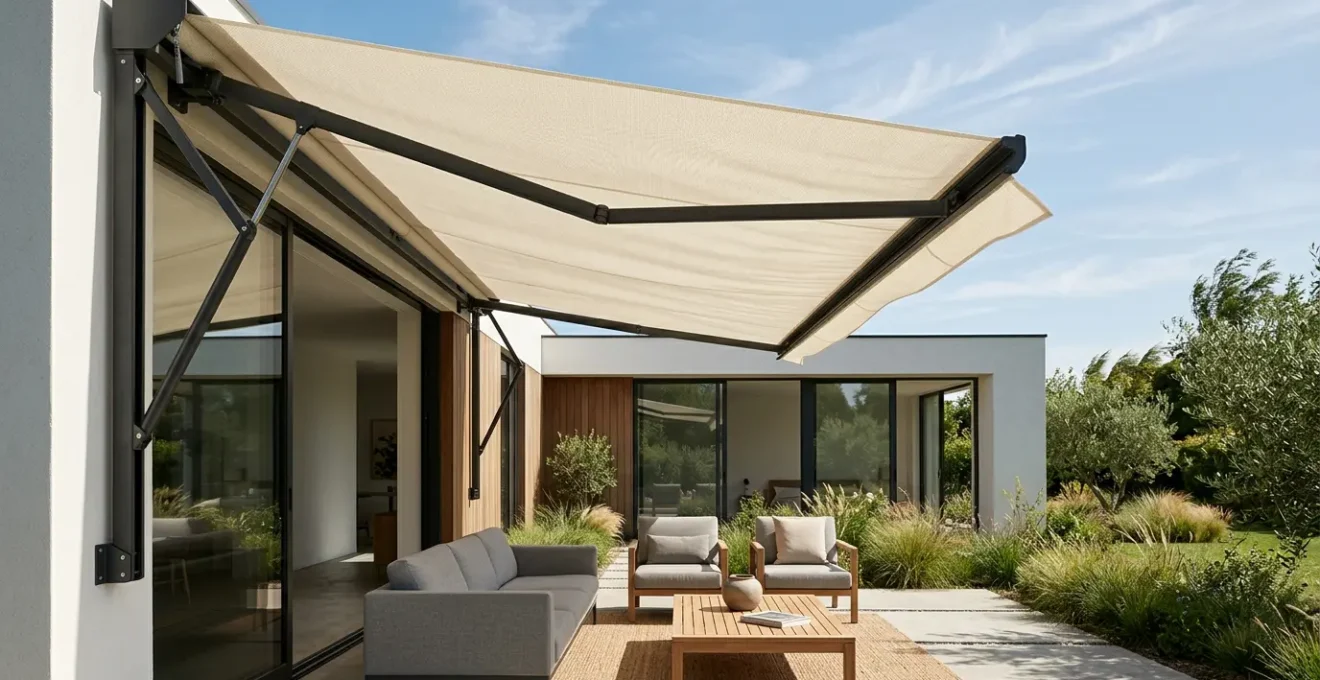
For windy locations, motorized canopies with automated wind sensors offer superior structural protection over manual systems.
- The core advantage is not convenience, but automated stress mitigation that preemptively retracts the canopy during high wind loads, preventing mechanical failure.
- Manual systems rely on user presence and reaction time, making them vulnerable to sudden gusts and potential frame or fabric damage.
Recommendation: Prioritize motorized systems with integrated weather sensors as a crucial safety and longevity feature, not a luxury add-on, in any area prone to gusty conditions.
For homeowners in gusty regions, selecting a retractable canopy is more than an aesthetic choice; it’s an engineering decision with significant consequences. The fear of a sudden windstorm turning a beautiful patio shade into a mangled wreck is a valid concern. The common debate often revolves around the convenience and cost of manual versus motorized systems. Many assume motorized options are simply a luxury, while manual cranks are a reliable, if laborious, default.
This analysis argues for a different perspective. The key to choosing the right system for a windy environment lies not in its method of operation, but in its capacity for automated stress mitigation. We will move beyond the surface-level discussion of convenience and delve into the structural dynamics, failure point analysis, and maintenance protocols that determine a canopy’s resilience. The true value of a motorized system in a high-wind area is not the push-button ease, but its ability to execute an automated weather response, protecting the investment when a human operator cannot.
This guide examines the critical engineering aspects of canopy systems, from fabric technology to maintenance, to provide a clear framework for making a durable and reliable choice. It’s time to reframe the question from “Which is easier?” to “Which is engineered to survive?”.
This article provides a detailed engineering comparison to help you determine the best canopy system for your specific environmental challenges. Explore the key factors that contribute to a canopy’s longevity and performance in adverse weather.
Summary: An Engineering Analysis of Canopy Performance in Windy Conditions
- How to Clean Bird Mess Off a Retractable Canopy Without a Ladder?
- When to Re-Cover Your Awning Instead of Buying a New One
- The Sagging Problem: How to Stop Water Pockets forming on Your Canopy?
- Stripes or Solids: Which Awning Pattern Increases Curb Appeal?
- How to Lubricate Awning Arms for Smooth Operation?
- The Difference Between ‘Water-Resistant’ and ‘Waterproof’ Outdoor Cushions
- The Convenience of “Movie Mode”: Closing Blackout Blinds With a Voice Command
- How to Lower Your Patio Temperature by 10 Degrees Without a Fan?
How to Clean Bird Mess Off a Retractable Canopy Without a Ladder?
Effective maintenance is the first line of defense in ensuring a canopy’s longevity, and here, motorized systems present an immediate, tangible advantage rooted in accessibility. The challenge of cleaning a fully extended canopy without a ladder is a practical safety and efficiency problem. A motorized system transforms this task from a precarious balancing act into a controlled procedure. By allowing the operator to partially retract the awning to an optimal working height, it creates a “Maintenance Mode.”
This precise positioning is not a feature of manual systems, which typically exist in only two states: fully open or fully closed. The ability to stop the fabric at any point allows for safer, more thorough cleaning from the ground using telescopic tools. This reduces the risk of personal injury and damage to the fabric that can occur when leaning ladders against the structure. A clean canopy is not just aesthetically pleasing; it prevents organic matter from degrading the fabric’s protective coatings, which is a key factor in its ability to withstand environmental stressors like UV radiation and moisture.
Ultimately, the motor’s role extends beyond simple deployment. It becomes an integral tool for preventative maintenance, directly contributing to the preservation of the fabric’s material properties and structural integrity over time. A well-maintained fabric is less likely to tear under wind load.
Your Action Plan: No-Ladder Canopy Cleaning Protocol
- For motorized canopies, use the motor to partially retract the awning to a safe, accessible cleaning height, creating a ‘Maintenance Mode’ advantage manual systems cannot replicate.
- Prepare a pH-neutral cleaning solution using mild soap and lukewarm water. Avoid bleach or harsh chemicals that degrade UV-protective and water-repellent fabric coatings.
- Use a soft-bristled telescopic pole brush with a water-fed system to gently scrub the affected area without climbing.
- Rinse thoroughly with clean water using a gentle squeegee attachment to prevent mineral deposits.
- Allow the fabric to air-dry completely before retracting to prevent mold growth.
- Apply a protective spray like 303 Aerospace Protectant to make future cleaning easier and enhance fabric resilience.
When to Re-Cover Your Awning Instead of Buying a New One
The decision to replace only the fabric (re-covering) versus the entire awning system is a critical economic and engineering calculation. The viability of this choice hinges almost entirely on the health of the underlying mechanical structure—the arms, joints, and operational mechanism. A high-quality awning fabric has a substantial lifespan, often lasting 10 to 15 years with moderate use and proper care. However, this is only half of the equation. If the mechanical frame is compromised, installing new fabric is a poor investment.
This is where the distinction between manual and motorized systems becomes crucial. Motorized systems, especially those with automated wind-retraction, are subjected to fewer instances of extreme stress over their lifetime. They avoid the torsional flex and shock loads that a manually operated canopy might endure if left out in a sudden storm. Consequently, their frames are often in better condition at the 10-year mark. A common industry guideline suggests re-covering is a viable option as long as the repair cost does not exceed 50% of a full replacement. As industry experts recommend, if repairs exceed this threshold, replacement is the more financially sound option.
Therefore, before deciding, a thorough inspection of the frame’s pivot points, arm integrity, and (for motorized units) the motor and gearbox is mandatory. A robust, well-maintained motorized frame makes a strong case for re-covering, extending the life of the total investment significantly.
The Sagging Problem: How to Stop Water Pockets forming on Your Canopy?
A sagging canopy that collects water is a significant structural hazard, not just a nuisance. Water is heavy—a single gallon weighs over 8 pounds—and “ponding” or “pockets” of water place immense, localized stress on the fabric, seams, and the entire support structure. This static load dramatically increases the system’s vulnerability to failure, especially when combined with dynamic wind loads. The primary defense against this is ensuring a proper pitch angle during installation.
From an engineering standpoint, the canopy must function as a watershed, not a basin. To achieve this, awning installation experts advise a pitch angle of at least 10 to 15 degrees (approximately 2 inches of drop per foot of projection). This angle uses gravity to ensure water runs off immediately, preventing accumulation. Maintaining proper fabric tension is equally critical. Over time, fabric can stretch, or the arm mechanism can lose tension, creating low spots where water can pool. Regular inspection and adjustment are necessary to maintain this tension.
Motorized systems with robust, spring-loaded arms are often better at maintaining consistent tension across the fabric’s surface throughout their extension and retraction cycle. This consistent tension is key to preventing the initial formation of slack areas that lead to sagging. The visual below demonstrates the goal: a taut surface where water beads and runs off, rather than pooling.
As the image illustrates, a properly tensioned fabric with a functional water-repellent coating forces water to bead up and shed away. This prevents the fabric from becoming saturated and heavy, preserving the structural integrity of the entire assembly and mitigating a primary failure point.
Stripes or Solids: Which Awning Pattern Increases Curb Appeal?
While structural integrity is paramount, the aesthetic impact of an awning—its curb appeal—is a significant factor in the selection process. The choice between striped and solid patterns is less about engineering and more about architectural harmony and visual perception. There is no universal rule; the “better” choice is the one that complements the building’s existing style, color palette, and scale.
Solid-colored awnings offer a modern, monolithic look. They can create a bold statement in a contrasting color or blend seamlessly with the facade for a subtle effect. They are often favored for contemporary or minimalist architecture. Striped patterns, a classic choice, can add a sense of rhythm and character. Wider stripes can feel traditional and stately (e.g., on a colonial-style home), while thinner, more frequent stripes can evoke a more casual, coastal, or café-like ambiance. The key is to ensure the pattern’s scale is proportional to the building’s size.
Beyond pattern, color choice has a thermodynamic impact. It is a well-established principle that light colors reflect more sunlight and absorb less heat. According to the U.S. Department of Energy, this makes lighter solids or patterns with significant amounts of white, cream, or beige more effective at keeping the space underneath cooler. Therefore, from a performance perspective, lighter colors are generally superior for heat reduction, a crucial function of any shade product.
How to Lubricate Awning Arms for Smooth Operation?
Lubrication is a critical maintenance task that directly impacts a retractable awning’s performance and longevity, especially in the context of automated wind response. A motorized system’s ability to retract quickly and smoothly during a wind event is its primary defense mechanism. Sticking, grinding, or slow-moving arms can delay this reaction, leaving the canopy exposed to damaging forces for longer. Proper lubrication ensures the mechanism operates at peak efficiency.
The process is more nuanced than simply applying a generic lubricant. The choice of product is crucial. Oil-based lubricants like WD-40 should be avoided at all costs, as they attract dust, grit, and sand, forming an abrasive paste that accelerates wear on joints and pivot points. The correct choice is a dry, non-stick lubricant, typically a silicone-based or PTFE (Teflon) formula. These lubricants create a slick, dirt-repelling film that reduces friction without attracting contaminants.
The application must be precise, focusing on the moving parts: hinges, pivot pins, and elbow joints in the arms. For manual systems, the gearbox mechanism also requires attention. It is imperative to clean all debris from these joints with a stiff brush and compressed air before applying any lubricant. This prevents trapping grit inside the mechanism.
Your Action Plan: Awning Lubrication Best Practices
- Clean Before You Lube: Use a stiff brush and compressed air to remove debris from joints before applying any lubricant.
- For Manual Systems: Focus on the gearbox, crank mechanism, and arm pivot points.
- For Motorized Systems: Lubricate hinges and pivot points only. Never apply lubricant to the motor housing, electrical wiring, or fabric.
- Choose the Right Lubricant: Use dry PTFE or silicone-based formulas. Avoid oil-based lubricants like WD-40 which attract dust and grit, creating abrasive paste.
- Apply Sparingly: Use small amounts at pivot points and moving joints, wiping away excess to prevent dirt accumulation.
- Schedule Regular Maintenance: Lubricate biannually (spring and fall) to ensure smooth operation during wind-sensor retractions.
The Difference Between ‘Water-Resistant’ and ‘Waterproof’ Outdoor Cushions
The terminology used to describe an awning fabric’s ability to handle rain is precise and has significant engineering implications. “Water-resistant” and “waterproof” are not interchangeable terms. Understanding this distinction is crucial for selecting the right material for a specific climate and avoiding costly water damage. Most standard, high-quality retractable awning fabrics are, by default, water-resistant, not truly waterproof.
Water-resistance is achieved through a combination of a tight fabric weave and a topical chemical coating (often acrylic or Teflon). This finish causes water to bead up and roll off the surface. It is effective for light to moderate rain, provided the awning has an adequate pitch for runoff. However, these coatings wear down over time due to UV exposure and environmental abrasion, requiring reapplication. Furthermore, in heavy or sustained downpours, the hydrostatic pressure can force water through the fabric. This material is highly breathable, which is excellent for dissipating heat and allowing the fabric to dry quickly, thus preventing mildew.
True waterproof fabrics, in contrast, create an impermeable barrier to water. This is typically achieved by laminating a layer of vinyl onto the fabric or using a sealed membrane. While this offers superior protection in heavy rain, it comes with trade-offs. Waterproof fabrics are significantly less breathable, which can trap heat and moisture under the awning, potentially leading to a greenhouse effect. If a waterproof awning is retracted while wet, the trapped moisture has no way to evaporate, creating an ideal environment for mildew and mold growth within the rolled-up canopy.
The following table breaks down the key performance differences between these two fabric technologies.
| Characteristic | Water-Resistant | Waterproof |
|---|---|---|
| Technology | Surface coatings (acrylic or Teflon) that wear off over time | Laminated vinyl layer or sealed membrane |
| Water Handling | Sheds light to moderate rain; requires proper pitch for drainage | Complete water barrier; can handle heavier rainfall |
| Breathability | High breathability; allows airflow to prevent heat buildup | Low breathability; can trap heat and moisture underneath |
| Mildew Resistance | Better resistance when fabric can breathe and dry quickly | Higher risk if moisture gets trapped when retracted wet |
| Best Application | Motorized canopies with rain sensors that auto-retract | Stationary or manual canopies in high-rainfall climates |
The Convenience of “Movie Mode”: Closing Blackout Blinds With a Voice Command
While the concept of “Movie Mode” relates more to interior blinds, the underlying technology—smart home integration and automation—is the single most important factor that elevates a motorized canopy from a convenience item to a sophisticated, self-preserving asset in windy locations. The ability to control a canopy via an app or voice command is a useful feature, but the true engineering advantage lies in its ability to operate autonomously in response to environmental conditions.
Advanced motorized systems can be equipped with a suite of sensors. Sun sensors can extend the awning automatically to provide shade and reduce solar heat gain on the home, while rain sensors can retract it to protect the fabric. Most critically for this discussion, wind sensors (anemometers) provide the ultimate protection against mechanical failure. These sensors continuously monitor wind speed. When gusts exceed a preset, safe threshold (e.g., 20-25 mph), the sensor automatically triggers the motor to retract the canopy. This “automated weather response” happens instantly, whether the homeowner is present or not.
This preemptive action is something a manual canopy can never achieve. A manual system is entirely dependent on a person being physically present, aware of the changing weather, and able to crank the awning closed before damaging winds hit. In a sudden squall, this is often not possible.
Case Study: Automated Weather Response with Wind Sensors
Motorized retractable awnings featuring wind sensors provide active protection for outdoor spaces. When the sensor detects wind gusts above the safety threshold, it initiates an automatic retraction sequence, safeguarding the awning’s arms and fabric from high stress loads. This automated protection is invaluable for homeowners who are away from home or simply cannot react in time to a sudden storm. According to a comparison by Carroll Architectural Shade, this smart technology is a key differentiator. The integration with smart home platforms further allows for custom scenes, such as a “Storm Mode,” which can be triggered by weather forecast data to retract the awning even before the high winds arrive, representing the pinnacle of preemptive structural protection.
Key Takeaways
- Automated Protection is Key: In windy areas, the primary benefit of a motorized awning is its ability to auto-retract with a wind sensor, preventing damage when you’re not home.
- Maintenance is Performance: Proper lubrication with silicone or PTFE-based products ensures fast, smooth retraction, which is critical for the wind sensor’s effectiveness.
- Pitch & Tension are Non-Negotiable: A pitch of at least 10-15 degrees and tight fabric tension are essential to prevent water pooling, which adds stress and increases wind vulnerability.
How to Lower Your Patio Temperature by 10 Degrees Without a Fan?
Beyond protecting against wind and rain, the primary function of a canopy is to create a comfortable, cool outdoor living space. A well-designed awning system can dramatically lower the ambient temperature on a patio by blocking solar radiation before it heats the surfaces below. This cooling effect is not marginal; it can be substantial enough to make an otherwise unusable space pleasant even on hot days.
The effectiveness of an awning as a cooling tool depends on two main engineering factors: its ability to block solar heat gain and the choice of fabric color. Awnings are exceptionally effective at this, and various statistics report that awnings can reduce solar heat gain by up to 77% on west-facing windows, which in turn lowers indoor cooling costs. This same principle applies to the patio underneath, where blocking direct sunlight can result in a temperature drop of up to 15 degrees Fahrenheit. This is achieved without the noise or energy consumption of an outdoor fan.
The fabric’s material and color play a crucial role in its heat-blocking performance. As discussed, lighter colors are more reflective and thus more effective at preventing heat absorption. Darker fabrics, while better at reducing glare, will absorb more heat and radiate some of it downwards. The table below outlines how different fabric and color combinations perform in terms of heat management, allowing for a strategic choice based on climate and desired outcome.
| Fabric Type & Color | Heat Reflection | Heat Absorption | Best Use Case |
|---|---|---|---|
| Light-colored vinyl-laminated | Up to 90% solar heat blocked | Low | Maximum cooling in hot climates; west-facing patios |
| White or cream acrylic | High reflection | Low to moderate | Energy efficiency priority; cooler patio temperatures |
| Dark acrylic (navy, charcoal) | Moderate (around 75%) | Higher | Reduced glare; cozy atmosphere; requires proper airflow |
| Striped multi-tonal pattern | Balanced | Balanced | Camouflages dirt; aesthetic appeal with functional cooling |
In conclusion, the choice between a manual and motorized canopy in a windy location is a clear engineering trade-off. While a manual system may appear simpler and more robust, its reliability is entirely contingent on human intervention. A motorized system, equipped with an automated wind sensor, removes this variable, offering consistent and reliable protection against the primary cause of catastrophic failure: sudden, high-stress wind loads. Investing in automation is investing in the structural longevity of the entire system. Now that you understand the critical differences, the next step is to evaluate your specific location’s weather patterns and architectural needs. A professional consultation can help determine the optimal system and sensor settings for your home to ensure maximum protection and peace of mind.