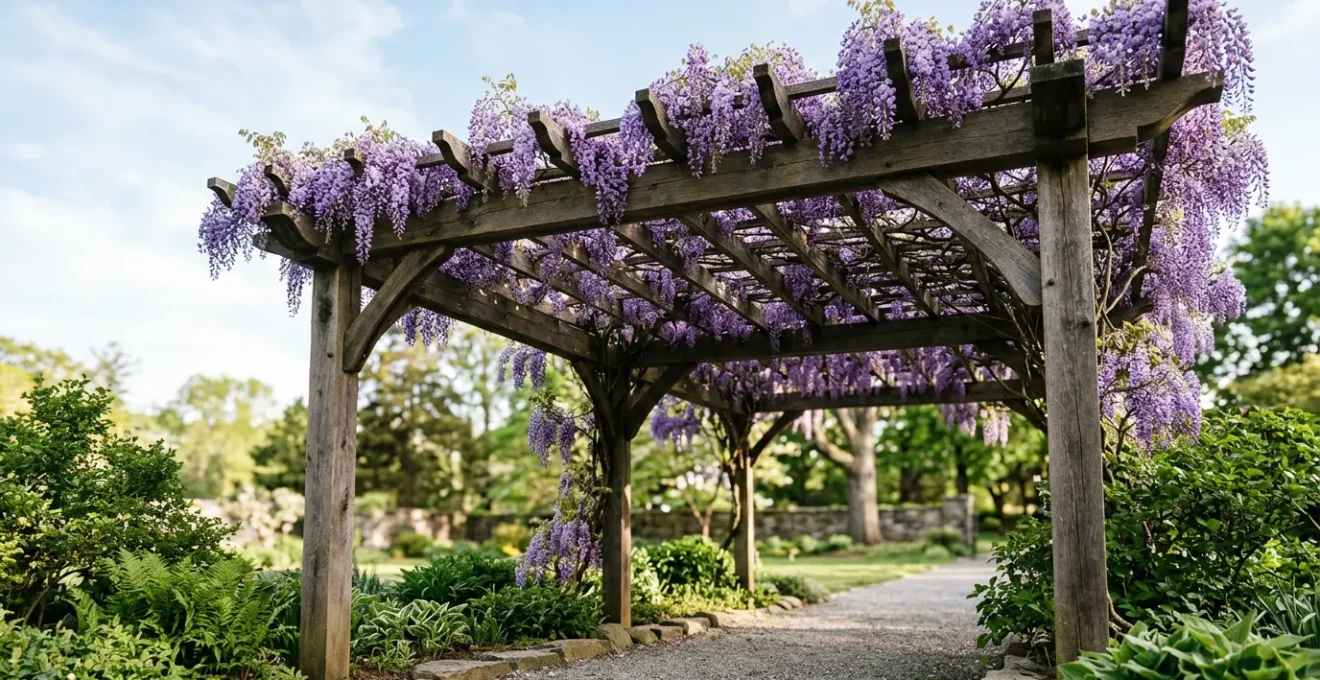
Training wisteria successfully is less about horticulture and more about managing its immense structural load over decades.
- Pruning is a biannual load-management task, not just an aesthetic trim, designed to control the vine’s powerful biomechanical force.
- A high-tensile wire-cable system is structurally superior to wood for supporting the immense weight of a mature wisteria.
Recommendation: For a less aggressive, structurally safer vine on standard pergolas, choose American Wisteria (Wisteria frutescens) over its highly vigorous Asian counterparts.
The vision is intoxicating: a cascade of fragrant, lavender blossoms dripping from a sun-drenched pergola, creating a magical outdoor room. For many gardeners, this wisteria-draped dream is the pinnacle of landscape design. Yet, a nagging fear often accompanies this ambition—the fear of a structure groaning, twisting, and ultimately collapsing under the crushing weight of a mature vine. This concern is not unfounded. The power of a wisteria is a force of nature that can splinter wood and bend metal.
Conventional wisdom offers basic advice: “prune it twice a year” or “build a strong support.” While not incorrect, this counsel barely scratches the surface. It treats wisteria as a common climbing plant, ignoring the profound structural engineering challenge it presents. The reality is that managing a wisteria is a long-term project in applied biomechanics. Its stems thicken into woody trunks that exert incredible torsional and compressive forces, turning a decorative feature into a dynamic, ever-increasing structural load.
This guide reframes the approach. We will move beyond simple horticultural tips to embrace a structural engineering mindset. The key is not to fight the wisteria’s power but to understand and direct it with precision. By managing its growth as a living load, selecting the right materials to contain its force, and even choosing the correct species from the start, you can ensure your pergola not only survives but thrives for decades, becoming the timeless, beautiful feature you envisioned.
This article provides a comprehensive framework for achieving that harmony between plant and structure. We will dissect the essential pruning schedule for load management, analyze the best support systems, and explore how to cultivate a thriving ecosystem around your vine. Read on to master the art and science of training wisteria.
Summary: The Structural Engineer’s Guide to Training Wisteria on a Pergola
- The Pruning Schedule You Must Follow to Stop Wisteria Taking Over
- Will Wisteria Roots Damage My House Foundation?
- Why Is My Wisteria Not Blooming After 5 Years?
- Wire vs. Wood Trellis: Which Supports Heavy Vines Best?
- American vs. Japanese Wisteria: Which Is Less Invasive?
- Do You Need Planning Permission for a Bioclimatic Pergola?
- Bee Hotels: Why Most DIY Versions Fail and How to Build a Good One?
- How to Create a Thriving Ecosystem in a 500 Sq Ft Urban Garden?
The Pruning Schedule You Must Follow to Stop Wisteria Taking Over
Viewing wisteria pruning as a mere aesthetic task is the first and most critical mistake. It is, in fact, an essential practice in structural load management. An unmanaged wisteria is not just overgrown; it’s an exponentially increasing weight and a powerful biomechanical force that will test every joint and beam of your pergola. With some varieties capable of growing 10 feet or more per year, a biannual pruning schedule is non-negotiable for maintaining structural integrity.
The strategy involves a two-pronged attack on its vigorous vegetative growth, redirecting the plant’s energy and controlling its physical expansion. The goal during the first few years is to establish a strong, well-spaced permanent framework of 4-5 main stems. This prevents a chaotic tangle of heavy wood from concentrating weight on one section of the pergola. Once this framework is established, the biannual cycle of pruning begins, designed to keep the plant’s size, weight, and spread in check while encouraging the formation of flower buds.
This disciplined approach transforms you from a simple gardener into a proactive structural manager, ensuring the vine’s beauty doesn’t become a destructive liability. Each cut is a strategic decision to balance aesthetics with the physical limitations of your support structure.
Your Action Plan: Biannual Wisteria Pruning for Structural Control
- Summer Pruning (July-August): This is your primary growth check. Cut back the whippy green shoots of the current year’s growth, leaving about six buds from the main framework. This curbs the vine’s outward expansion and redirects energy into developing flower buds for next year.
- Winter Pruning (January-February): Now you refine the structure. Take those same shoots you shortened in summer and reduce them further to just 2 or 3 buds. This is also the time to remove any dead, damaged, or overcrowded stems, further reducing the overall weight and improving air circulation.
- Framework Establishment (Years 1-3): Be ruthless. Select 4-5 strong, healthy main stems to form the permanent structure and remove everything else. Train these leaders vertically toward the top of the pergola, removing all side shoots to encourage upward growth.
- Horizontal Training (Year 4+): Once your main stems reach the top, encourage horizontal branching to create the canopy. Aim to space these lateral branches 12-24 inches apart to distribute weight evenly and prevent any single beam from bearing a concentrated load.
Will Wisteria Roots Damage My House Foundation?
The impressive power of wisteria is not limited to its visible vines; its root system is equally vigorous, raising valid concerns about proximity to structures like a house foundation. While wisteria roots are not typically the primary cause of foundation damage—they don’t have the force to crack solid concrete—they are opportunistic. If pre-existing cracks or weaknesses exist in a foundation, the fine, searching roots can and will penetrate them. Once inside, they will expand, exacerbating the crack and potentially leading to significant structural issues over time.
The primary risk comes from planting the vine too close to your home. The roots seek moisture, and the soil near a foundation can often be a reliable source. A safe planting distance is crucial; a minimum of 10-15 feet from any foundation or underground utility line is a wise precaution. This provides a buffer zone, reducing the likelihood that the root system will interact with your home’s structural base.
The vigorous nature of the plant, both above and below ground, demands respect and careful planning. As the experts at Backyard & Beyond warn, neglect can be costly. Their advice underscores the importance of considering the entire plant as a powerful, dynamic system:
If neglected, wisteria’s vigorous growth can damage your pergola, as the vines are capable of threading and twisting around the structure’s support beams. If planted too close to your home or underground pipes, wisteria roots can cause the same sort of damage.
– Backyard & Beyond Garden Experts, Backyard & Beyond – How to Train Wisteria on a Pergola
Therefore, the decision of where to plant your wisteria is the very first step in long-term structural management for your entire property, not just the pergola.
Why Is My Wisteria Not Blooming After 5 Years?
Waiting years for a wisteria to bloom only to be met with a profusion of leaves is a common and profound frustration. The primary culprit is often not a lack of care, but a case of misplaced energy. From a botanical engineering perspective, the plant is operating on a “nutrient budget.” If its budget is too rich in nitrogen—often from being planted in fertile soil or near a heavily fertilized lawn—it will invest all its resources into producing vigorous vegetative growth (leaves and stems). This adds more structural load to your pergola but yields zero flowers.
The solution is to force a shift in its energy allocation, encouraging it to invest in reproduction (flowers) instead of expansion (leaves). This involves strategically altering its nutrient intake to favor phosphorus, a key element for bloom development. The goal is to create a slight level of stress, signaling to the plant that its comfortable expansionist phase is over and it’s time to focus on flowering.
Another critical factor, especially with older plants, is their origin. Many wisterias are grafted onto rootstock. If the graft union fails and the plant is growing from the rootstock, or if it was grown from seed in the first place, it can take 7 to 15 years to reach maturity and bloom. A grafted plant, in contrast, should bloom within 3 to 5 years. Checking for the graft union—a visible swelling or change in bark texture near the base—can diagnose this issue.
- Step 1: Adjust the Nutrient Budget. Add a high-phosphorus fertilizer (like a 0-20-0 formulation) to the soil in early spring. This directly counters the excess nitrogen and provides the resources needed for flower formation.
- Step 2: Perform Root Pruning. In the fall, drive a sharp spade into the ground in a circle about 3 feet from the trunk. This severs some of the surface roots, reducing the plant’s ability to absorb excess nitrogen from the surrounding soil.
- Step 3: Conduct a Soil Test. To work with precision, test your soil. If nitrogen levels are above 35 ppm, cease all spring fertilization. You are already providing too many resources for leafy growth.
- Step 4: Check the Graft Union. Locate the base of the plant. If you cannot find a noticeable graft union, you may have a seed-grown plant, and patience is your only recourse.
Wire vs. Wood Trellis: Which Supports Heavy Vines Best?
Choosing a support system for wisteria is not an aesthetic choice; it is a critical engineering decision. While a wooden trellis or pergola offers a classic, rustic appeal, it is often fundamentally unsuited to the long-term structural demands of a mature wisteria. Wood is susceptible to rot, warping, and insect damage, and the immense, twisting force of the vine’s woody stems can easily splinter and destroy insufficient supports within a few years. For a plant that lives for decades, a support system that requires frequent replacement is a losing battle.
An engineered wire/cable system is, by every structural metric, the superior choice. Composed of high-tensile galvanized or marine-grade stainless steel cables, eye bolts, and turnbuckles, this system offers immense load capacity, flexibility, and longevity. The wires themselves are visually unobtrusive, disappearing beneath the foliage and allowing the wisteria itself to be the star. Most importantly, the tension can be adjusted over time with turnbuckles to accommodate the vine’s increasing weight, a feature impossible with a rigid wooden structure.
For a heavy vine like wisteria, professional standards recommend using 11-12.5 gauge high-tensile wire for the main load-bearing horizontals. This is not just a suggestion; it’s an engineering specification designed to prevent sagging and failure over the long term. Investing in a properly engineered wire system is a higher upfront cost, but it provides peace of mind and is far better long-term value than replacing a crushed wooden trellis every few years.
The following table, based on a comparative analysis of trellis materials, starkly illustrates the differences in performance, durability, and maintenance.
| Characteristic | Wire/Cable System | Wood Trellis System |
|---|---|---|
| Load Capacity | High-tensile galvanized steel cable can support enormous weight when properly anchored (marine-grade stainless recommended for wisteria) | Wood trellises can warp, crack, or rot over time; insufficient for mature wisteria unless using 6×6 posts |
| Lifespan | Metal trellises last approximately 10 years minimum; properly tensioned cable systems can last decades | Wooden trellises last 3-4 years untreated; up to 20 years with tanalised wood and proper maintenance |
| Adjustability | Highly flexible – wires can be added or repositioned as vine grows; turnbuckles allow tension adjustment | Fixed structure; difficult to modify once vines are established |
| Maintenance | Low maintenance after installation; requires annual tension checks | Requires regular sealing, painting, or staining to prevent rot; susceptible to insect damage |
| Installation Cost | Higher initial cost but better long-term value | Lower upfront cost but may need replacement within 5 years |
| Aesthetic | Visually unobtrusive; wire disappears beneath mature vine | More decorative before plant coverage; traditional cottage garden appeal |
American vs. Japanese Wisteria: Which Is Less Invasive?
The single most important structural decision you will make happens before a single hole is dug: choosing the right species. Not all wisterias are created equal. The popular Asian species, Japanese Wisteria (*Wisteria floribunda*) and Chinese Wisteria (*Wisteria sinensis*), are infamous for their extreme vigor and invasive tendencies. They grow at an explosive rate, developing massive, heavy woody vines that can reach over a foot in diameter and extend up to 100 feet. While their dramatic, long flower clusters are stunning, they require a heavily engineered, over-built pergola to support their immense weight and are listed as highly invasive in many regions.
For most residential applications, the native American Wisteria (*Wisteria frutescens*) is a far superior and structurally safer choice. It is significantly less aggressive, with a slower growth rate and lighter wood density. This makes its weight and size much more manageable on a standard pergola. While its flower clusters are shorter and more compact, they are still beautiful and appear later in the spring, often reblooming in the fall. Crucially, it is non-invasive and supports local ecosystems.
Identifying the species is key. One of the most reliable methods, besides flower and leaf characteristics, is the texture of the seed pods: Asian wisterias have velvety, fuzzy pods, while the American species has smooth pods. The direction of the vine’s twist is another clue: Japanese wisteria twines clockwise (like its American cousin), while Chinese wisteria twines counter-clockwise. This information is critical for managing an existing vine or making a new purchase.
The following table, drawing from data provided by university extension research, details the critical differences that impact structural planning.
| Characteristic | American Wisteria (W. frutescens) | Japanese Wisteria (W. floribunda) | Chinese Wisteria (W. sinensis) |
|---|---|---|---|
| Invasiveness | Non-invasive; native to southeastern U.S. | Highly invasive; listed as invasive in Mid-Atlantic and Southeast states | Highly invasive; listed as invasive in Mid-Atlantic and Southeast states |
| Twining Direction | Clockwise | Clockwise | Counterclockwise |
| Flower Cluster Length | Shorter, 5-10 cm, compact pinecone-shaped racemes | Very long, 10-50 cm, dramatic trailing clusters | Medium, 15-20 cm, all flowers open simultaneously |
| Bloom Time | Late spring/early summer (May-July); may rebloom in fall | Early spring (April-May) before leaves | Early spring (April-May) before leaves |
| Mature Weight/Vigor | Less aggressive; lighter wood density; slower growth | Extremely vigorous; can extend up to 100 feet; heavy woody vines over 15 inches diameter | Very vigorous; rapid growth rate; heavy mature vines |
| Seed Pods | Smooth, glabrous, 2-4 inches long | Velvety, fuzzy, 4-6 inches long | Velvety, fuzzy, 4-6 inches long |
| Leaflet Count | 9-15 leaflets | 13-19 leaflets | 7-13 leaflets (typically 11) |
| Best Use for Pergola | Ideal for smaller pergolas; easier structural management | Requires heavily engineered pergola; dramatic floral display | Requires robust structure; profuse flowering |
Do You Need Planning Permission for a Bioclimatic Pergola?
The question of planning permission often arises when installing substantial garden structures, and a pergola robust enough for wisteria certainly qualifies. While rules vary significantly by local jurisdiction, a “bioclimatic” pergola—typically featuring a louvered roof and a more permanent construction—often crosses the threshold from a simple garden feature to a regulated structure. Because wisteria is infamous for demolishing inadequate supports, the structural advice is always to overbuild your pergola. This necessity for a stout, securely footed structure often pushes it into a category that requires a permit.
Several universal triggers almost always necessitate a conversation with your local planning authority. These are not just bureaucratic hurdles; they are safety measures related to structural integrity, property lines, and land use. Any pergola attached directly to your house is almost certainly going to require a permit, as it is considered an extension of the dwelling. Likewise, structures exceeding a certain height (often around 10 feet or 3 meters) or those built with permanent concrete footings fall into a more permanent classification that is regulated.
Before you even begin construction, it is imperative to check with your local municipal office. Going ahead without necessary permissions can lead to fines and orders to dismantle your structure. The following checklist outlines common triggers, but it is not a substitute for official local guidance.
- Height Threshold: Does the pergola exceed 3 meters (approximately 10 feet) in total height? Taller structures often require permits.
- Attachment to Dwelling: Is the pergola physically attached to your house? If so, it is almost always considered an extension and needs a permit.
- Property Coverage: Does the structure’s footprint cover a significant percentage of your property (e.g., more than 30-40%)? Jurisdictions have limits on lot coverage.
- Property Line Proximity: Will the structure be built on or very close to a property boundary? This often requires both a permit and neighbor notification.
- Foundation Type: Does the design call for deep concrete footings? This classifies it as a permanent structure, which typically requires a permit, unlike structures on temporary post spikes.
Bee Hotels: Why Most DIY Versions Fail and How to Build a Good One?
Once you have mastered the structural aspects of your wisteria and pergola, you can elevate the project from a mere feature to a functioning piece of an ecosystem. A pergola draped in wisteria is a magnet for pollinators, and you can amplify this benefit by integrating a “bee hotel” directly into the structure. However, many popular DIY bee hotels do more harm than good. They often feature holes that are too wide, too short, or made of materials that retain moisture, leading to mold and disease that kill the bee larvae they are meant to protect.
A good bee hotel provides safe, clean nesting cavities for non-aggressive, solitary native bees like mason bees and leafcutter bees. These are crucial pollinators. The key is to use deep holes (5-6 inches), a variety of small diameters (3/32″ to 3/8″), and materials that breathe, like natural wood or replaceable paper tubes. The hotel should be placed in a sunny, protected spot, ideally facing south-east.
The strategic value of this integration is highlighted when using American Wisteria. As documented in a case study on its ecological role, American Wisteria’s later bloom time (May-July) provides a critical food source for native bees during their brood-rearing period. By placing a correctly built bee hotel on the posts of the pergola supporting the wisteria, you create a perfect pollinator service station: a one-stop shop for both food and lodging. This is a masterful example of ecosystem integration, where the structure and the plant work together to support local biodiversity.
This approach moves beyond simple gardening and into the realm of ecological design, creating a feature that is not only beautiful but also environmentally productive. It’s a way to give back to the ecosystem that your wisteria so effectively attracts.
Key Takeaways
- Treat wisteria training as a long-term structural engineering project, not just a gardening task, by actively managing its biomechanical forces.
- Always choose a high-tensile wire-cable system over a wood trellis for a mature wisteria. The superior load capacity and adjustability are essential for long-term structural integrity.
- Select the less aggressive American Wisteria (W. frutescens) for a beautiful and structurally manageable vine that is also non-invasive and beneficial to local ecosystems.
How to Create a Thriving Ecosystem in a 500 Sq Ft Urban Garden?
A wisteria-trained pergola, when managed correctly, transcends its role as a simple garden feature. It becomes the architectural and ecological anchor of your space, especially in a compact urban garden. In as little as 3-4 years, a wisteria can fully cover a pergola, creating a dynamic, multi-layered canopy. This canopy establishes a unique microclimate beneath it, offering shade, trapping humidity, and providing shelter that allows a new community of understory plants like ferns and hostas to thrive where they previously could not.
This vertical ecosystem becomes a hub of biodiversity. The cascade of blooms is a powerful attractant for a wide range of pollinators, and as we’ve seen, integrating bee nesting sites can create a self-sustaining habitat. The dense foliage provides nesting sites and cover for birds, while the fallen leaves and blossoms contribute to the organic matter in the soil, enriching the garden floor.
The long-term potential of this integration is nothing short of extraordinary. Consider the case study of a single wisteria plant at the Visco-Coffele Palace in Soave, Italy. For over 120 years, this vine has grown on a wrought-iron gazebo, creating a permanent, living structure that defines the courtyard. It is a testament to the idea that with proper structural support and thoughtful management, a wisteria doesn’t just occupy a space; it creates an entire, self-sustaining ecosystem hub, even in a very limited footprint.
By applying the engineering principles outlined in this guide, you are not just preventing your pergola from being crushed. You are laying the foundation for a thriving, vertical ecosystem that will bring decades of beauty, shade, and wildlife to your garden.
Begin applying these structural principles today to cultivate a wisteria that provides generations of beauty without compromising the integrity of your garden’s architecture.