In summary:
- Natural fiber issues like shedding or wrinkling are manageable when you understand the material’s properties and choose the right construction for your needs.
- The biggest safety risk for hardwood floors comes from the chemical reaction of cheap rug pads, not the natural rug itself.
- A sophisticated look with natural fibers comes from prioritizing authentic textures and a refined color palette over literal, theme-park-style motifs.
- Layering rugs and selecting the right weave (e.g., flatweave for high traffic) allows you to enjoy natural beauty even in a busy, pet-friendly home.
There’s an undeniable allure to natural fibers. The earthy texture of a jute rug or the relaxed elegance of a linen sofa can instantly elevate a space, promising a home that feels both stylish and grounded. For pet owners, however, this aesthetic dream often clashes with a practical nightmare. You envision a beautiful, textured foundation for your room, but you also picture pet accidents, shedding, and delicate materials that just can’t withstand daily life. The common advice is often to simply avoid these materials in a busy household, sacrificing the look you love for the sake of practicality.
Many guides will offer surface-level tips on spot cleaning or choosing dark colors. But what if the key wasn’t about compromise, but about knowledge? The secret to successfully incorporating natural fibers into a home with pets and people isn’t about avoiding spills; it’s about making smart, application-specific choices from the start. It requires a shift in perspective—from seeing these materials as fragile liabilities to understanding their inherent properties and fiber engineering.
This guide moves beyond the generic warnings. We’ll delve into the science behind the style: why certain weaves last longer in hallways, how a rug pad can be a chemical hazard, and why your linen sofa’s wrinkles might be the fault of its internal fill, not the fabric. By understanding the ‘why’ behind the ‘how,’ you can build a durable, beautiful, and livable home filled with the natural textures you’ve always wanted, without the fear of it all falling apart.
To help you navigate these choices, this article breaks down the most common questions and challenges, providing specific, solution-oriented answers. Explore the table of contents below to jump directly to your most pressing concerns.
Summary: Your Guide to Mastering Natural Fibers
- Why Does My Jute Rug Shed and How Do I Stop It?
- Is Jute Too Rough for a Nursery? Alternatives for Soft Natural Texture
- Chunky Loop vs. Flatweave: Which Jute Style Lasts Longer in Hallways?
- The Safety Risk of Natural Rugs on Hardwood Floors
- How to Layer a patterned Rug Over Jute for a Boho Look?
- How to Transition Flooring Between Rooms Without Ugly Threshold Strips?
- The Decor Mistake That Turns Coastal Style into a Theme Park
- How to Stop a Linen Sofa From Wrinkling Immediately After Sitting?
Why Does My Jute Rug Shed and How Do I Stop It?
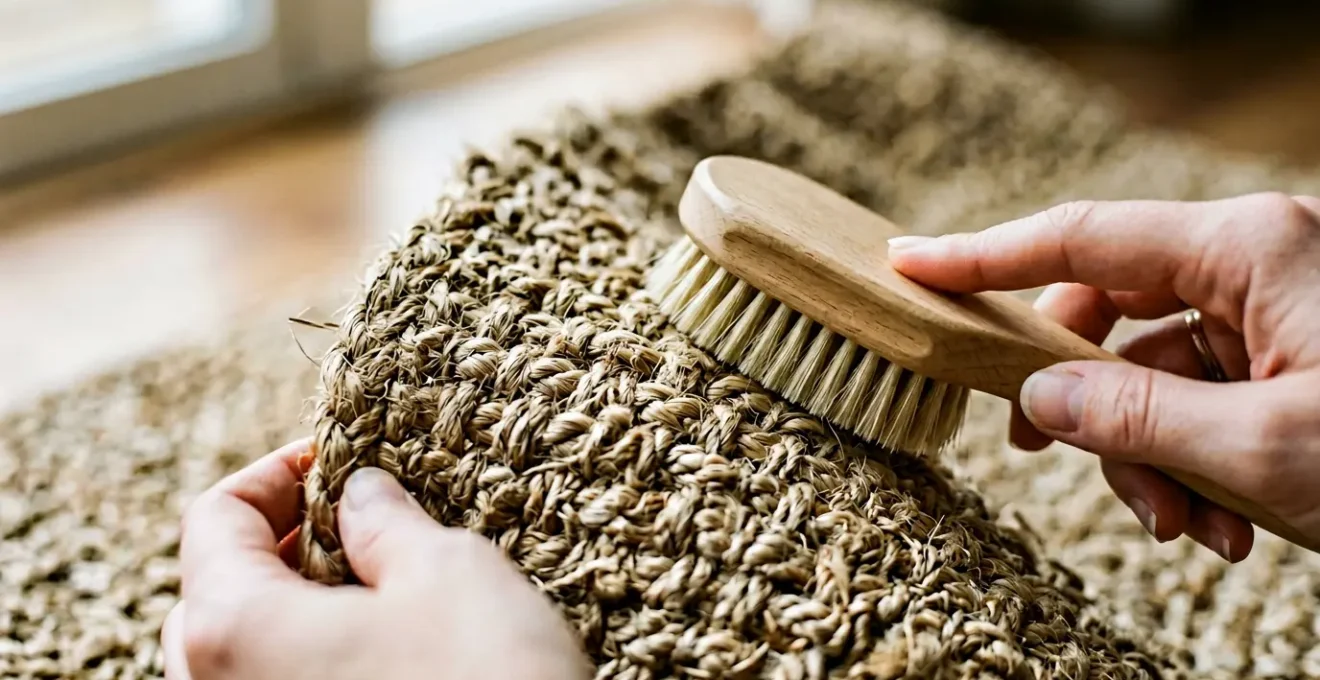
The initial shedding from a new jute rug can be alarming, especially for pet owners who are already battling pet hair. It’s crucial to understand that this is not a defect but a natural characteristic of the fiber. According to rug care experts, jute is the most shedding natural fiber among common plant-based materials. The short, somewhat brittle fibers on the surface break and work their way out, creating “rug dust.” The good news is that this is most intense when the rug is new and can be managed effectively with the right approach.
The key is to remove loose fibers proactively rather than letting them get ground in. A vacuum cleaner without a beater bar is your best tool. Using the beater bar can be too aggressive and may pull out or break more fibers, worsening the problem. Instead, use a suction-only attachment and go over the rug regularly. For a brand new rug, you might do this two to three times in the first week to capture the initial bulk of loose material. Over time, the shedding will naturally decrease to a minimal level.
To drastically reduce shedding from the start and for the long term, consider these structural and preventative measures:
- Vacuum Regularly: Start by vacuuming once or twice a week with a suction-only setting to remove loose surface fibers before they become airborne.
- Choose Low-Traffic Areas: If possible, place a new, shedding-prone jute rug in areas with less foot traffic to minimize fiber breakage.
- Use a High-Quality Rug Pad: A dense rug pad provides a cushion that absorbs the impact of foot traffic, reducing the friction and stress on the jute fibers.
- Beat It Out (Initially): For a brand-new rug, take it outdoors and give it a few gentle whacks with a carpet beater to release the most significant amount of excess fibers from the manufacturing process.
- Select a Tighter Weave: When purchasing your next jute rug, opt for a tightly woven flatweave style. These constructions have less room for fibers to come loose compared to chunky, looped weaves.
By treating shedding as a manageable feature of the fiber’s “break-in” period, you can enjoy the texture of jute without the constant cleanup. The initial effort pays off in a stable, beautiful, and less-sheddy rug for years to come.
Is Jute Too Rough for a Nursery? Alternatives for Soft Natural Texture
The desire for a natural, non-toxic nursery is strong, and jute often comes to mind for its eco-friendly credentials. However, its primary drawback is its texture. For a baby’s delicate skin during tummy time, jute’s coarse and scratchy surface is far from ideal. While it is naturally hypoallergenic, its roughness makes it a poor choice for the primary play surface. This doesn’t mean you have to abandon the natural aesthetic; it simply requires a more strategic, application-specific choice of materials.
A brilliant solution is layering. Use a large jute rug as a durable, affordable, and texturally rich base layer that defines the space. Then, place a smaller, ultra-soft rug on top in the main play area. This gives you the best of both worlds: the grounded, earthy look of jute framing the room, and a plush, safe surface right where your baby will be. As the Gentle Nursery Editorial Team notes in their guide, “The Softest, Safest Non-Toxic Rugs for Baby Nurseries”:
Jute and sisal are eco-friendly and biodegradable, but slightly rougher textures — better for decorative purposes or older babies.
– Gentle Nursery Editorial Team
This layering approach is beautifully functional. The top rug can be an organic cotton or wool piece that is not only soft but often machine-washable—a huge plus for any nursery. This “sacrificial” soft layer handles the spills and daily wear, while the jute base remains protected.
When selecting materials for a nursery, softness is just one factor. Cleanability and hypoallergenic properties are equally vital. The following table provides a clear comparison of common natural fiber options, helping you make an informed decision for your child’s space.
| Material | Softness Level | Cleanability | Hypoallergenic | Nursery Suitability |
|---|---|---|---|---|
| Jute | Low (rough texture) | Moderate (dry cleaning only) | Yes (natural fiber) | Better as base layer |
| Organic Cotton | High (very soft) | High (machine washable) | Yes (breathable) | Excellent for tummy time |
| Wool | High (plush) | High (stain-resistant) | Yes (natural) | Excellent for play areas |
| Sisal-Wool Blend | Medium-High | Moderate | Yes | Good balance of durability and softness |
Chunky Loop vs. Flatweave: Which Jute Style Lasts Longer in Hallways?
Not all jute rugs are created equal, especially when it comes to durability in high-traffic zones like hallways. The choice between a chunky, looped pile and a tight flatweave is a critical decision that impacts not only the rug’s lifespan but also its safety and maintenance. While a chunky loop rug offers a cushy, highly textural feel underfoot, its open construction is its biggest weakness in a corridor. The raised loops are prone to snagging on shoes, pets’ claws, or even the vacuum cleaner, leading to pulled threads and premature wear. Furthermore, the valleys in the weave trap dirt, making it much harder to clean.
For a hallway, a jute flatweave is unequivocally the superior choice for longevity. The fiber engineering of a flatweave involves a tight, interlocking construction that creates a dense, low-profile surface. This structure has several key advantages:
- No Snagging: The flat surface offers nothing for heels or claws to catch on.
- Easier Cleaning: Dirt and debris sit on the surface rather than getting trapped deep within the pile, making vacuuming far more effective.
- Better Stability: Flatweaves are less likely to crush or mat down under constant foot traffic, maintaining their appearance over time.
The superior performance of this construction is why certain types are even used in commercial settings. This is a clear indicator of their ability to withstand intense use.
High-Traffic Flatweave Performance Analysis
For maximum durability in the most demanding areas, look for flatweave rugs that include an integrated stabilizing backing. These contract-grade rugs are specifically engineered for commercial settings like hotel lobbies and offices due to their exceptional stability and resistance to wear. This construction is ideal for residential entryways, kitchens, and hallways where foot traffic is most concentrated, ensuring the rug maintains its structural integrity.
Regardless of the weave, one factor can dramatically extend its life: a quality rug pad. Research on rug durability shows that high-quality dense felt rug pads can effectively double the lifespan of natural fiber rugs. The pad acts as a shock absorber, cushioning the impact from every footstep and preventing the rug’s fibers from being ground against the hard floor beneath.
The Safety Risk of Natural Rugs on Hardwood Floors
When placing a natural fiber rug like jute or sisal on a hardwood floor, most people worry about two things: slipping and scratching. While a good grip pad can prevent slipping and the softness of jute is unlikely to scratch a modern floor finish, the most significant and often overlooked risk comes from the rug pad itself. Choosing the wrong pad can cause permanent, irreversible damage to your hardwood’s finish through a chemical process called off-gassing.
Many inexpensive rug pads are made from PVC (plastic) or low-quality synthetic rubber. These materials contain plasticizers and chemicals that are not stable. Over time, especially when exposed to heat from sunlight or underfloor heating, these chemicals can leach out of the pad as a gas. This gas gets trapped between the pad and the floor, where it chemically reacts with the polyurethane or other finish on your hardwood. This reaction can lead to a cloudy, hazy discoloration or a sticky residue that cannot be cleaned off because it has altered the finish itself.
The National Wood Flooring Association (NWFA), a leading authority on hardwood care, explicitly warns against this. In their guidance, they highlight the danger these materials pose:
Rubber and vinyl pads can off-gas chemicals when exposed to heat or sunlight. This off-gassing can react with your floor’s finish, causing a dull or hazy appearance. Combined with UV exposure, it can lead to uneven discoloration.
– National Wood Flooring Association (NWFA), The Ultimate Guide to Flooring Safe Rug Pads
To avoid this, you must choose a pad made from materials that are safe for your floor’s finish. The two best options are 100% natural rubber and dense, recycled felt. Natural rubber provides excellent grip without the harmful chemicals, while felt offers superior cushioning and protection from furniture indentations. The ultimate solution, often recommended by flooring experts, is a hybrid pad that combines both.
Your Action Plan: Choosing a Hardwood-Safe Rug Pad
- Good Tier (Grip-Focused): Opt for a natural rubber pad. This eco-friendly material provides excellent non-slip grip and is biodegradable. It’s best for hallways or areas where slipping is the main concern.
- Better Tier (Cushion-Focused): Choose a dense felt pad (at least 1/4 inch thick). This adds luxurious cushioning underfoot, protects floors from heavy furniture impressions, and significantly extends the life of your rug.
- Best Tier (Hybrid Solution): Select a hybrid felt-and-rubber pad. This combines a solid felt core with a natural rubber backing. It offers the best of both worlds: superior cushioning, insulation, and non-slip grip, while creating a breathable, chemically safe barrier for your hardwood.
How to Layer a patterned Rug Over Jute for a Boho Look?
Layering rugs is a hallmark of the Bohemian and modern rustic styles, and using a large jute rug as the foundation is a classic designer move. It provides an expansive, neutral texture that grounds the room and makes it feel complete. The magic, however, is in the execution. A well-layered rug arrangement looks intentional and sophisticated, while a poorly executed one can look like a random afterthought. The key is to think of the jute rug as a “frame” for the top rug.
The most important rule is proportion. The base jute rug should be large enough to extend at least 12 to 18 inches beyond the top patterned rug on all sides. This creates a deliberate, even border that gives the arrangement structure and purpose. This frame of natural texture draws the eye inward to the centerpiece—the patterned rug. The top rug should be chosen for its contrast, not just in pattern, but in texture. A plush, high-pile wool rug or a smooth, thin Kilim laid over the coarse jute creates a rich tactile dialogue that adds immense depth to the room.
This technique is also incredibly practical, especially for pet owners or families. You can place the smaller, often more delicate or expensive patterned rug in a central location, while the durable, affordable jute covers the high-traffic pathways around it. In a dining area, a washable top rug can be placed directly under the table to catch spills, acting as a beautiful and sacrificial layer that’s easy to clean or replace.
To achieve a professional, polished look, follow this proven formula:
- Step 1 (The Frame): Choose a base jute rug that allows for a 12-18 inch border around the top rug. This is the most crucial step for a deliberate look.
- Step 2 (The Contrast): Select a top rug with a contrasting texture—plush, shaggy, or smooth—to create visual and tactile interest.
- Step 3 (The Anchor): Secure the rugs to prevent shifting. Either use a single large rug pad that fits under the entire base rug or anchor the corners of both rugs with the legs of your furniture (sofa, coffee table, armchairs).
- Step 4 (The Protection): For fine hardwood floors, avoid using double-sided rug tape which can damage the finish. Opt for specialized rug grippers or the furniture anchor technique.
By following these principles, you can transform a simple room into a dynamic, layered space that is both stylish and functional.
How to Transition Flooring Between Rooms Without Ugly Threshold Strips?
Threshold strips, those metal or wood humps in doorways, are a common but often unsightly solution to bridging two different types of flooring. They exist to hide the expansion gap between materials like wood and tile, but they disrupt the visual flow of a home and can be a tripping hazard. Achieving a seamless, zero-transition look requires more sophisticated techniques that prioritize both aesthetic continuity and structural integrity.
For materials of slightly different heights, professional installers often use a nearly invisible solution. A thin, flexible cork strip can be used as a transitional element between, for example, tile and engineered wood. The cork is installed in the gap, then sanded and finished to perfectly match the wood flooring. Because cork has natural flexibility, it can absorb the subtle movements and expansion of both flooring materials while creating a flat, seamless joint. This completely eliminates the need for a bulky t-molding strip on top.
However, a physical transition isn’t always necessary. You can create a powerful sense of separation between rooms using architectural and design cues alone. As Interior Design Professionals point out, the transition can be psychological. This approach allows two different flooring materials to simply abut one another cleanly within a doorway.
Creating a ‘psychological threshold’ doesn’t always require a physical strip. Architectural features like a cased opening, a change in wall color, or a dropped ceiling beam can create a visual sense of transition, allowing two different flooring materials to simply abut one another seamlessly.
– Interior Design Professionals, Rug Construction Types Demystified
This works best when the two flooring materials are of the exact same height. The edge of the wood plank is laid flush against the edge of the tile, often with just a thin line of color-matched grout or silicone filling the hairline gap. To make this look intentional, the transition should happen directly under the center of a door or perfectly aligned with a cased opening or archway. This creates a clean, modern, and uninterrupted flow from one space to the next, making the entire home feel more cohesive and spacious.
The Decor Mistake That Turns Coastal Style into a Theme Park
Coastal decor is perpetually popular for its light, airy, and relaxing feel. However, there’s a fine line between a sophisticated coastal-inspired home and a space that looks like a kitschy beach-themed tourist shop. The single biggest mistake is relying on literal motifs instead of evoking an authentic feeling. A room filled with anchor-print pillows, “Life’s a Beach” signs, and bowls of generic seashells screams “theme” rather than “style.”
Authentic coastal design is about capturing the essence of the coast through texture, light, and color—not by displaying a catalog of nautical clichés. It’s about how the space *feels*, not what it depicts. The foundation of this style is a deep reliance on natural, weathered textures that one might genuinely find near the sea. Think of the rough texture of a jute or sisal rug underfoot, the soft weave of linen upholstery, the sun-bleached look of weathered wood, and the organic form of rattan furniture. These materials provide the tactile experience of the coast.
Instead of cluttering surfaces with store-bought decor, embrace a “found vs. bought” philosophy. Focus on one or two significant, sculptural objects that have a sense of history or place, such as a large piece of gnarled driftwood on a console table or a simple ceramic bowl filled with sea glass collected over time. These elements feel personal and organic, unlike mass-produced trinkets. To achieve this refined look, focus on these core principles:
- Prioritize Textures Over Motifs: Build your room around a palette of natural materials like jute, linen, weathered wood, and rattan. Let their inherent textures be the primary story.
- Refine Your Color Palette: Move beyond basic navy-and-white. Instead, draw from the sophisticated, misty colors of the shore: soft grays, warm sands, muted sea-grass greens, and the pale blues and pinks of a sunrise over the water.
- Maximize Light and Airiness: Use sheer, breezy window treatments that let light filter through. Paint ceilings a very pale “haze” blue to create a subtle sense of an open sky. Keep spaces uncluttered to promote a feeling of openness.
By focusing on the sensory experience—the feel of natural textures, the play of light, and a nuanced color palette—you create a home that is a serene coastal retreat, not a caricature of one.
Key Takeaways
- Shedding is a natural feature of fibers like jute, not a defect. It can be managed by choosing a tight flatweave and using proper vacuuming techniques.
- The greatest safety risk to hardwood floors isn’t the rug, but the chemical off-gassing from cheap vinyl or PVC rug pads that can permanently damage the finish.
- Authentic interior style comes from a sophisticated use of texture and color, not from literal motifs that turn a design concept into a theme park.
How to Stop a Linen Sofa From Wrinkling Immediately After Sitting?
A linen sofa embodies a relaxed, effortless style, but that “effortless” look can quickly turn to “messy” when every seat leaves a map of wrinkles. Many people blame the linen fabric itself, but often, the true culprit lies hidden inside the cushion. The ability of a cushion to recover and smooth out its fabric cover has more to do with its internal fill and structural integrity than the linen itself. A low-quality fill that flattens easily will cause any fabric, especially linen, to sag and wrinkle.
As professional upholsterers explain, the core of the cushion is key. A high-quality foam core wrapped in a layer of down and feathers provides active push-back. When you stand up, the resilient foam core expands, while the down/feather wrap helps to gently push the linen fabric back into a smoother state. In contrast, a basic poly-fill cushion simply compresses and stays compressed, leaving the fabric loose and prone to deep-set wrinkles. If you’re constantly fighting wrinkles, investigating your cushion inserts might be the most effective long-term solution.
The wrinkle-recovery of a cushion has more to do with the internal fill than the linen itself. A high-quality foam core wrapped in down/feathers actively pushes back and helps the linen smooth out, unlike basic poly-fill cushions which flatten and cause fabric to sag.
– Professional Upholstery Experts
For immediate, day-to-day maintenance, you don’t need an iron. The combination of light steam and manual smoothing is a fast and effective way to refresh the surface. A handheld garment steamer is the perfect tool for this. This quick method relaxes the linen fibers, allowing you to easily release the wrinkles without damaging the fabric.
Follow this simple, two-minute refresh method:
- Steam Lightly: Hold a handheld steamer about 6 inches away from the linen surface. Move it gently over the wrinkled areas to lightly moisten and warm the fabric. Don’t saturate it.
- Smooth Immediately: While the fabric is still warm and slightly damp, use the palm of your hand or a clean, dry cloth to smooth the surface. Apply gentle pressure, moving in the direction of the fabric’s weave.
- Air Dry: Allow the spot to air dry naturally for a few minutes. The combination of heat, moisture, and pressure effectively releases the wrinkles without the harsh, direct heat of an iron.
By applying this deeper understanding of materials—from your floors to your furniture—you can begin to curate a home that is not only beautiful but also built to last. Start today by auditing one room and identifying where a smarter, application-specific choice could make all the difference.