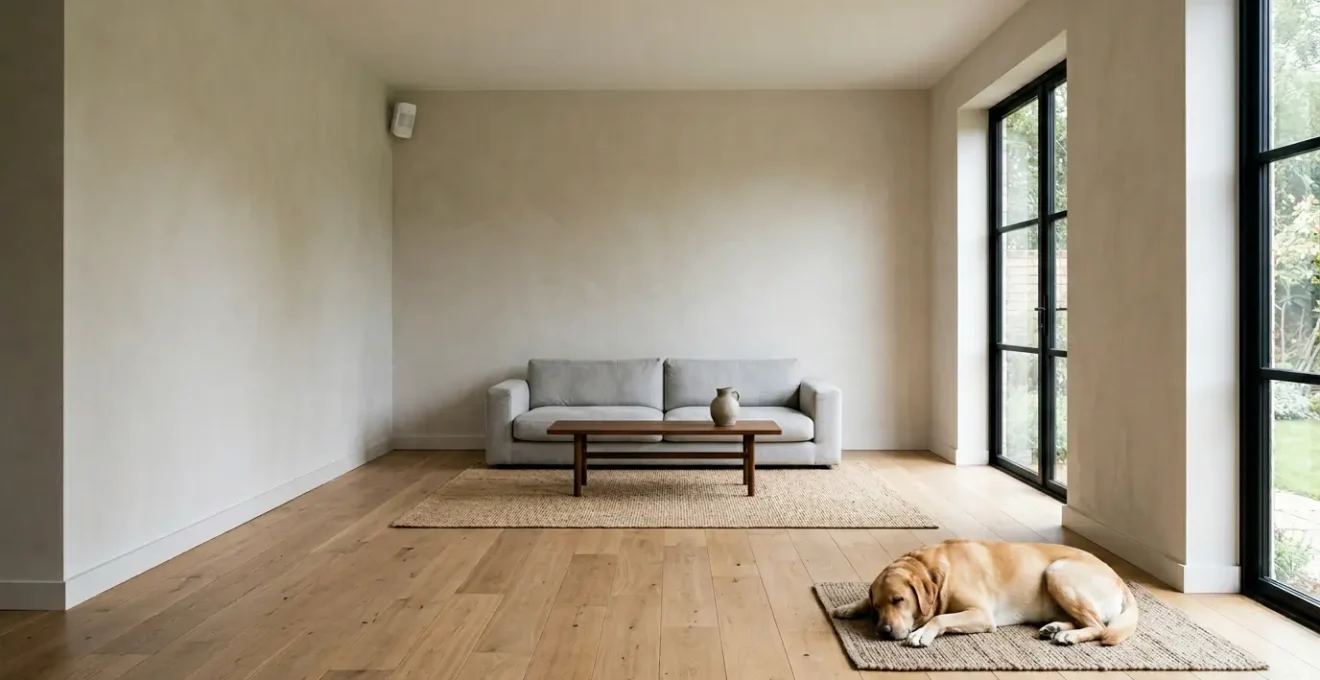
Contrary to popular belief, solving pet-related false alarms isn’t just about sensor placement or sensitivity tweaks. The true solution is a strategic shift to “logic-fencing”: using multiple, diverse sensors to understand the context behind movement. This system-level intelligence doesn’t just fix the pet problem; it unlocks genuinely smart automations for security, energy efficiency, and safety throughout your entire home.
For every pet owner who has stumbled into a dark room only to have the lights flash on because the cat decided to chase a dust bunny, the promise of a “smart” home feels like a frustrating joke. The common advice is a patchwork of fixes: place the sensor higher, turn down the sensitivity, or buy a specific “pet-immune” model. These are merely tactical retreats in a battle you are losing. The core problem isn’t your pet; it’s the simplistic, one-dimensional logic your smart home is using.
This guide reframes the entire question. Instead of asking how to make a single sensor ignore your pet, we will ask: “How can we give our home enough information to know the difference between a cat walking the perimeter and a person arriving home?” The answer lies in moving beyond simple motion detection to embrace a more sophisticated, layered strategy. We call this system-level intelligence, achieved through concepts like “sensor fusion” and “logic-fencing.” It’s about building a network of digital senses that work together to understand spatial context and user intent.
By exploring solutions for a range of common household scenarios—from hyperactive bathroom lights to truly secure smart locks—we will demonstrate how this strategic approach not only solves the pet problem for good but also elevates your entire home automation system from a series of clumsy reactions to a symphony of intelligent, intentional actions.
This article provides a strategic framework for deploying sensors throughout your home. The following sections break down specific challenges and solutions to build a truly context-aware smart home.
Summary: A Strategist’s Guide to Smart Sensor Placement
- How to Use Motion Sensors to Trigger “Welcome Home” Scenes?
- The “Waving Hand” Problem: How to Set Timeouts for Bathroom Lights?
- Window vs. Room Sensors: Which Is Better for Perimeter Security?
- How Occupancy Sensors Can Tell Your HVAC to Stop Cooling Empty Rooms?
- Recessed or Corner Mount: How to Hide Sensors in a Minimalist Room?
- When to Avoid Handle-Less Cabinets if You Plan to Age in Place
- The Safety Risk of Natural Rugs on Hardwood Floors
- Are Smart Locks Safe? The Hacking Risk No One Talks About
How to Use Motion Sensors to Trigger “Welcome Home” Scenes?
A truly effective “Welcome Home” scene shouldn’t trigger just because your car pulls into the driveway or because the dog runs to the front door. This is a classic failure of single-sensor logic. The strategic solution is to create a multi-condition “logic-fence” that requires two or more events to be true before executing. This confirms intentional entry rather than just proximity or random movement. For example, the automation should only run if your phone’s GPS enters the home’s geofence AND the garage door contact sensor is triggered.
This layered approach transforms the automation from a novelty into a reliable utility. By requiring multiple confirmations, you create a robust system that can differentiate between you arriving and a delivery person dropping off a package. The key steps involve:
- Setting a geofencing trigger to detect your approach via your phone’s GPS.
- Adding a secondary physical trigger, like a front door contact sensor or a smart lock being unlocked.
- Incorporating a state condition, ensuring the automation only runs if the home was previously in “Away” mode.
- Personalizing the actions, so your arrival triggers your preferred lights and thermostat setting, while another family member’s arrival triggers theirs.
- Refining the timing delays to ensure the sequence feels natural and seamless.
This method of sensor fusion—combining data from different sources—is the foundation of a smart home that works with you, not against you.
Ultimately, a successful “Welcome Home” scene is less about the motion sensor itself and more about the intelligent system orchestrating events around it.
The “Waving Hand” Problem: How to Set Timeouts for Bathroom Lights?
Every smart home enthusiast knows the “waving hand” dance—frantically trying to signal a motion sensor from a shower or toilet to prevent the lights from turning off. This happens because standard Passive Infrared (PIR) motion sensors are designed to detect large movements. They are fundamentally blind to stillness. The strategic solution isn’t a longer timeout, which wastes energy, but deploying a different type of technology that understands spatial context and micro-movements.
This is where millimeter-wave (mmWave) radar technology comes in. Unlike PIR sensors that look for heat signatures moving across zones, mmWave sensors can detect subtle, in-place movements like breathing or the slight shift of a person reading. They provide true occupancy or presence detection, not just motion detection. This technological shift is crucial in spaces like bathrooms where periods of stillness are common and expected.
Case Study: Solving PIR Limitations with mmWave Radar
Research on sensor applications in bathrooms reveals the inherent weaknesses of traditional PIR technology. PIR sensors are often defeated by glass shower partitions and can be disrupted by steam and humidity. A study showed that mmWave radar sensors overcome these specific challenges by reliably detecting micro-movements, penetrating glass enclosures, and remaining unaffected by environmental changes. By using advanced algorithms to filter out noise, these sensors maintain static presence detection and eliminate the “waving hand” problem entirely.
Therefore, the strategic placement here is not about position, but about technology choice. By replacing a simple motion sensor with a mmWave presence sensor in a bathroom, you can set a short, energy-efficient timeout (e.g., 2-5 minutes) with confidence, knowing the lights will only go out when the room is truly empty.
This approach solves the immediate problem while making the home’s automation genuinely smarter and more intuitive for its inhabitants.
Window vs. Room Sensors: Which Is Better for Perimeter Security?
When designing a security system, the question isn’t whether to use window sensors or room motion sensors; it’s how to use them *together* to create a layered defense. Relying on a single type of sensor creates vulnerabilities. A burglar could break a window’s glass without opening the frame, bypassing a contact sensor. Conversely, a motion sensor alone only triggers an alarm *after* an intruder is already inside. The strategist’s solution is to implement a layered security model where each sensor type has a specific role.
Combining motion sensors, door and window sensors, and glassbreak sensors gives layered protection.
– Brinks Home Security Systems, Brinks Home Sensor Technology Guide
This principle of “sensor fusion” creates a robust system that reduces false alarms and provides confirmed alerts. Think of it as a series of digital tripwires, from the outside in. An outdoor motion sensor provides a pre-emptive warning. Contact and glass break sensors on windows and doors form the first line of defense, detecting a breach at the exact point of entry. Finally, indoor motion sensors act as the second, confirmatory layer, verifying that movement has occurred inside after a perimeter breach.
This comprehensive comparison highlights how different sensor types work in concert to build a more resilient security posture.
| Sensor Type | Detection Method | Coverage Area | Best Use Case | Limitation Addressed |
|---|---|---|---|---|
| Window/Door Contact Sensors | Magnetic contact separation | Individual entry points | Layer 1: Detects breach when frame is opened | Cannot detect glass breakage without frame opening |
| Glass Break Sensors | Acoustic frequency detection | Up to 25 feet radius | Layer 1.5: Detects smashed glass without frame breach | Complements contact sensors for comprehensive window protection |
| Indoor Motion Sensors | Passive infrared (PIR) heat signature | Room-wide coverage zones | Layer 2: Confirms presence after perimeter breach | Requires both breach and movement to trigger alarm, reducing false positives |
| Outdoor Motion Sensors | PIR or AI camera detection | Perimeter approach zones | Pre-emptive Layer: Triggers deterrent before breach attempt | Enables proactive floodlight/warning activation |
By combining these elements, you create a system that can intelligently distinguish between a ball hitting a window and a genuine intrusion attempt, providing greater peace of mind.
How Occupancy Sensors Can Tell Your HVAC to Stop Cooling Empty Rooms?
Heating and cooling empty rooms is a significant source of energy waste in any home. While smart thermostats with schedules are a step up from manual controls, they still operate on assumptions, not reality. A meeting gets canceled and the home office stays at a cool 70°F for no one. The strategic solution is to move from a time-based to a presence-based control system, using occupancy sensors to provide real-time data to your HVAC system.
This creates a dynamic and responsive environment. When you enter your home office, an occupancy sensor detects your presence and signals the thermostat (or smart vent) to adjust to your preferred temperature. When you leave for more than a set period (e.g., 15-20 minutes), the sensor reports the room as vacant, allowing the system to revert to a more economical temperature. This “system-level intelligence” ensures that energy is only being expended when and where it is actually needed, delivering significant savings without sacrificing comfort.
The financial impact of this strategy is well-documented. For instance, research from Schneider Electric on occupancy-based HVAC controls showed a 22% average operational energy reduction in commercial settings, a principle that applies directly to the home. The key is to see sensors not just as triggers for lights, but as crucial data points for your home’s most energy-intensive system. Implementing this requires sensors in key rooms and a smart home hub capable of creating rules that link sensor state (occupied/unoccupied) to HVAC actions.
By making your HVAC system aware of human presence, you transform it from a blunt instrument into a precision tool for comfort and efficiency.
Recessed or Corner Mount: How to Hide Sensors in a Minimalist Room?
In a minimalist interior, every object must justify its existence. A clunky plastic sensor mounted clumsily on a wall can completely disrupt the clean aesthetic. The strategic challenge isn’t just to install a sensor, but to make it disappear. This involves thinking like an architect and employing techniques of integration and misdirection. The goal is to provide the necessary coverage without creating visual clutter, making the technology feel inherent to the space rather than added on.
There are two primary strategies for concealing sensors:
- Recessed Mounting: For the ultimate in stealth, a recessed sensor is installed flush with the ceiling or wall. This requires more intensive installation, often cutting into drywall, but the result is a device that is almost invisible. This is the best option for new builds or major renovations where wall access is planned.
- Strategic Corner Mounting & Camouflage: In existing rooms, the art of placement is key. Mounting a small, modern sensor high in a corner where the wall meets the ceiling often places it above a person’s natural eye line. The effect can be enhanced by choosing a sensor that matches the paint color. Another technique is misdirection: placing the sensor on a bookshelf among other objects or near a more prominent decorative item that naturally draws the eye away.
The choice of sensor is also critical. Newer, smaller devices, particularly tiny mmWave presence sensors, are far less obtrusive than older, bulky PIR models. Some sensors are even designed to be painted. The key is to plan the sensor placement as part of the overall design scheme, not as an afterthought.
By prioritizing concealment and integration, you can achieve full smart home functionality without compromising on a single element of your minimalist design philosophy.
When to Avoid Handle-Less Cabinets if You Plan to Age in Place
Handle-less cabinets are the epitome of sleek, minimalist design, but they can pose a significant challenge for individuals with arthritis, limited dexterity, or decreasing strength—common issues when aging in place. The small grooves or push-to-open mechanisms can be difficult to operate. However, this doesn’t mean you must sacrifice style for function. The strategic solution is to leverage smart sensor automation to bridge the gap, making these cabinets accessible without adding bulky hardware.
Instead of relying on physical force, imagine opening a cabinet with a voice command, a gentle tap, or simply by being in proximity. This is achievable through sensor fusion. A contact sensor on the cabinet door can be paired with an electric latch and triggered by various inputs. This is where system-level logic creates accessibility.
Smart home sensors can trigger automated actions based on device status changes, enabling voice-activated or gesture-controlled cabinet opening for those with limited mobility.
– Energizer Connect Smart Home Team, Smart Scene Automations Guide
This same logic can also be applied to safety. The combination of different sensor types allows for intelligent, context-aware safeguards that go far beyond what a simple physical lock can offer.
Case Study: Presence Detection for Safety and Accessibility
The principle of combining sensors for enhanced safety is well-established. For example, a smart home can fuse data from a cabinet contact sensor and a room presence sensor to create a child-proof lock that only activates when a toddler is detected in the room. This exact “sensor fusion” logic can be repurposed for aging in place. An automated cabinet could be programmed not to open if a nearby fall-detection sensor has been triggered, preventing potential injury. This transforms a design feature from a potential hazard into a safe, accessible, and intelligent part of the home.
By thinking of cabinets not as static boxes but as interactive elements in a smart ecosystem, you can create a home that is both beautiful and supportive through all stages of life.
The Safety Risk of Natural Rugs on Hardwood Floors
Natural fiber rugs like jute or sisal are popular for their texture and aesthetic, but on hardwood floors, they represent a significant safety risk, especially for the elderly or those with mobility issues. They tend to slip, and their edges can curl, creating a serious trip hazard. While rug pads are a partial solution, the strategist’s approach is to assume a fall *could* happen and build a proactive safety net using sensor technology. This involves two key components: immediate fall detection and preventative environmental adjustments.
The first component is reliable, privacy-respecting fall detection. Modern mmWave presence sensors offer a revolutionary leap in this area. Unlike cameras, they don’t record video, and unlike wearable pendants, they don’t need to be worn. Placed on the ceiling, they can monitor a room for the specific motion patterns associated with a fall. For example, according to Aqara’s FP2 presence sensor specifications, the device can provide fall detection alerts without any camera monitoring, instantly notifying a caregiver or family member if an incident occurs.
The second, more proactive component is creating a safer environment to navigate, especially at night. This is where a “Path-to-Safety” lighting system, built with a chain of motion sensors, becomes invaluable. Instead of a single, jarringly bright overhead light, this system uses multiple low-mounted sensors to illuminate a path as you walk.
Your Action Plan: Implementing Path-to-Safety Lighting
- Install low-mounted sensors: Position sensors 12-18 inches above the floor along hallways and key routes, spacing them every 6-8 feet for overlapping coverage.
- Configure sequential activation: Program the system so that movement triggers only the lights immediately ahead, creating a “following” pattern of light.
- Set appropriate brightness levels: For nighttime scenes, activate lights at a low 10-20% brightness to provide safe visibility without disrupting sleep.
- Implement gradual fade timing: Configure lights to stay on for 60-90 seconds after motion ceases, then fade out slowly to avoid sudden darkness.
- Combine with bed occupancy detection: Integrate with a pressure mat under the mattress so the pathway lighting only activates when someone actually gets out of bed at night.
By using sensor technology to both watch over and light the way, you can significantly reduce the danger posed by common household items like throw rugs.
Key Takeaways
- Embrace “Logic-Fencing”: The solution to most smart home frustrations isn’t a better sensor, but better logic. Combine data from multiple sensors (geofencing, contact, presence) to confirm user intent before triggering an action.
- Utilize Sensor Fusion: Use the right tool for the job. Combine PIR motion sensors for general awareness with mmWave presence sensors for detecting stillness in critical areas like bathrooms and offices.
- Think in Layers: Apply the principles of layered security to all automations. A single point of data is a guess; multiple points of data create a confirmation, reducing false alarms and increasing reliability.
Are Smart Locks Safe? The Hacking Risk No One Talks About
The debate around smart lock safety often centers on digital vulnerabilities: can the lock be hacked, or can the code be stolen? These are valid concerns, but they overlook a more common and insidious risk: the failure of system-level logic. A code, no matter how secure, can be shared under duress or observed. A lock can be remotely opened by accident. The true measure of a smart lock’s security isn’t just its own resilience, but how it integrates into a wider ecosystem of verification.
The strategic solution is to implement a form of two-factor authentication based on physical presence. The system should demand not just the “what” (the correct code or digital key) but also the “who” (an expected pattern of human behavior). This is another application of logic-fencing, creating a final, critical security layer at your home’s most important entry point.
System-Level Logic for Enhanced Smart Lock Security
Advanced security platforms demonstrate this principle effectively. A sophisticated automation can be created that links the smart lock to an interior motion sensor covering the entryway. The logic is simple but powerful: IF the smart lock is unlocked with a valid code, BUT no motion is detected inside the entry zone within 30-60 seconds, THEN the system automatically re-locks the door and sends an immediate alert to the homeowner. This system-level intelligence validates the unlock event with expected human presence, effectively neutralizing the threat of a compromised code being used when no one is home.
This approach shifts security from a single point of failure (the lock) to a distributed, intelligent system. It answers the question, “A correct code was used, but did a person actually walk through the door?” By requiring both events to be true, you create a far more robust and trustworthy security posture. This is the future of home security: not just stronger walls, but smarter sentinels watching over them.
Start thinking of your smart devices not as individual gadgets, but as a team of data collectors. By creating intelligent rules that require them to agree before taking action, you can build a home that is not only smarter but fundamentally safer.