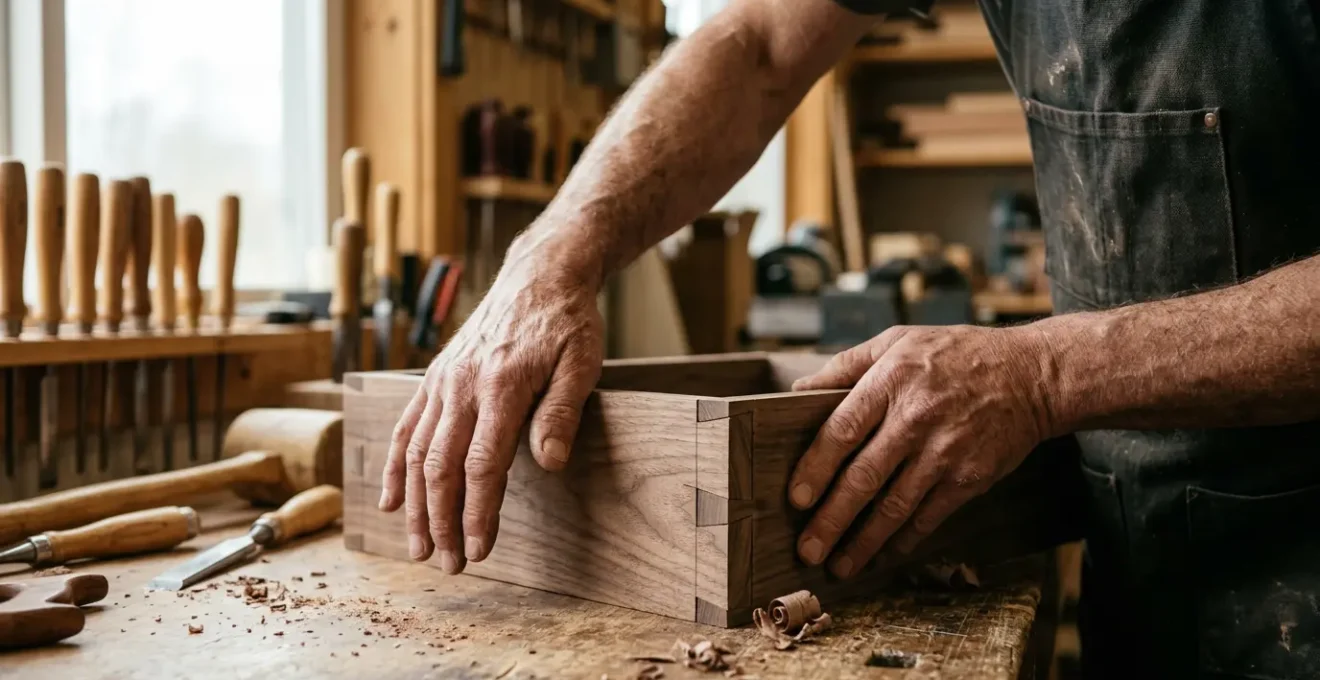
Artisanal furniture is not an expense; it’s a slow-depreciating asset with a lower Total Cost of Ownership (TCO) than its mass-produced counterparts.
- Cheap furniture requires multiple replacements over two decades, making its long-term cost higher.
- Superior construction, from joinery to frame materials, directly translates into a 10+ year longer lifespan.
Recommendation: Evaluate furniture as a long-term investment by calculating its cost-per-year of service, not just its initial purchase price.
The decision often feels like a simple trade-off. On one hand, there’s the instant gratification of a trendy, affordable sofa that fits the budget today. On the other, the daunting price tag of a custom, artisanal piece that requires saving and patience. For most, the choice is driven by immediate financial pressure and aesthetics. The common wisdom is to buy cheap now and upgrade “later”—a later that often never comes, locking you into a cycle of replacement.
But what if we approached this decision not as decorators, but as financial analysts? The sticker price is only one part of the equation. The true cost of any asset is its Total Cost of Ownership (TCO), which accounts for its initial price, maintenance, and lifespan. When viewed through this lens, the entire debate shifts. The narrative that artisanal furniture is a “splurge” or a luxury expense begins to fall apart. It reveals itself not as a cost, but as an investment with a drastically different, and flatter, depreciation curve.
This analysis moves beyond the generic praise of “quality” and “craftsmanship.” We will dissect the tangible, structural differences that create long-term value. From the engineering of a drawer joint to the density of a sofa frame, we will explore the specific attributes an investor must look for. This guide provides the framework to stop buying disposable decor and start investing in functional assets that deliver quantifiable returns in durability, longevity, and retained value over a 20-year horizon.
The following sections break down the key inspection points and investment principles for evaluating furniture. This table of contents will guide you through the critical factors that separate a short-term expense from a long-term asset.
Contents: An Investor’s Guide to Furniture Value
- Dovetail vs. Stapled: How to Check Drawer Construction in Seconds?
- How to Commission a Custom Piece Without Miscommunication?
- Is It Worth Reupholstering a Vintage Chair or Buying New?
- Wabi-Sabi: When is a Crack a Defect and When is it Character?
- How to Ensure Your ‘Artisan’ Wood Table Isn’t Illegal Rainforest Timber?
- The Knotting Mistake That Signals Low-Quality Macramé
- Why a Heavy Sofa Frame Lasts 10 Years Longer Than a Light One
- How to Protect a Reclaimed Wood Table From Water Rings and Stains?
Dovetail vs. Stapled: How to Check Drawer Construction in Seconds?
The most immediate indicator of a piece’s structural integrity lies in its joinery—the methods used to connect pieces of wood. While mass-produced furniture often relies on staples, glue, and dowels that fail under stress, artisanal construction uses interlocking joints. The dovetail joint is the gold standard, a hallmark of high-quality cabinetry and case goods for a reason: its mechanical strength is immense. The angled “tails” and “pins” create a powerful bond that resists being pulled apart, ensuring a drawer can withstand decades of use without sagging or separating.
This isn’t a modern innovation; it’s a time-tested engineering principle. In fact, research shows that archaeologists have found dovetail joinery in ancient Egyptian tombs dating back thousands of years, a testament to its incredible durability. An investor doesn’t need to be a woodworker to spot this quality. A few simple physical tests in a showroom can reveal the underlying construction in seconds, separating a true asset from a disposable item.
As seen in the detail above, the precision of the interlocking parts is a clear visual cue. A drawer built this way is not just assembled; it is engineered. The ability to perform a quick quality audit is the first step in making a sound furniture investment. The following checklist provides a simple, non-destructive method to assess drawer quality on the spot.
Your Showroom Audit: 5 Steps to Verify Drawer Quality
- The Corner Press Test: Pull the drawer out halfway and gently push down on the front corner. A drawer with quality dovetails will exhibit zero flex or movement.
- The Racking Test: Apply gentle side-to-side pressure to the partially opened drawer. Any wobble or “racking” signals poor joinery, even if the joints themselves are hidden from view.
- Internal Corner Inspection: Look inside the drawer at the corners. True dovetails will show the interlocking, wedge-shaped tails and pins passing through the wood, creating a visible and structural connection.
- Uniformity Check: Machine-cut dovetails are perfectly identical and spaced. Hand-cut dovetails, often found in high-end bespoke pieces, will show subtle variations in shape and size, which is a sign of superior hand-craftsmanship, not a flaw.
- Spotting the Fakes: Be wary of cosmetic patterns. Some manufacturers use a router to carve a dovetail pattern onto the wood that has no structural function. If the pattern doesn’t go all the way through the corner, it’s a fake.
How to Commission a Custom Piece Without Miscommunication?
Investing in a custom or bespoke piece of furniture moves you from a consumer to a patron. This relationship requires clear communication and contractual safeguards to protect both you and the artisan. Misunderstandings over materials, finishes, or timelines can turn a dream investment into a costly dispute. The key is to establish a clear framework from the outset, particularly regarding design approval and payment structure. This is not about mistrust; it’s about professional project management for a significant asset.
A professional artisan will welcome this structure. It ensures they are compensated for their materials and labor at key stages, while you retain control and approval at critical milestones before committing further funds. Vague agreements are a red flag. A structured process, including physical samples and phased payments, eliminates ambiguity and aligns expectations. As one professional woodworker noted in a testimonial on Navillus Woodworks, longevity is the goal from the start:
When you craft a bedroom set or a glass-topped table, I use techniques that ensure longevity, like reinforced joints and durable finishes. Clients tell me they’re still using custom items I made years ago, and some have even passed them down to family members.
– Professional woodworker testimonial, Navillus Woodworks – Hand-Crafted vs Mass-Produced Furniture
To ensure your commission proceeds smoothly and your investment is protected, insist on a contract that specifies payment milestones tied to project progress. This approach de-risks the process for both parties.
- Milestone 1: Initial Deposit (typically 50%): This is paid upon signing the contract and final design approval. It commits the artisan to your project schedule and covers the initial cost of high-quality material procurement.
- Milestone 2: Progress Payment: This payment is triggered once the core structural work is complete and, crucially, after you have approved physical samples for the stain color and finish sheen. This step prevents disputes arising from on-screen color variations.
- Milestone 3: Final Payment: The final balance is due only after you have performed an in-person inspection upon delivery and confirmed the piece meets all agreed-upon specifications. This is your ultimate protection.
Is It Worth Reupholstering a Vintage Chair or Buying New?
The “disposability” mindset of modern consumer culture often suggests that when an upholstered chair becomes worn or dated, it should be replaced. From an investment perspective, this is often a financial error. Reupholstering a vintage or high-quality piece is not merely a repair; it is a renewal of a valuable asset. The most critical—and expensive—component of a chair is its frame. A vintage chair with a solid hardwood frame is a superior foundation compared to the particleboard and softwood frames of most new, budget-friendly chairs.
While professional reupholstery is not cheap—with industry data from Angi showing that furniture reupholstery costs between $370 and $1,146 on average—it is often a fraction of the cost of a new chair of equivalent quality. More importantly, it extends the life of a proven asset rather than sending it to a landfill and purchasing a new, inferior one destined for the same fate in a few years. The Total Cost of Ownership calculation makes the financial case clear.
| Scenario | Initial Cost | Replacements Needed | 20-Year Total Cost | Environmental Impact |
|---|---|---|---|---|
| Quality Vintage Frame + Reupholstery | $150 (frame) + $600 (reupholstery) = $750 | 0 replacements | $750 | 1 piece kept from landfill |
| New Budget Chair (replaced every 7 years) | $300 per chair | 3 replacements over 20 years | $900+ | 3 pieces to landfill |
| Quality New Chair | $2,000+ minimum | 0 replacements | $2,000+ | Lower if well-made |
The data starkly illustrates the long-term financial folly of choosing a low-quality, disposable option. Over a 20-year period, the “cheaper” chair becomes the more expensive proposition, all while contributing significantly more waste. Investing in a quality frame—whether new or vintage—is the most economically and environmentally sound decision.
Wabi-Sabi: When is a Crack a Defect and When is it Character?
In the world of mass-produced goods, any imperfection is a defect. A scratch, a dent, or a crack signals a flaw in manufacturing and devalues the item. However, in the realm of artisanal furniture, especially pieces made from solid, natural wood, this binary view is overly simplistic. The Japanese philosophy of Wabi-Sabi offers a more mature investment perspective: finding beauty in imperfection and accepting the natural lifecycle of materials. For an investor, the key is to differentiate between a structural defect that compromises the asset’s function and a mark of character that enhances its story and uniqueness.
A crack in a chair leg is a liability. But a check or filled knot on a tabletop might be a sign of the wood’s history, a feature to be celebrated. High-end artisans often stabilize these natural “flaws” with techniques that turn them into design elements, such as butterfly key inlays. This intervention is a mark of high craftsmanship, transforming a potential weakness into a point of strength and visual interest. Recognizing this difference is crucial for assessing value.
The butterfly key shown here doesn’t just patch a crack; it mechanically holds the wood together, preventing further splitting while adding a beautiful, contrasting detail. This is not a repair; it’s an enhancement. To determine whether an imperfection is a defect or a value-adding characteristic, one must apply a simple decision framework based on structural principles.
- Functionality: Does the crack impact the piece’s stability or function? A crack in a structural joint or a leg is a defect. A stable surface check is not.
- Stability: Is the crack growing? Tiny surface checks that appear and disappear with humidity changes are normal for solid wood. A large, expanding crack is a defect.
- Intentionality: Has the “flaw” been stabilized and celebrated? Butterfly keys or high-quality epoxy fills that integrate into the design are marks of character and high craft.
- Impact on Value: A beautifully integrated character mark can increase a piece’s value to connoisseurs. A poorly repaired structural crack renders it nearly worthless.
How to Ensure Your ‘Artisan’ Wood Table Isn’t Illegal Rainforest Timber?
An essential component of an asset’s long-term value is its provenance. For wood furniture, this means having certainty about the origin of the timber. An “artisan” table made from illegally harvested, endangered rainforest wood is not a sound investment; it is a liability. It carries significant ethical baggage and potential legal risks, and its value is unstable. True artisanal quality is inseparable from sourcing ethics and sustainability. Therefore, verifying the wood’s provenance is a critical step in your due diligence.
Certifications like the Forest Stewardship Council (FSC) provide a reliable chain-of-custody, ensuring that the wood comes from responsibly managed forests. This isn’t just an ethical checkbox; it’s a mark of quality that a growing number of consumers recognize and value. According to the FSC, the FSC label is recognized by 46% of consumers globally, who trust that it stands for sustainable and responsible forestry. An honest artisan will be transparent about their sourcing and welcome questions about it. Evasiveness is a major red flag.
To protect your investment and ensure you are acquiring a legitimate, sustainable asset, you must be prepared to ask direct questions. The following points provide a checklist for your conversation with a maker or dealer.
Provenance Audit: 5 Questions to Ask Your Artisan
- “Where was this lumber milled?” A specific, verifiable location is a good sign. Vague answers like “from a supplier” are not sufficient.
- “Can I see the chain-of-custody certificate?” For new wood, ask for documentation from bodies like the FSC. This is independent verification of responsible sourcing.
- “Is this reclaimed wood, and from where?” Reclaimed wood from old buildings is excellent, as it’s stable and sustainable. Be wary of “salvaged” wood with a murky or undocumented origin story.
- “What is your policy on using endangered species?” A reputable artisan will have a clear, firm policy against using woods from threatened species and will be happy to explain their ethical framework.
- “Do you work with local sawyers?” Locally sourced timber often has a clearer provenance and a lower carbon footprint, adding to the asset’s story and sustainable credentials.
The Knotting Mistake That Signals Low-Quality Macramé
The principles of assessing quality extend beyond wood and into every facet of decorative arts, including textiles. Macramé, for example, might seem purely decorative, but the difference between a high-quality artisanal wall hanging and a cheap, mass-produced imitation is immediately apparent to a trained eye. Just as with dovetail joints, the giveaway is in the execution of the fundamental units—in this case, the knots.
While a novice might focus on the overall pattern, an investor should look at the consistency. The most common mistake signaling low-quality work is uneven knot tension. When knots are pulled with inconsistent force, the piece will look wavy, buckled, or uneven. It lacks the crisp, geometric precision that defines professional work. This seemingly small detail is a powerful indicator of the artisan’s experience and dedication to their craft. As one craftsmanship analysis points out:
Tension Inconsistency is the primary giveaway: unevenly tightened knots create a wavy, amateurish look, versus the crisp, geometric precision of professionally-knotted macramé. Consistent tension is the hallmark of experience.
– Macramé craftsmanship analysis, Artisan furniture craftsmanship standards
This principle applies universally: whether it’s the stitching on a leather chair, the glaze on a ceramic pot, or the knots in a textile, consistency is a proxy for quality. An artisan who has mastered their craft demonstrates it through thousands of small, repeated actions performed with uniformity and precision. This mastery is what creates lasting value and separates a fleeting trend from a timeless piece.
Why a Heavy Sofa Frame Lasts 10 Years Longer Than a Light One
If joinery is the micro-indicator of quality, the frame is the macro-foundation of your investment, especially in upholstered furniture like a sofa. When you encounter a surprisingly light sofa, it should be an immediate red flag. That lack of weight is a direct result of using inferior materials: a frame made of particleboard, plywood, or softwood (like pine) instead of dense, kiln-dried hardwood (like oak, maple, or ash). A heavy sofa isn’t cumbersome; it’s a sign of a robust, long-lasting asset.
The density and strength of the wood used in the frame are directly correlated with its lifespan. Hardwood frames resist warping, cracking, and loosening at the joints. They can support the tension of springs and upholstery for decades, not just a few years. A light particleboard frame, by contrast, will often fail at stress points, leading to wobbling arms, a sagging middle, and ultimately, a trip to the landfill. The difference in longevity is not marginal; it’s an order of magnitude, as a real-world comparison demonstrates.
Case Study: Particle Board vs. Solid Wood Furniture Lifespan
A real-world comparison documented by furniture professionals offers a stark financial lesson. One colleague invested $800 in a quality solid wood desk, which remained stable and fully functional for over 15 years. A second colleague, seeking to save money, purchased three different particle board desks over the same period, spending a total of $750. Each cheaper desk succumbed to wobbling joints and surface damage within 4-5 years. According to a comparative analysis of furniture lifespan, particle board items typically last only 5-10 years under normal use, while quality solid wood furniture can last 20-50 years or more, proving the superior long-term TCO of dense hardwood construction.
This is why a heavy frame can easily last ten years longer, if not more. The initial higher cost is amortized over a much longer service life, resulting in a lower cost-per-year. When you buy a heavy sofa, you are investing in its unseen skeleton—the very foundation of its value.
The exposed frame above, with its corner-blocked joints and solid hardwood construction, is an asset built to last generations, not just a few seasons. The weight is a feature, not a bug.
Key Takeaways
- Think in TCO: Evaluate furniture based on its Total Cost of Ownership (initial price divided by lifespan in years), not its sticker price.
- Inspect the Unseen: Quality is found in the details—the joinery, the frame material, and the consistency of craftsmanship are better indicators of value than surface aesthetics.
- Protect Your Asset: A quality piece is an investment that requires proper commissioning, provenance verification, and a clear maintenance plan to retain its value over decades.
How to Protect a Reclaimed Wood Table From Water Rings and Stains?
Acquiring a high-quality artisanal piece is the first half of the investment strategy. The second half is asset protection. A reclaimed wood table, with its unique history and character, requires a specific care regimen to protect it from damage and preserve its value for the long term. Unlike mass-produced furniture with a thick, plastic-like polyurethane coating, many artisan pieces feature more natural oil or wax finishes that are designed to be maintainable and to develop a patina over time.
This finish allows the wood to breathe but also makes it more susceptible to damage from water and heat if not cared for properly. The goal is not to encase the table in an impenetrable shield, but to work with the nature of the material. As a guide from Homemakers Furniture wisely puts it, this is the essence of sustainability:
Artisan crafted wood furniture is made to age gracefully, be refinished not replaced, develop richer color over time, and survive moves, kids, and everyday life. This is sustainability at its best. Buy once, enjoy forever.
– Homemakers Furniture craftsmanship guide, High-Quality Wood Furniture: Inside the Craftsmanship That Matters
Protecting this “forever” asset requires a simple but consistent maintenance schedule. Rather than reacting to damage, a proactive approach will keep the wood nourished and resistant to daily life. Having a clear plan turns maintenance from a chore into a routine part of asset management.
Your Asset Protection Plan: Reclaimed Wood Care Schedule
- Daily Defense: Wipe up spills the moment they happen using a soft, damp cloth. Water rings are not caused by water itself, but by moisture left to sit on the finish. Coasters are your first line of defense.
- Monthly Cleaning: Clean the surface with a pH-neutral wood soap diluted in water. Avoid all-purpose cleaners, silicone-based polishes, or harsh chemicals that can strip the protective oils from the finish.
- Yearly Refresh: Apply a maintenance coat of the appropriate finish (wax or oil) for your table. This simple act refreshes the protective layer and restores the luster. Always use the product recommended by the artisan.
- 5-Year Refinish: One of the greatest advantages of oil/wax finishes is that they are repairable. Minor stains or scratches can often be spot-sanded with very fine grit sandpaper and re-oiled, seamlessly blending the repair.
- First-Aid Kit: Keep a small kit with soft cloths, mineral spirits for stubborn grime (use sparingly), a wax-fill stick for deeper scratches, and a small amount of the original matching oil or wax from your artisan.
By adopting an investor’s mindset, you transform a simple purchase into a strategic acquisition. The next time you evaluate a piece of furniture, look past the price tag and apply this analytical framework to assess its true, long-term value. Your portfolio of home assets will thank you for it.