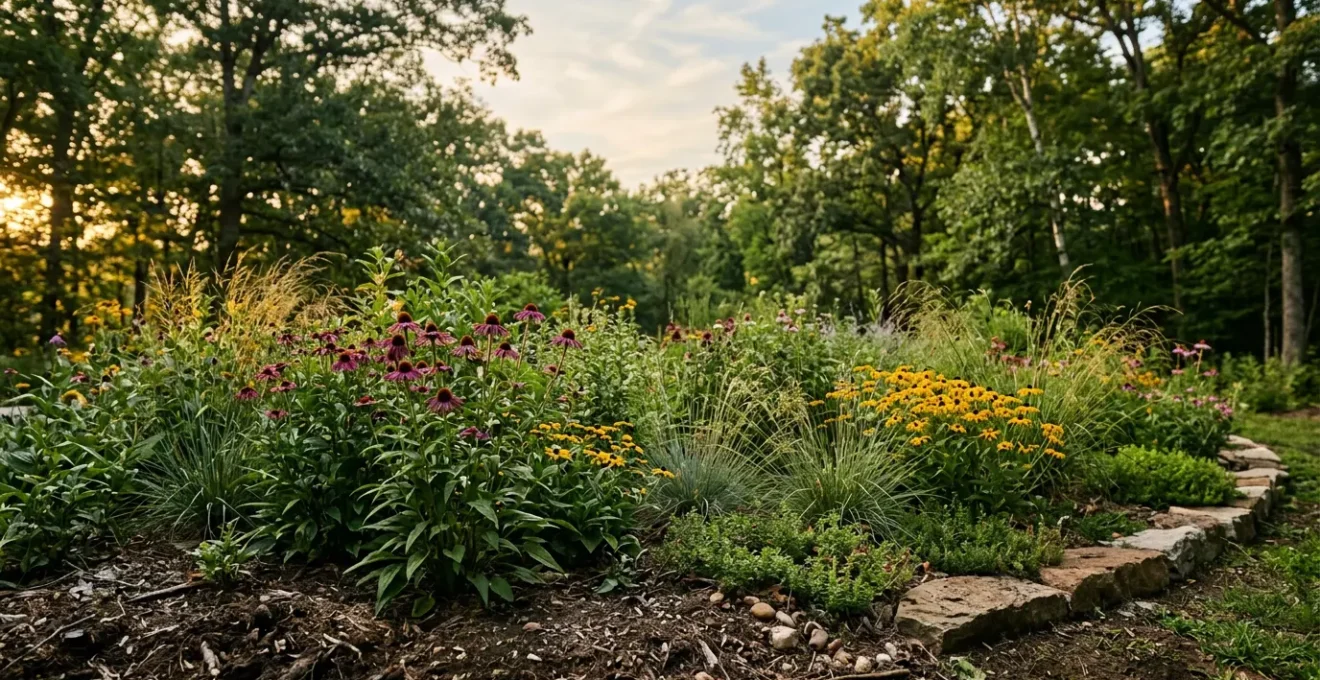
The key to a low-maintenance yard isn’t working harder; it’s engineering a landscape system that runs itself by using native plants.
- Native plants develop deep root systems that tap into soil moisture, drastically reducing your need to water during droughts.
- They function as “host plants” for specific insects, which in turn feed birds that provide natural, free pest control for your entire garden.
- Replacing high-maintenance invasives and lawns with native groundcovers can cut maintenance time and costs by over 50%.
Recommendation: Start by identifying and replacing one high-maintenance “problem area” in your yard, like a patch of thirsty lawn or invasive ivy, with a group of regionally appropriate native plants.
For many busy homeowners, the traditional yard is a time-sucking liability. It’s a weekly battle of watering, mowing, weeding, and spraying just to keep exotic, ill-suited plants alive. You bought into the dream of a lush, green space, but ended up with a second job you don’t get paid for. The common advice is to install irrigation systems or use more chemicals, but these are just expensive patches on a fundamentally flawed system. You’re treating the symptoms, not the cause: fighting against your local environment instead of working with it.
What if the solution wasn’t about better tools, but a better design? The shift from a high-effort garden to a low-effort landscape lies in one strategic decision: embracing native flora. This isn’t just about planting a few local flowers for the bees. It’s about engineering a self-sufficient ecosystem where every component is adapted to thrive with minimal intervention. This approach transforms your landscape from a fragile dependant into a resilient, self-managing asset that gives you back your weekends.
This guide moves beyond the simple “plant natives” mantra. We will break down the specific strategies and system-level advantages that lead to a dramatic reduction in garden labor. We’ll explore how to identify the right plants, how to design with them so they look intentional (not weedy), and how their unique biological features—from deep roots to insect partnerships—create a positive feedback loop of efficiency. By the end, you will have a clear blueprint for investing in a landscape that pays you back with 50 hours of reclaimed time, year after year.
To help you navigate this strategic shift, this article breaks down the core components of engineering a low-maintenance, native landscape. The following sections will provide a clear roadmap from initial plant selection to long-term efficiency gains.
Summary: A Blueprint for a Self-Sufficient Landscape
- How to Find Which Plants Are Truly Native to Your Zip Code?
- How to Style Native Plants So They Don’t Look Like Weeds?
- The Deep Root Advantage: Why Natives Survive Droughts When Lawns Die?
- Host Plants: Why You Need Milkweed Specifically for Monarchs?
- English Ivy vs. Native Ginger: Swapping Invasives for Eco-Friendly Covers
- How Mulch Encourages Earthworms and Why You Need Them?
- The Mileage Cost: Why Local Stone Is Greener Than Imported Bamboo?
- How to Attract Bees to Your Vegetable Patch Without Getting Stung?
How to Find Which Plants Are Truly Native to Your Zip Code?
The foundation of an efficient landscape is selecting the right components. The term “native” is often used loosely by garden centers selling plants that are native to the continent, but not your specific region. A plant from the Arizona desert will not be low-maintenance in a New England backyard. True efficiency comes from using plants that belong to your local plant community. These are the species that have co-evolved for millennia with your soil, rainfall patterns, and local wildlife, making them genetically programmed for survival without your help.
Bypassing generic nursery tags and identifying these hyper-local species is a critical first investment. A truly native plant creates a cascade of benefits. For example, as entomologist Doug Tallamy’s research shows, native oak trees support over 500 species of caterpillars, which are essential food for birds. In contrast, a non-native ginkgo tree supports only five. Choosing the correct native species isn’t just a plant choice; it’s a decision to activate a free, self-regulating pest control and wildlife support system.
To move from theory to practice, you need a reliable process for identifying these authentic local workhorses. The following checklist provides a multi-pronged approach to ensure the plants you choose are genuine, high-value assets for your landscape system.
Action Plan: Identifying Your True Native Plants
- Use a Scientific Database: Start with the Audubon Native Plant Database. Entering your zip code reveals plants specifically adapted to your area and even shows which birds they support, allowing you to engineer for specific ecological outcomes.
- Become a Local Observer: Use an app like iNaturalist to identify the “volunteer” plants thriving in nearby parks, roadsides, or untended areas. These are proven survivors in your exact microclimate.
- Distinguish “Nativars” from “Straight Species”: Check plant labels for names in single quotes (e.g., Phlox paniculata ‘David’). These are “nativars,” cultivated for specific traits, which can reduce their ecological value. For maximum benefit, always choose the straight species without a cultivar name.
- Research Your Plant Community: Identify your local ecological community type (e.g., ‘Oak-Hickory Forest’ or ‘Coastal Sage Scrub’). Sourcing multiple plants from the same community ensures they will work together as a cohesive, self-sustaining system.
How to Style Native Plants So They Don’t Look Like Weeds?
A common fear holding homeowners back from native plants is the perception they will look “messy” or “weedy.” This is a design problem, not a plant problem. An effective low-maintenance landscape looks intentional, not neglected. The key is using what landscape designers call “cues to care”—visual signals that communicate the space is purposefully designed and maintained, even if the plants within it have a natural, untamed form.
These cues act as a frame for the “wildness,” making it legible as a deliberate aesthetic choice. Simple, clean borders, defined pathways, and massing several of the same plant species together create a sense of order and rhythm. This structure provides a powerful contrast to the soft, natural forms of the plants, elevating the entire design from a random patch of weeds to a sophisticated, modern meadow. You are not just planting; you are composing a living picture.
As the image above demonstrates, a crisp stone edge and a clear path signal human intent. The native grasses and perennials inside the bed can grow naturally, but the overall impression is one of deliberate beauty. This approach allows you to have the ecological benefits and low-maintenance reality of native plants without sacrificing curb appeal.
Case Study: Tasha Medve’s 10-Month Native Garden Transformation
Gardening expert Tasha Medve showcased this principle in practice by documenting her yard’s transformation. After adding a native plant garden, her yard was a vibrant oasis for pollinators within 10 months. Critically, she leaves the plant structures standing through winter. This provides essential habitat for insects and birds, and the dried stalks and seed heads offer visual interest. This strategy is a powerful “cue to care,” showing the garden is managed year-round for ecological function, reinforcing its intentional, rather than neglected, appearance.
The Deep Root Advantage: Why Natives Survive Droughts When Lawns Die?
The single greatest time and resource drain in a conventional landscape is water. A typical lawn of Kentucky Bluegrass has roots that are only 2-3 inches deep, making it completely dependent on frequent watering to survive summer heat. This is where native plants offer a radical advantage in efficiency, an advantage hidden deep underground. Native grasses and perennials, having adapted to local climate volatility, develop extensive root systems that can reach several feet into the soil.
This “root asset” is the core of their drought-resilience engine. These deep roots tap into subterranean moisture reserves that shallow-rooted turf and exotic annuals can’t access. During a dry spell, while your lawn is browning and demanding water, your native plants are quietly drawing from the soil’s deep-down savings account. A recent study highlighted this remarkable efficiency, finding that during the dry season, native plants drew 20-38% of their water from deep soil (below 1 meter), even though those deep roots represented a tiny fraction of their total root mass. This is a system engineered for survival.
This biological infrastructure means you are freed from the tyranny of the sprinkler. After an initial establishment period of a year or two, a well-chosen native planting requires little to no supplemental water, even during droughts that would kill a conventional lawn. You aren’t just saving water; you are saving the time spent deploying, moving, and monitoring irrigation systems. You are investing in an asset that manages its own water supply.
Host Plants: Why You Need Milkweed Specifically for Monarchs?
A truly efficient system doesn’t just survive; it creates its own beneficial services. One of the most powerful services a native landscape provides is natural pest control, and this is achieved through the strategic use of “host plants.” A host plant is a specific native species that a particular insect—often a butterfly or moth—relies on exclusively for laying its eggs and feeding its larvae (caterpillars). The most famous example is the relationship between Monarch butterflies and Milkweed (Asclepias species).
Monarch caterpillars can *only* eat milkweed. Without it, the entire species cannot reproduce. With an estimated 80-90% decline in monarch numbers east of the Rockies, planting regionally appropriate milkweed is a critical conservation action. But from an efficiency standpoint, the benefit is broader. These caterpillars become a primary food source for birds, which you want patrolling your garden. By planting a host plant, you are setting up a free, automated pest-control supply chain. You are feeding the “good bugs” that, in turn, feed the birds that will then help manage the “bad bugs” in your vegetable patch.
You can engineer this benefit by moving beyond a single species and creating a diverse portfolio of host plants to support a wider range of beneficial wildlife. This turns your garden into a functioning, productive ecosystem, not just a static display.
- Butterfly Specialist: Plant milkweed species native to your region (like Swamp Milkweed or Common Milkweed) to support Monarchs. Avoid non-native tropical milkweed, which can disrupt their migration patterns.
- Moth Specialist: As noted earlier, native oak trees are a powerhouse, hosting over 500 species of caterpillars. These are the primary food source for baby songbirds, making an oak tree a bird-feeder that never runs empty.
- Native Bee Specialist: Incorporate a variety of native perennials that bloom in succession from early spring to late fall. This provides a consistent food source for solitary native bees, ensuring they are present and active when your summer vegetables need pollinating.
English Ivy vs. Native Ginger: Swapping Invasives for Eco-Friendly Covers
Not all plants are assets; some are significant liabilities. Invasive species like English Ivy, while often sold as “low-maintenance” groundcovers, create a perpetual cycle of work. They provide no ecological value, and their aggressive growth requires constant trimming to prevent them from damaging property. Replacing these ecological and financial drains with native groundcovers is one of the highest-return projects a homeowner can undertake.
Native alternatives like Wild Ginger (Asarum canadense) or Wild Strawberry (Fragaria virginiana) form dense, weed-suppressing mats, but they don’t have the destructive tendencies of invasives. Once established, their maintenance is virtually zero. The upfront effort of removing an invasive and planting a native pays for itself in reclaimed time within a few seasons. The financial case is just as compelling when you factor in the long-term costs and risks associated with invasive species.
As this comparative analysis of long-term costs shows, the choice to go native is a clear financial win. The initial investment is slightly higher, but the return on investment through reduced maintenance and avoided property damage is massive.
| Cost Category | English Ivy (Invasive) | Native Groundcovers (e.g., Wild Ginger, Wild Strawberry) |
|---|---|---|
| Annual Maintenance Hours | 8-12 hours (perpetual trimming, climbing removal) | 1-2 hours after establishment |
| Property Damage Risk | High (damages wood, stone, brick via aerial rootlets) | Minimal to none |
| Maintenance Budget | Baseline (100%) | Reduced by up to 80% when used in lieu of grass |
| Removal Cost (if needed) | $500-$2,000 per 1,000 sq ft (professional) | N/A (desirable to keep) |
| Ecological Value | Zero (supports no native wildlife) | High (supports local insects, birds, soil health) |
| Initial Investment | $100-$200 per 1,000 sq ft | $150-$300 per 1,000 sq ft (one-time) |
Removing established invasives can seem daunting, but effective, low-effort methods exist. The “sheet mulch” or “lasagne bed” technique allows you to smother the invasive plants and build rich soil at the same time, without strenuous digging. Simply mow the area short, cover it with overlapping cardboard, and layer organic materials on top. Over 6-8 months, this decomposition process kills the invasive below and creates a perfect, nutrient-rich bed to plant your new natives directly into.
How Mulch Encourages Earthworms and Why You Need Them?
In an efficient landscape system, you don’t buy fertilizer; you create it. The engine of this free nutrient factory is the soil food web, powered by mulch and populated by essential workers like earthworms. Mulch, particularly in the form of fallen leaves or shredded bark, serves three critical functions that save you time and money. First, it suppresses weeds. Second, it retains soil moisture, reducing water needs. Third, and most importantly, it provides food and habitat for a thriving community of decomposers.
Earthworms are your underground champions of efficiency. As they tunnel through the soil, they create channels that improve water infiltration and aeration—a process called bioturbation—which is far more effective than any mechanical aerator. As they digest organic matter from the mulch layer, their castings (waste) become a perfectly balanced, slow-release fertilizer rich in nitrogen, phosphorus, and potassium. They are, in effect, tilling, aerating, and fertilizing your garden for free, 24/7. Your job is simply to provide their food and habitat.
This means resisting the tidy-up impulse to rake away every last leaf in the fall. As the experts at Grow Native Massachusetts advise:
Resist the temptation to remove leaf litter. It is highly beneficial to the insects, birds, and animals in your garden to allow leaves to remain in place over the winter and throughout the seasons.
– Grow Native Massachusetts, Getting Started — For Beginners Guide
Case Study: The “Lasagne Bed” Method in Action
The Wild Ones West Cook Chapter demonstrated the power of this approach. In Fall 2014, they laid cardboard and organic layers over an existing lawn. By spring, the lawn was gone, and the material had decomposed into rich soil teeming with earthworms. They planted native seedlings directly into this new bed. By 2016, the garden was a mature, flourishing ecosystem that required no tilling or synthetic fertilizers, all powered by the natural decomposition process they had initiated.
Key Takeaways
- A native landscape is an engineered system that pays you back in reclaimed time and reduced costs.
- The key to drought survival is the deep “root asset” of native plants, which eliminates the need for constant watering.
- Strategic design using “cues to care” like clean borders ensures your low-maintenance yard looks intentional and valuable, not weedy.
The Mileage Cost: Why Local Stone Is Greener Than Imported Bamboo?
A truly efficient landscape accounts for all inputs, not just plants. The hardscaping materials you choose—stones for a path, wood for a border, mulch for a bed—have their own “mileage cost.” This refers to the energy and resources consumed to produce and transport them to your yard. Sourcing materials locally is the hardscaping equivalent of choosing a native plant. Local stone, for example, has a much lower carbon footprint than bamboo decking shipped from Asia or exotic slate from another continent.
This principle of “local first” extends the system’s efficiency beyond your property line. It reduces reliance on long, fossil-fuel-dependent supply chains and supports local economies. Furthermore, local materials inherently look more appropriate in the landscape, reinforcing the sense of place and authenticity that is a hallmark of good native design. They complete the picture, making the entire composition feel cohesive and grounded in its environment.
Ultimately, every choice contributes to the overall return on investment. The initial cost of materials is only part of the equation. A landscape built with resilient, locally-adapted components—both living and non-living—yields significant long-term savings. According to landscape maintenance data, the payoff is clear: maintenance costs drop by roughly 50% as natives require less pruning, mowing, and replacing. This initial investment in a well-designed system typically pays for itself within just two to three growing seasons.
many native plants, especially long-living trees like oaks and hickories, have extensive root systems that can store substantial amounts of carbon in the soil.
– National Audubon Society, Why Native Plants Matter
How to Attract Bees to Your Vegetable Patch Without Getting Stung?
One of the top-tier benefits of a native landscape is the army of pollinators it attracts. These insects are essential for a productive vegetable garden, but many people worry that attracting bees means increasing the risk of getting stung. This fear is largely based on a misunderstanding of bee behavior. The bees you are most likely to attract with native plants are not aggressive honeybees or wasps; they are solitary native bees.
These bees are typically docile, non-aggressive, and rarely sting. They are too busy working to bother with you. The key to safely harnessing their pollination services is a smart design strategy that encourages them to visit your vegetable patch without concentrating their nesting activity right where you work. Instead of planting flowers directly between your tomato rows, you can build a “pollinator highway.” This involves creating a corridor of diverse native plants that leads from a wilder part of your yard *toward* your vegetable patch. The bees will use this highway to forage, naturally spilling over to pollinate your crops along the way.
To make this highway effective year-round, your strategy must account for the entire growing season. Here’s how to structure your pollinator support system:
- Create a Spatial Corridor: Plant a “highway” of native flowers leading toward, but not directly in, your vegetable garden to encourage visits without creating a hive of activity where you are working.
- Provide ‘Shoulder Season’ Blooms: Your vegetables bloom mid-summer. To support a healthy, year-round bee population, ensure your native plantings include species that bloom in early spring (e.g., Golden Alexanders) and late fall (e.g., Asters).
- Design Layered Habitats: Include native shrubs and small trees along the pollinator highway. These provide crucial nesting sites and shelter for native bees, ensuring a robust population is ready to work when your vegetables need them most.
- Avoid Chemical Interference: Never use insecticides in or near your pollinator highway. A healthy native ecosystem will create its own pest control, rendering chemical sprays obsolete.
By implementing these design strategies, you get all the benefits of enhanced pollination for your food crops without the perceived risk. You are not just attracting bees; you are managing their traffic flow for maximum efficiency and safety.
Start today by choosing one area of your yard to convert. Use the principles in this guide to select the right plants and materials, and begin the process of engineering a landscape that works for you, giving you back your most valuable asset: your time.